Get Full Government Meeting Transcripts, Videos, & Alerts Forever!
Get email alerts on the Redistricting topic
No spam. Unsubscribe anytime.
Committee re-refers bill to send bipartisan redistricting commission proposal to Rules
Summary
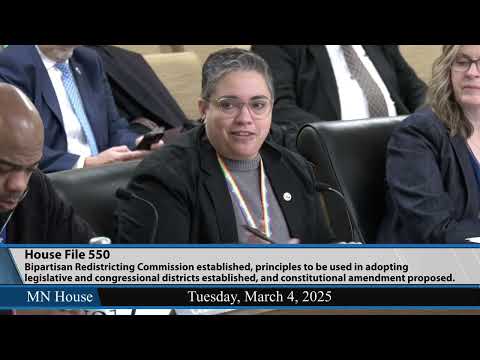
House File 550, which would create an eight‑member bipartisan redistricting commission and submit the proposal to voters as a constitutional amendment, was re‑referred from the House Judiciary Finance and Civil Law Committee to the Committee on Rules and Administration.
House File 550, which would create an eight‑member bipartisan redistricting commission and submit the proposal to voters as a constitutional amendment, was re‑referred from the House Judiciary Finance and Civil Law Committee to the Committee on Rules and Administration during the committee meeting.
Supporters told the committee the change is intended to reduce recurring litigation over legislative maps and to place map‑drawing in a bipartisan, constitutionally enshrined process. Representative West, presenting the bill, said, "House file 550 creates a bipartisan redistricting commission and submits it to the voters for approval for our next redistricting cycle." He added that the current legislative process has repeatedly led to court review: "Every single map of my lifetime has gone to the courts."
Opponents and testifiers raised questions about conflicts of interest, transparency of commission proceedings, and whether the courts would remain the ultimate backstop if the commission failed to reach agreement. Tom Weason, a Mahtomedi resident, urged the committee to reject the bill unless its drafters could defend the commission’s conflict‑of‑interest structure, saying the proposal "requires an 8 member redistricting committee that's selected by the foremost partisan members of government, who have the most to gain from rigging elections." Paul Huffman of the League of Women Voters Minnesota said the bill leaves unspecified how many public hearings would be held and where, and predicted deadlocks could still send maps to the courts, citing experience from other states.
Committee staff and fiscal staff identified the limited portions of the measure that fall within this committee’s jurisdiction. House research staff told members the primary items for this committee are the provisions making the commission subject to Minnesota’s open‑meetings law: "At 7.18 to 7.24 of the bill, the commission is subject to chapter 13 and chapter 13D, the open meetings law," Mr. Hopkins told the panel. Members also highlighted sections the author acknowledged touch the courts' role and the fiscal impacts the courts might experience; House Fiscal said the Supreme Court reported the cost to them would be "immaterial" in the fiscal note staff had reviewed.
Several legislators pressed for more detail before a final vote. Representative Liebling said he was "a little bit troubled" and asked for clearer statements on what would happen if the commission did not agree. Representative Curran and others suggested the measure as drafted gives partisan actors central appointment power and urged consideration of a more nonpartisan or clearance process; Representative Engin proposed eligibility limits on appointees to exclude lobbyists or recent candidates.
The committee ultimately re‑referred House File 550 to Rules and Administration for further consideration. The motion to re‑refer was carried by voice vote with no recorded roll call in the transcript.
Committee discussion and the testimony submitted to the record focused on three recurring concerns: (1) whether a bipartisan model selected by legislative leaders can avoid conflicts of interest; (2) what deadlines and processes would send unresolved plans to the courts; and (3) how many and where public hearings would be held to allow meaningful voter participation. No vote on adoption of the underlying constitutional change occurred during this hearing; the committee forwarded the bill for further committee consideration.