Get Full Government Meeting Transcripts, Videos, & Alerts Forever!
Get email alerts on the Non Public School Counseling topic
No spam. Unsubscribe anytime.
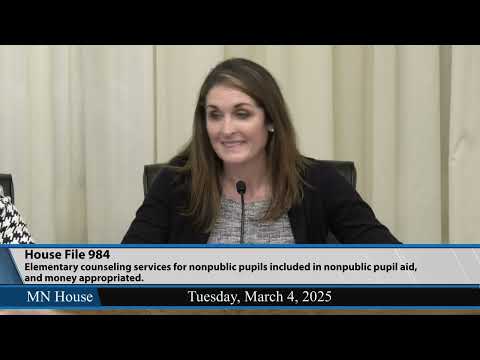
Minnesota committee hears bill to expand counseling aid to K–6 students in nonpublic schools
Summary
Lawmakers and advocates urged the House Education Finance Committee to expand nonpublic pupil counseling aid to kindergarten through sixth grade students; fiscal note pending and the bill was laid over for possible inclusion in an omnibus measure.
The House Education Finance Committee heard testimony on House File 984 on March 5, 2025, a bill that would expand nonpublic pupil counseling aid to students in kindergarten through sixth grade. Chair Krisha Kresha laid the bill over for possible inclusion in a later omnibus bill.
Advocates, nonpublic school leaders and the bill’s author said early counseling can prevent more intensive interventions later and argued many nonpublic elementary students lack access to school-based counseling. Representative Clardy, the bill’s chief author, told the committee that nonpublic students currently receive counseling services beginning in grades 7–12 and that HF 984 would extend coverage to younger grades.
Tim Benz, identified in testimony as president of Independent (a statewide organization representing nonpublic schools), said the organization’s 180 member schools enroll more than 41,000 students and that expanding the aid would open services to “more than 44,000 students in grades K through 6 in nonpublic schools.” He cited Minnesota Statute 123B.40 and federal requirements in the Elementary and Secondary Education Act and IDEA as context for providing equitable services to students in nonpublic schools.
Nonpublic school providers told the committee the need is widespread. Elizabeth Carver, chief of operations for Phoenix School Counseling, which serves nonpublic schools in the state, described short-term changes in behavior she said counselors can reverse and told lawmakers, “Every $1 spent in early intervention saves as much as $11 in later-stage, more intensive intervention.” Carmen Grace Poppert, director of academics and elementary at Risen Christ Catholic School in Minneapolis, described trauma in her community following the pandemic and the Lake Street unrest and said a counselor often serves as the only mental-health resource for some families.
Representatives of the Minnesota Association of Independent Schools, including Anne Weiss (testimony read by Shepherd Harris of Frederickson Government Relations), and school leaders such as Kyle Rickbile, principal at Saint Joseph’s Catholic School in West St. Paul, and Andrew Hilliker, president of Stella Maris Academy in Duluth, also urged passage, saying early intervention helps attendance, graduation and long-term outcomes. Dr. Michelle Kramer, director of schools for the Diocese of New Ulm (remote testimony), said elementary students show mental-health needs that earlier detection and treatment could address.
Education Minnesota opposed the bill. Caitlin Snyder, representing Education Minnesota, said the union opposes state investment in private schools because private schools are not bound by federal laws and accountability measures in the same way as public districts. Snyder also noted the Legislature created a student support personnel aid stream in 2023 and warned that unrelated proposals could risk undermining public-school mental-health funding.
House fiscal staff clarified budget implications but did not provide a final cost. Solvei Beckel of House Fiscal confirmed the bill “would have a cost to the state” and that a fiscal note was pending; nonpartisan staff earlier estimated a prior fiscal note in the neighborhood of about $2,000,000 per year based on existing nonpublic aid formulas.
Committee members asked how the aid is distributed and monitored. Nonpartisan staff and Tim Benz explained aid is requested by nonpublic schools through the local district; most services under the program are delivered through the public district (district employees) or via contracts overseen by the district, which creates a local check on spending. Staff explained the aid amount is a per-pupil allocation based on existing nonpublic aid methods and does not vary by a school’s tuition levels or family income.
The chair laid over House File 984 for possible inclusion in an omnibus bill and for further consideration at a later date.
Votes at a glance
- House File 984 — laid over for possible inclusion in omnibus bill; no final vote. (motion by Chair Krisha Kresha to lay the bill over) - House File 921 (technical corrections, aid/levy adjustment) — placed on the general register after a voice vote; no roll-call recorded (committee voice vote: all in favor said “aye”; exact tally not specified). - House File 922 (technical corrections) — re-referred to Taxes after a voice vote; exact tally not specified.
Ending
Committee members signaled general support for the bill’s aims while noting budget constraints and the need to protect public-school mental-health funding streams. The chair said nonpartisan staff would provide further fiscal information and left the bill available for later omnibus consideration.