Get Full Government Meeting Transcripts, Videos, & Alerts Forever!
Get email alerts on the Illegal Dumping topic
No spam. Unsubscribe anytime.
Philadelphia council holds hearing on illegal dumping; focus on cameras, small‑hauler disposal and prevention
Summary
Philadelphia City Council’s Committee on Streets and Services on March 3 examined the city’s response to illegal dumping following Resolution 240827, taking testimony from city officials and dozens of neighborhood residents about enforcement, cameras, small‑load disposal and prevention.
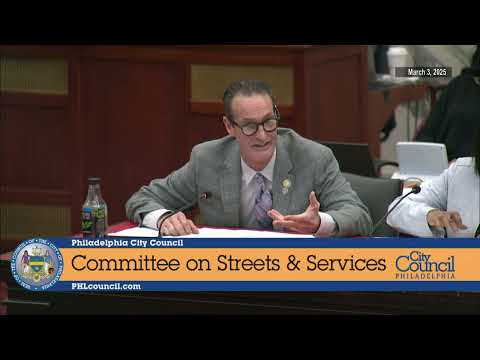
Philadelphia City Council’s Committee on Streets and Services on March 3 took testimony and public comment during a hearing on Resolution 240827, which asks the committee to examine the city’s response to illegal dumping, focusing on monitoring of high‑activity areas, enforcement strategies and tools to prevent repeat incidents.
The hearing brought together city sanitation and public‑works officials, community advocates and residents from neighborhoods that report persistent “short dumping,” with testimony spanning hallmarks of the current administration’s Clean and Green initiative and consistent requests from residents for more prevention and clearer enforcement.
Why it matters: Speakers said cleanup operations have increased citywide but many trash hot spots remain legacy locations — places cleaned repeatedly yet quickly re‑dumped. Residents, neighborhood groups and environmental nonprofits argued that long‑term prevention (affordable small‑load disposal, vacancy activation, stronger enforcement and better 311/PhillyStat data) will be needed to reduce recurring costs and health risks.
City testimony: Carlton Williams, director of the Office of Clean and Green Initiatives, described programs launched under Mayor Cheryl Parker’s administration and budgeted in the FY25–26 budget: expanded district cleaning crews, a citywide “1 Philly United City” cleanup conducted twice yearly, a residential district cleaning program that has logged more than 30,000 blocks to date, a reintroduced bulk collection program (more than 5,000 items collected since October 2024) and an order to install roughly 1,500 additional Big Belly solar trash receptacles outside Center City.
Williams said the administration is using data and cameras to target hot spots. “We have installed over 300 cameras specifically to catch illegal dumpers,” he told the committee, adding, “We will expand the number of cameras by 100 this year” and expand the use of wireless mobile cameras to monitor parks and other hard‑to‑wire locations. He described the law department’s recent use of civil procedures that, he said, produced more than 50 cases and “more than $3,000,000 in judgments” and about $200,000 in settlements in 2024, and noted the civil penalty authority allows fines “up to $5,000 per item per incident.”
Officials also described workforce and prevention programs: the city’s FutureTrack workforce pipeline (about 200 participants a year, council staff cited 36 hires last year), expansion of PHS LandCare (now covering 13,000 lots year‑round) and partnerships with CLIP (Community Life Improvement Program) and neighborhood cleaning organizations.
Public and nonprofit testimony: Dozens of neighborhood residents, block captains and community groups urged enforcement, but emphasized prevention. Many speakers asked the city to create or expand small‑load disposal or convenience centers so small contractors and homeowners could legally tip construction and demolition (C&D) debris without paying a large minimum tipping fee at commercial facilities. Multiple witnesses described repeated dumping at particular “legacy” sites such as the 5600 block of Newtown Avenue (known locally as Snake Road), parts of Kensington, Eastwick, Strawberry Mansion and other neighborhoods.
“Dumping here is not eliminated. It is simply a revolving cleanup site,” said Diane Payne of 215 People’s Alliance, describing repeated cleanup efforts at Snake Road. Residents and community organizations urged the committee to measure not only how much trash is collected but how long cleaned sites remain free of new dumping.
Proposals and disagreements: Witnesses and nonprofit leaders proposed a multi‑pronged approach: (1) maintain and expand cleanups where needed; (2) make permanent and scaled prevention measures (land care, lot activation, lighting, community stewardship); (3) establish affordable small‑haul drop‑off points for C&D materials with proportional fees so informal haulers choose legal disposal; and (4) strengthen enforcement and transparency — including publishing camera evidence and posting identities of prosecuted dumpers where legally permissible.
Some residents and advocates warned about the placement of cameras in over‑policed neighborhoods and urged care with surveillance programs; others stressed that cameras had helped identify plate numbers and encourage settlements. Businesses and the Chamber of Commerce urged continued investment in targeted technology and corridor cleaning to protect commercial districts.
Costs cited: Council Member Anthony Phillips said the city spends “nearly $48,000,000 annually on cleanup efforts,” a figure he used to argue for increased prevention spending. Clean and Green/streets testimony separated sanitation operating cleanup costs from other enforcement and program expenditures; Williams testified that the Sanitation Department itself spends about $2,000,000 per year directly on cleaning illegal dump sites (excluding enforcement and other aggregate costs).
Next steps directed or reported at the hearing: Williams and other officials described near‑term program expansions that are already planned or underway — installing 100 additional cameras this year, adding roughly 1,500 Big Belly units citywide (outside Center City), maintaining twice‑weekly residential collections pilots in places where they’ve been tested, expanding LandCare and CLIP maintenance, and continuing the bulk collection program. The committee opened the record to neighborhood testimony and signaled that the findings would be part of council’s budget review and any follow‑on legislation or budget requests.
What residents asked for: Testimony repeatedly asked the committee to (a) fund and license affordable small‑haul disposal for C&D to reduce the incentive to dump, (b) improve 311 responsiveness and transparency on cleanup times and outcomes, (c) publish clearer data on camera placements and enforcement results where legally allowed, (d) keep and expand workforce programs that hire locally through FutureTrack and CLIP, and (e) prioritize activation of vacant lots so they become monitored, cared for community spaces rather than persistent dumping targets.
No vote taken: The committee convened the hearing under Resolution 240827, but there was no committee vote recorded during the session. The measure created the hearing and the Committee took testimony and public comment on the record.
Community context and next steps: Multiple nonprofit and philanthropic partners — including the Pennsylvania Horticultural Society and the William Penn Foundation, which awarded about $1.7 million in grants to support neighborhood anti‑dumping work — told the panel they would continue to partner with the city on land care and neighborhood activation. Residents said they hoped the hearing would lead to concrete, measurable improvements: faster cleanup times, access to affordable disposal for small loads, and more consistent enforcement in neighborhoods that report repeat dumping.
Quotes from the hearing
• “Illegal dumping is not just an eyesore in the city of Philadelphia. It is a direct threat to public health and neighbors’ stability and environmental sustainability,” said Council Member Anthony Phillips (sponsor of the resolution).
• “We have installed over 300 cameras specifically to catch illegal dumpers... We will expand the number of cameras by 100 this year,” said Carlton Williams, director of the Office of Clean and Green Initiatives.
• “We need prevention in the form of education and small load deposit places, which would charge a cheaper fee instead of paying $100 or more a ton,” said Dallas Herbert, a Longcrest resident and member of 215 People’s Alliance.
• “Cleaning alone will not change behavior. A successful strategy will address laws, enforcement, infrastructure and education,” said Shannon Reeder (Keep Pennsylvania Beautiful), in submitted testimony read into the record.
Ending note: The committee hearing organized extensive testimony and returned multiple technical requests to city staff for data and program detail. Residents and nonprofit partners said they will press council and administration to translate the stated program expansions and grant funding into affordable disposal options and transparent, enforceable follow‑through so that cleaned sites stay clean.