Get Full Government Meeting Transcripts, Videos, & Alerts Forever!
Get email alerts on the Jail Population And Detention Center Closure topic
No spam. Unsubscribe anytime.
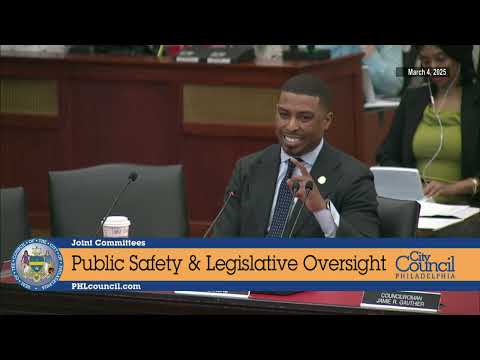
Council committees hold joint hearing on reducing Philadelphia jail population and conditions at the Detention Center
Summary
Philadelphia City Council’s joint public hearing on a resolution to examine ways to cut the city jail population opened with council leaders and witnesses describing a months-long decline in county custody numbers but sharply differing views on whether the Detention Center can be closed now.
Philadelphia City Council’s joint public hearing on a resolution to examine ways to cut the city jail population opened with council leaders and witnesses describing a months-long decline in county custody numbers but sharply differing views on whether the Detention Center can be closed now. District Attorney Larry Krasner and Philadelphia Department of Prisons Commissioner Michael Resnick testified on efforts to reduce population and improve safety, while advocates, legal counsel and community reentry groups pressed for faster bail reforms, more reentry services and expanded restorative-justice funding.
The hearing, convened by Councilmember Curtis Jones with co-chair Councilmember Isaiah Thomas, centered on Resolution 240718, introduced by Councilmember O'Rourke, which authorizes joint committee hearings “examining actions necessary to significantly reduce Philadelphia prison population in an effort to permanently close Philadelphia’s oldest and most inhumane prison facility, the Detention Center.” The discussion ranged from initial-arraignment and early-bail-review procedures to staffing, medical care and community-based alternatives to incarceration.
Why it matters: witnesses said continuing reductions in the jailed population could allow the city to consolidate housing and redeploy staff, but that progress so far has left the system concentrated with higher-security inmates and persistent operational problems. Advocates and reentry providers urged the council to invest in diversion, reentry and restorative programs — arguing those investments reduce recidivism and are cheaper than incarceration — while prison officials described immediate facility and custody constraints that make closure premature.
District Attorney Larry Krasner said Philadelphia has shown that “safety and freedom are in no way inconsistent,” arguing that changes in pretrial processes and supportive services can safely lower the jail count. Krasner described an expanded early-bail-review program and urged collaboration among the DA’s office, public defenders and the courts to reduce unnecessary pretrial detention. He said, “We led the country among big cities in improvements in public safety last year,” and urged the city to press reforms that keep non-dangerous people out of custody while holding truly dangerous individuals in place.
Commissioner Michael Resnick of the Philadelphia Department of Prisons said population and custody mix are the central operational constraints to closing the Detention Center. Resnick told the committees that the jail population has fallen from 4,811 in July 2024 to roughly 3,800 as of late winter, and that about 60 percent of those now in custody are classified as close custody — inmates with violent charges or major facility infractions who must be housed separate from minimum- or medium-custody people. “We currently have approximately 500 inmates housed in the Detention Center, and that’s the only way we can house those of that lower custody level completely separate from the close custody population,” Resnick said. He also described medical and program capacities housed at the Detention Center, including a licensed prison health services wing (PHSW).
Resnick said the department has hired aggressively — hiring 230 correctional officers since April 2024 and reducing the vacancy rate from about 47 percent to 34 percent — and has budgeted capital projects to add air-conditioning to dorms and to replace and integrate cameras. He reported maintenance and medical budget increases (he cited roughly $5.5 million for facilities maintenance and about $3.4 million added to medical care) and said the facility’s off-site appointment backlog declined from 104 to 11. He described a pilot medical-monitoring device paid for from REMICK settlement funds and said the detention center provides treatment programs such as the “Options” drug and alcohol program and a “Leash on Life” cohort that trains inmates to prepare rescue dogs and receive transitional services.
Advocates, legal representatives and community providers described conditions inside the jails and argued for alternative investments. Lee Owens of the Pennsylvania Prison Society urged significant population reductions to restore safe staffing and programming, saying on recent walk-throughs “people are now let out of their cells for three hours, but even this isn’t a guarantee,” and citing interviews where people said they had been locked up all day for holidays. Sue Meng Yeh, co-counsel for the plaintiffs in Remick v. Philadelphia, reminded the panel that the federal monitor found persistent noncompliance with out-of-cell-time requirements and other provisions of the settlement.
Reentry and diversion providers said their programs prevent incarceration and cut recidivism. Jody Dodd of the District Attorney’s restorative-justice office summarized program results: “People that go into the criminal system, the recidivism rate is 61 percent. People that go through restorative justice, it’s 26 percent,” she said. Nigel Bowe of JEVS Human Services described an established diversion program and said the cost to operate diversion is about $5,000 per participant versus roughly $40,000 to incarcerate a person for a year. Latricia Webb of The Elevation Project said her program tracks outcomes and reported a 4 percent recidivism rate among participants since 2022.
Legal and procedural reforms were discussed at length. Krasner and representatives from the Defenders Association emphasized improving the initial arraignment process and sustaining early-bail-review hearings, a court process that reviews bails within days of arrest and has been expanded in recent years. Krasner outlined problems with how bails are set (including the role of bail commissioners, the 10 percent commission rule and the ability of bail bondsmen to post a fraction of bail), and urged changes that allow “the highs are high and the lows are 0,” meaning stiffer measures for the most dangerous defendants and zero cash bail for those who do not pose a risk.
The city’s $25 million the court-ordered sanctions fund stemming from the Remick contempt proceeding was raised repeatedly. Krasner and others suggested the council consider a joint letter to the federal judge and partners proposing targeted use of remaining funds for prevention, diversion and community-based services that reduce admissions and length of stay, an idea several council members supported in principle.
Committee members pressed for measurable next steps: tighten initial-arraignment screening, stabilize staffing, maintain the early-bail-review program (the Defenders requested $750,000 to sustain MacArthur-funded early-bail work beyond June 30), expand restorative and diversion programs, and strengthen reentry supports — including help obtaining IDs, Social Security documentation and connecting people to housing, jobs and treatment. Commissioner Resnick and others warned that unless the proportion of close-custody inmates falls and length of stay declines, the Detention Center will remain needed for specialized housing and medical units.
Witnesses asked the council for three types of investment: funding to sustain and expand early-bail-review and emergency bail hearings; funding and contracting changes to expand evidence-based diversion and restorative programs (several witnesses estimated multi-million-dollar annual investments — for example, community leaders asked for expanded restorative program funding in the low millions); and investment in reentry case management and services at intake so people leave custody with IDs, benefits, and workforce connections. Providers described pilot and federal grant activity already underway, including a JEVS partnership to expand a diversion program into firearm-related cases with PCCD support and a prison medical-monitoring pilot funded from Remick sanctions.
Outlook: members said they would return to many of the items in the budget process and in future hearings. Councilmember O'Rourke and others pledged follow-up on bail-process reforms; several councilmembers asked the administration to provide detailed accounting of how the $25 million Remick funds have been spent and suggested creating a cross-branch work group to coordinate courts, the DA, public defenders and service providers.
Ending: the committees recessed the formal hearing because of room scheduling and moved to continue public testimony in a neighboring caucus room. No formal vote or decision to close any facility was taken at the hearing; the testimony was collected as part of ongoing oversight and planning work by the council’s public safety and legislative oversight committees.