Get Full Government Meeting Transcripts, Videos, & Alerts Forever!
Appropriations Committee hears bills on transportation oversight, local road funding, BWI firefighters and behavioral health grants
Summary
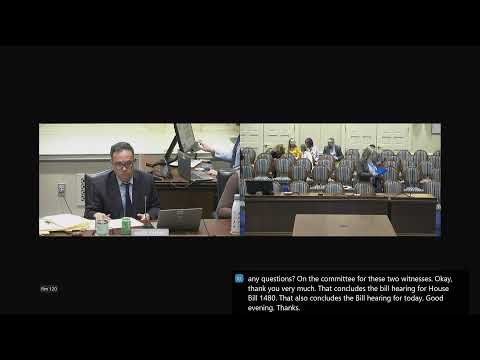
The Maryland House Appropriations Committee held a long bill hearing Oct. 27 that covered transportation procurement oversight, local highway user formula restoration, binding arbitration for BWI Airport firefighters, continued funding for behavioral health crisis response and proposed continuity‑of‑care requirements for child advocacy centers.
The Maryland House Appropriations Committee convened a multi‑hour bill hearing on Oct. 27 that addressed a range of policy items including transportation procurement oversight, restoration of local highway user revenues, labor and public safety concerns at Baltimore‑Washington International Thurgood Marshall Airport (BWI), continued funding for community behavioral health crisis response, and proposed continuity‑of‑care requirements for child advocacy centers.
The meeting opened with testimony on House Bill 14‑32, a bill from Chairman C.T. Wilson to recast Minority Business Enterprise (MBE) programs into a race‑neutral “small disadvantaged business” coordination office; Wilson said the change responds to recent Supreme Court rulings and aims to preserve federal funding while maintaining outreach and accountability for businesses in enterprise zones. "And again, just wanna reemphasize that we do have to turn a corner. The Supreme Court has made that very clear through its Harvard decision and its USDA decision. And we can do so in a race neutral way," Chairman C.T. Wilson said.
Transportation procurement and local roads dominated the earliest panels. Delegate N. Scott Phillips and Treasurer Derek Davis urged the committee to support House Bill 5‑78 to remove a long‑standing blanket exemption that prevents the Board of Public Works (BPW) from reviewing many Maryland Department of Transportation (MDOT) capital procurements. Treasurer Derek Davis said that, as a member of BPW, "this means that the legislature and the public have limited visibility into the process and specifications for these important transportation projects." Supporters said bringing high‑value MDOT contracts before BPW would increase public oversight without unduly…
Already have an account? Log in
Subscribe to keep reading
Unlock the rest of this article — and every article on Citizen Portal.
- Unlimited articles
- AI-powered breakdowns of topics, speakers, decisions, and budgets
- Instant alerts when your location has a new meeting
- Follow topics and more locations
- 1,000 AI Insights / month, plus AI Chat