Get Full Government Meeting Transcripts, Videos, & Alerts Forever!
Get email alerts on the Unmanned Aircraft Drones topic
No spam. Unsubscribe anytime.
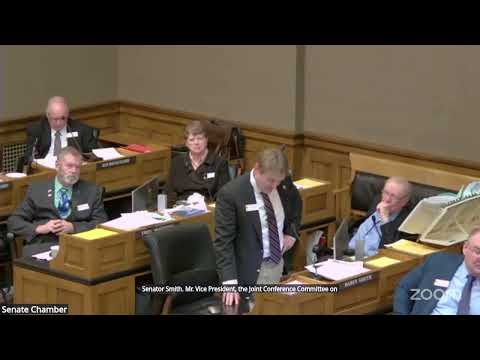
Wyoming Senate overrides governor veto on drone bill after heated debate
Summary
The Wyoming Senate voted 23-8 on March 4, 2025 to override Governor Mark Gordon's veto of Senate File 132, a bill aimed at protecting critical infrastructure from unmanned aircraft. Lawmakers split over federal preemption, enforcement powers and potential civil-liberties implications.
CHEYENNE, Wyo. — The Wyoming Senate on March 4, 2025 voted 23-8 to override Governor Mark Gordon’s veto of Senate File 132, known in enrolled form as Senate Enrolled Act 58, a bill described by supporters as a measure to protect critical infrastructure from unmanned aircraft systems.
Senators spent more than an hour and a half debating the measure before the roll call. The motion to reconsider and override the veto was made under Article 4, Section 8 of the Wyoming Constitution; the chamber approved the override 23-8 after a brief recess to resolve technical issues with the roll call system.
The vote followed sharply divided remarks on whether the state law would conflict with federal authority over navigable airspace and whether it properly limited use of force. Supporters said the bill gives local officials additional tools to investigate and respond to unauthorized drone activity near critical facilities. “This is just something for us to be able to protect ourselves,” Senator Jones, a member of the Senate, said on the floor, referring to the bill’s investigatory and enforcement provisions.
Opponents repeatedly warned of federal preemption and the risk of criminalizing innocent behavior. “The FAA . . . has responsibility in this area. We don’t,” Senator Case said, urging colleagues to sustain the veto and “let this cool off a little bit.” Senator Eyde said he voted against the bill in earlier proceedings because he was “nervous about . . . potentially criminalizing innocent behavior.”
Other senators framed the bill as permissive rather than mandatory, noting the measure authorizes — but does not require — the governor, the National Guard or local law enforcement to take actions when they deem them appropriate. “The provisions the governor specifically called out . . . are strictly permissive,” Senator Hicks said on the floor, adding, “It’s not a duty on law enforcement. It just provides an opportunity.”
Supporters pushed back on fears of widespread use of force, saying disabling or removing an aircraft over a “prohibited location” is unlikely to mean routine shoot-downs. “The important parts of this bill . . . give law enforcement the ability to potentially find the folks on the ground, presumably within line of sight,” a supporter said, adding the probability of a dramatic takedown is “very small.” Another senator invoked recent international events to argue the measure would help guard against weaponized drones.
Senator Salazar said the phenomenon being addressed had unanswered questions and that the problem could worsen, but did not state a position for or against the override. Several senators urged coordination with federal partners, and at least one speaker recommended returning later with statutory refinements if needed.
After the vote, the president of the Senate announced the override had passed and the measure would be enrolled as an act. The roll call recorded 23 votes in favor of the override and 8 opposed.
Votes at a glance
- Senate File 132 (Senate Enrolled Act 58), “Protecting critical infrastructure and systems from drones” — Veto override passed, 23 yes, 8 no. The motion to reconsider and override was made under Article 4, Section 8 of the Wyoming Constitution. (Debated; see transcript excerpts.)
- Joint Conference Committee Report No. 2 to Senate File 32 (unpaved roads speed limit amendments) — Adopted, roll-call recorded 22 yes, 9 no.
- Joint Conference Committee Report No. 1 to Senate File 196 (Second Amendment Protection Act amendments) — Adopted, roll-call recorded 30 yes, 1 no.
- Motion to jacket, assign and introduce draft LSO 25LSO802 (State Shooting Complex Funding Amendment) past deadline — Motion approved on two-thirds vote as required; roll-call recorded the motion passed by the chamber (closing vote recorded as 20 yes, 6 present/aye notation and 5 no in transcript summary).
- Motion to set order of consideration to place House Bill 249 (runoff elections) as second item in Committee of the Whole — Motion failed, 5 yes, 26 no.
Background and context
Senate File 132 passed both chambers earlier in the session but was vetoed by the governor; the Senate then considered a motion to reconsider and override that veto under its constitutional authority. Debate centered on the practical effect of the bill’s language, the limits of state authority in federally regulated airspace, and whether the statute’s permissive language could nonetheless create unsafe or unlawful practices. Several senators emphasized the bill’s permissive wording and asserted that coordination with federal partners would still be required for certain actions. Others warned that inclusion of language authorizing “disabling, damaging or removing” an unmanned aircraft from a prohibited location raised difficult federal-preemption and safety questions.
What’s next
Because the Senate overrode the veto, Senate File 132 will be enrolled as a law per the enrolled act procedures recorded later in the session. Lawmakers and staff indicated during debate that clarifying amendments could be considered in a future session if problems arise or federal partners identify conflicts.
Source notes
This article is based on the Wyoming Senate floor transcript for March 4, 2025. Quotes and roll-call results are drawn from that transcript and identified speakers on the record.