Get Full Government Meeting Transcripts, Videos, & Alerts Forever!
Get email alerts on the Supportive Housing Services Reform topic
No spam. Unsubscribe anytime.
Metro outlines reform plan for Supportive Housing Services; Multnomah County calls for shared metrics and transparency
Summary
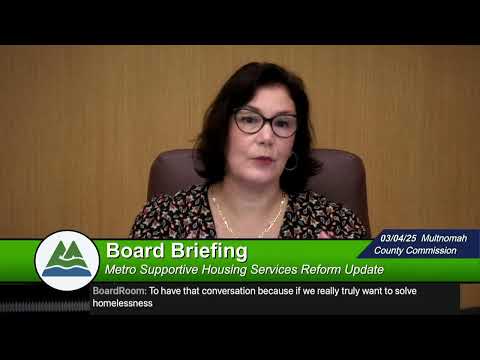
Metro Council President Lynn Peterson briefed the Multnomah County Board on proposed reforms to the Supportive Housing Services program, urging a regional “North Star,” shared data and governance changes to address rising homelessness and volatile revenues.
Metro Council President Lynn Peterson told the Multnomah County Board of Commissioners on Feb. 24 that Metro is advancing reforms to the Supportive Housing Services program (SHS) to address rising homelessness, funding volatility and uneven regional implementation.
Peterson said Metro’s review would aim to set a regional “North Star,” standardize performance measures across the three counties, and propose changes to governance and oversight. "SHS is working, changing thousands of lives," she said, while also warning that "inflow into homelessness is exceeding the ability of Multnomah County to end chronic homelessness."
The briefing focused on three linked reform strands: a data-sharing agreement to combine SHS-funded results with state and federal program data; an ordinance and possible ballot measure that could permit SHS funds to be used for affordable housing, reduce the personal income tax rate for the program, and extend the program; and a new Metro policy advisory committee on housing and homelessness to replace the current regional oversight structure and improve auditing and accountability.
Why it matters
Peterson and county officials said the reforms matter because SHS revenue is volatile and public confidence has eroded. Peterson argued that without clearer regional goals, shared definitions and stronger data, Metro will continue to struggle to demonstrate results to voters and to stabilize SHS revenue. "Until we can reform how we deliver the services to our most vulnerable, we will continue to see slower than expected growth or even outright declines in SHS revenue," she said.
What Metro proposed
- Data sharing: Peterson said Metro’s data-sharing agreement — soon to be signed by Metro’s COO — currently covers outcomes funded directly by SHS dollars and must be supplemented with state and federal program data and county general-fund information to show the full regional picture. She asked the county commission to approve Metro’s agreement and work with Metro to amend it within three months so the region can "communicate effectively to the public."
- Ballot measure elements: Peterson said Metro has been discussing a possible ballot measure with three components: allowing SHS funds to be used for affordable housing, reducing the SHS personal income tax rate, and extending the program. She said the ballot track has been under discussion for about nine months and cautioned that adding housing without extension would be infeasible because of costs.
- Governance and oversight: Metro proposes creating a policy advisory committee on housing and homelessness — modeled on other Metro advisory committees — to set a regional "North Star," define key performance indicators (KPIs) and conduct audits of county use of funds. Peterson described the committee as an iterative, five‑year effort that would ultimately inform Metro Council decisions.
County responses and key questions
Commissioners pressed Metro on three consistent themes: (1) board-level engagement and shared decision-making; (2) comprehensive, integrated data that includes federal and state funding as well as county general-fund contributions; and (3) clear accountability tied to measurable outcomes rather than sole focus on expenditure compliance.
- Commissioner Moyer asked Metro to engage county boards at the elected level and to convene an inclusive forum so counties, cities and Metro jointly agree on strategy and avoid "robbing Peter to pay Paul." He urged "radical transparency" for voters about what the program can and cannot do.
- Commissioner Singleton emphasized the need for shared definitions (for example, consistent definitions of population categories and what constitutes emergency shelter versus transitional housing) and to ground reform in evidence-based practice such as Housing First. "Sometimes you have to slow down to move fast," she said, urging a baseline of common definitions.
- Commissioner Bridal Edwards said governance changes alone will not ensure results; she urged that Metro and counties adopt independent, validated performance metrics that measure inflow and outflow so the region can tell whether it is "treading water, making progress, or backsliding." She endorsed Metro’s call for auditing and stronger performance data.
Operational details and constraints discussed
Peterson acknowledged early implementation challenges: the original SHS ballot measure was developed quickly during a crisis, counties initially funded many existing programs rather than building a unified regional system, and the volatile personal-income-tax revenues underpinning SHS have complicated long-term budgeting. She cited regional accomplishments from the first years of SHS — more than 6,000 households placed in housing, nearly 16,000 evictions prevented and funding for almost 2,000 shelter beds — while saying those successes are not sufficient to meet growing inflow.
County staff and elected officials flagged practical items that would affect implementation, including:
- Data scope: Metro’s current data-sharing agreement covers only SHS-funded services. County leaders and Peterson agreed the region needs to link SHS data with federal and state funding and with county general-fund expenditures to measure integrated outcomes. Peterson asked for a three-month timeline to amend the agreement.
- Homeless response system (HRS) participation: Peterson said Metro is not currently part of Multnomah County’s HRS steering and oversight table because Portland requested a change to the intergovernmental agreement. County leaders welcomed Metro attendance at HRS meetings and said Metro was intended to be at the table under the original IGA.
- Providers and conflicts of interest: Several commissioners expressed concern about advisory bodies where providers that receive SHS dollars are voting members. Peterson said the proposal envisions a technical staff committee and a provider input structure that would feed information upward without creating voting conflicts on the policy advisory committee.
- Housing production and affordable-housing uses: Commissioners and Peterson agreed that affordable-housing production is central to long-term success. Peterson said the advisory committee would need to match needs analysis to production capacity, and she warned that voter support for an expanded use of funds would likely require specific, measurable commitments on housing targets.
No formal actions recorded
The briefing produced no formal motions or recorded votes in the transcript. Peterson requested that the county review and approve the forthcoming data-sharing agreement and engage with Metro on the proposed governance changes; county commissioners asked Metro to include county boards in further discussions and to provide integrated data.
Ending
County leaders said they welcomed Metro’s outreach, asked for frequent public reporting, and repeatedly called for shared outcomes, consistent definitions across counties, and independent performance metrics. "We are all in this together," Peterson said. Commissioners agreed to continue the conversation in upcoming joint briefings, steering-committee meetings and work group sessions as Metro moves toward drafting ordinance and ballot materials and refining the proposed policy advisory committee.