Get Full Government Meeting Transcripts, Videos, & Alerts Forever!
Get email alerts on the Police Oversight topic
No spam. Unsubscribe anytime.
Civilian Police Review Board and Inspector General present 2024 annual report: 1,741 complaints; board flags follow-up on chain-of-command outcomes and mental‑‑
Summary
The Civilian Police Review Board and the Department of Inspector General reported 1,741 citizen complaints in 2024 and urged clearer follow-up from the Columbus Division of Police after disagreements over findings and concerns about police responses to people in mental‑health crisis.
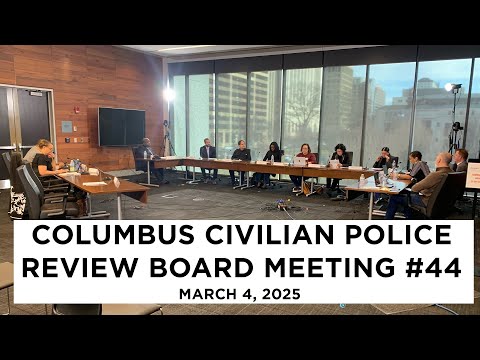
The Civilian Police Review Board and the Department of Inspector General (DIG) presented their joint 2024 annual report March 4, saying they received 1,741 complaints last year and opened 269 investigations.
The report, presented by the DIG’s statistician and the board’s executive assistant, showed 1,469 complaints were closed at intake, 269 were opened into investigation and 246 investigations were completed in 2024. The DIG reported an average of 2.6 allegations per investigated case in 2024, down from 3.0 in 2023. The most common allegation categories were “actions taken / not taken,” rude or discourteous conduct and use of force. The DIG recorded 98 sustained allegations in 2024 and noted an increase in sustained findings compared with the prior year.
Board members and DIG staff said the board and DIG continue to agree on findings in most cases but asked for clearer post-decision follow-up from the Columbus Division of Police. The board agreed with the DIG’s findings 99.5% of the time; the division’s chain of command agreed with DIG findings 92.7% of the time in cases the division reviewed, the report said. Board members told DIG staff the disagreement rate and the subsequent outcomes at the chain-of-command level created a “black box” and argued for more transparency and a clearer follow‑up process.
DIG staff presented the complaint intake and disposition data and said most complaints arrive by hotline. Of the complaints closed at intake, the top reasons were referral to another agency, insufficient information to proceed, and preliminary investigation finding no policy violation. DIG staff explained that “withdrawn” intake closures often reflect the complainant’s decision not to proceed after DIG follow‑up attempts rather than a unilateral DIG decision.
The report included discipline and outcome data: 19 positive corrective actions, 14 documented constructive counselings, two written reprimands and one dismissal among reported outcomes. Precinct‑level data showed Precinct 2 (North Linden) had the most investigated allegations (71), followed by Precinct 11 (South Side) and Precinct 16 (downtown).
Board members urged the DIG and CPD to develop more detailed coding for intake categories such as “actions taken / not taken” and to provide additional breakdowns for body‑worn camera (BWC) issues. The board emphasized that while the DIG’s statistics identify trends, the board needs clearer tracking of what happens after the DIG’s findings are shared with the division of police, including how many sustained findings result in discipline after the division’s process and arbitration.
The annual report also summarized community outreach in 2024, the board’s history (the board was created by a November 2020 public vote that carried with roughly 76% support), and reforms the board has recommended and that CPD has implemented, including expanded implicit‑bias training and additional body‑worn cameras funded and rolled out by CPD leadership.
Board members asked DIG staff for memos on cases where the board and DIG think additional training is warranted even if a policy violation was not found. The DIG agreed to provide memos when reviewers identify recurring training or policy concerns separate from a formal sustained finding.