Get Full Government Meeting Transcripts, Videos, & Alerts Forever!
Our City, Our Home fund projects roughly $330 million a year; committee cautions on volatility
Summary
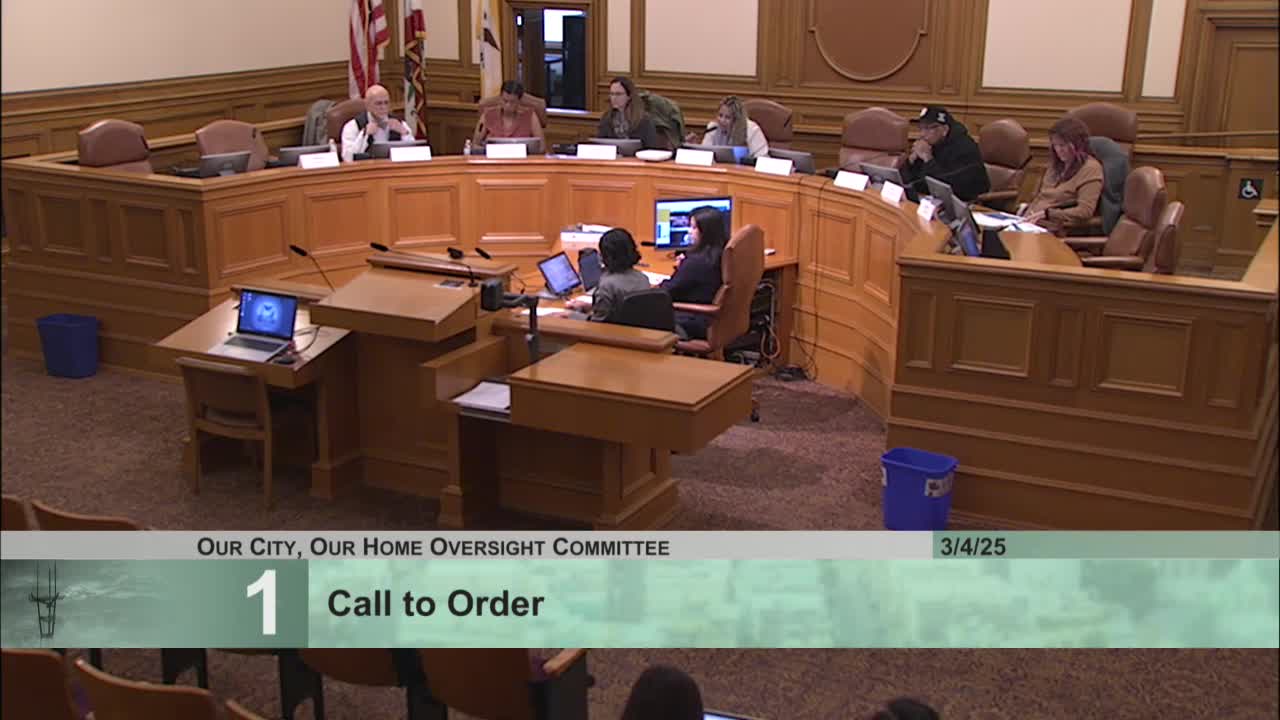
San Francisco’s Our City, Our Home (OCO) Oversight Committee received a revenue forecast and a fiscal year 2024–25 midyear budget update on March 4, 2025, showing projected annual OCO receipts near $330 million but continuing revenue volatility that the city plans to manage with reserves and one‑time program savings.
San Francisco’s Our City, Our Home (OCO) Oversight Committee received a revenue forecast and a fiscal year 2024–25 midyear budget update on March 4, 2025, showing projected annual OCO receipts near $330 million but continuing revenue volatility that the city plans to manage with reserves and one‑time program savings.
Controller’s Office staff presenting the forecast told the committee the two most relevant years for the current budget cycle are fiscal 2025–26 and 2026–27 and that the most recent forecast assumes roughly 3% annual growth in receipts, with a near‑term projection of about $325 million for the first year and $336 million for the second — an approximate $330 million level overall. The presenter said, “Forecasts are of course just our best thinking, at 1 point in time.” (Radhika, Controller’s Office Budget and Analysis Division, presenter.)
The midyear update showed that the OCO revised budget authority is $785 million (including unspent prior‑year allocations and the current year’s budget authority). Departments reported $167 million spent in the first half of the fiscal year and projected an additional $247 million in spending in the second half. Staff reported about $99 million in obligated funds earmarked for specific initiatives (notably Safer Families and TAY housing expansions) and $158 million held in reserves to cover shortfalls between projected revenue and the adopted spending plan. Departments identified a projected remaining balance of about $115 million of one‑time program savings, “primarily driven by the mental health acquisition fund,” staff said.
Why…
Already have an account? Log in
Subscribe to keep reading
Unlock the rest of this article — and every article on Citizen Portal.
- Unlimited articles
- AI-powered breakdowns of topics, speakers, decisions, and budgets
- Instant alerts when your location has a new meeting
- Follow topics and more locations
- 1,000 AI Insights / month, plus AI Chat