Get Full Government Meeting Transcripts, Videos, & Alerts Forever!
Get email alerts on the Oco Fund Budget topic
No spam. Unsubscribe anytime.
Our City, Our Home fund projects roughly $330 million a year; committee cautions on volatility
Summary
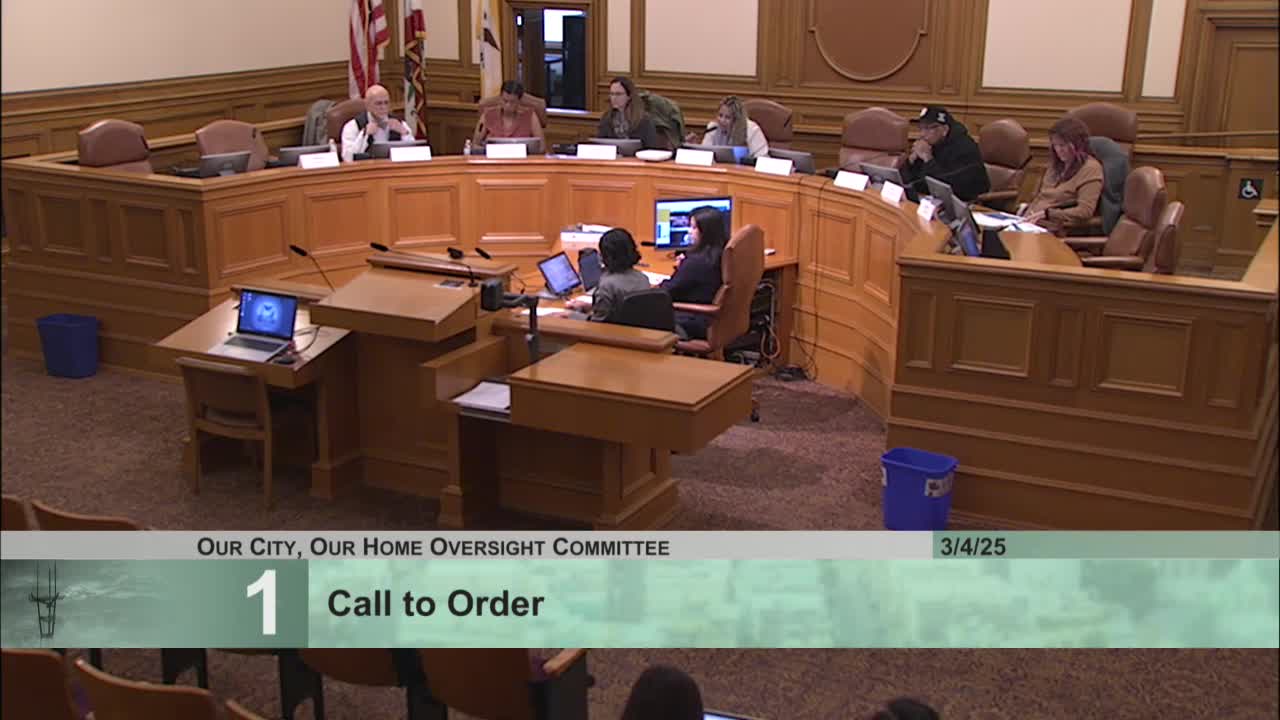
San Francisco’s Our City, Our Home (OCO) Oversight Committee received a revenue forecast and a fiscal year 2024–25 midyear budget update on March 4, 2025, showing projected annual OCO receipts near $330 million but continuing revenue volatility that the city plans to manage with reserves and one‑time program savings.
San Francisco’s Our City, Our Home (OCO) Oversight Committee received a revenue forecast and a fiscal year 2024–25 midyear budget update on March 4, 2025, showing projected annual OCO receipts near $330 million but continuing revenue volatility that the city plans to manage with reserves and one‑time program savings.
Controller’s Office staff presenting the forecast told the committee the two most relevant years for the current budget cycle are fiscal 2025–26 and 2026–27 and that the most recent forecast assumes roughly 3% annual growth in receipts, with a near‑term projection of about $325 million for the first year and $336 million for the second — an approximate $330 million level overall. The presenter said, “Forecasts are of course just our best thinking, at 1 point in time.” (Radhika, Controller’s Office Budget and Analysis Division, presenter.)
The midyear update showed that the OCO revised budget authority is $785 million (including unspent prior‑year allocations and the current year’s budget authority). Departments reported $167 million spent in the first half of the fiscal year and projected an additional $247 million in spending in the second half. Staff reported about $99 million in obligated funds earmarked for specific initiatives (notably Safer Families and TAY housing expansions) and $158 million held in reserves to cover shortfalls between projected revenue and the adopted spending plan. Departments identified a projected remaining balance of about $115 million of one‑time program savings, “primarily driven by the mental health acquisition fund,” staff said.
Why it matters: the committee must recommend budget and policy priorities to the mayor and later to the Board of Supervisors. Committee members stressed that while underspending has preserved a pool of one‑time funds, persistent structural deficits mean those reserves are needed to keep ongoing programs running. Member Friedenbach said the committee must balance caution and urgency: “we don't want to have money sitting there.” (Member Friedenbach, Our City, Our Home Oversight Committee.)
Key drivers and risks noted by staff
- Litigation holdbacks: staff explained the city withholds revenue to cover potential litigation claims against the homeless gross receipts tax. The presentation cited two large examples discussed at the meeting — suits involving GM and Lyft — which staff used to illustrate why revenue is sometimes held back. The presenter said litigation risk reduces the revenue available to the fund until cases are resolved. (Controller’s Office presenter.)
- Proposition M: staff said the November ballot measure changed the business tax structure that funds OCO (the homeless gross receipts tax), shifting from payroll to sales and lowering exemption thresholds. The forecast incorporates assumptions about Prop M and estimates the tax will add roughly 400 additional taxpayers, which staff said should lower volatility over time but whose full implementation effects will not be known until late 2026.
- Local economy and office vacancy: the presenter reported that downtown office vacancy peaked near 35% in 2024 and that reduced office activity has depressed gross receipts collections. Staff noted high interest rates and hybrid work patterns are relevant to near‑term projections.
Program‑level highlights from the midyear update
- Permanent housing: the largest share of OCO spending, driven by ongoing operations for permanent supportive housing sites and scattered‑site expansions. State Homekey awards for two sites (including 42 Otis and 1174 Folsom, as presented) freed OCO allocations to be used elsewhere. Staff said some openings (partial‑year operations) and capital/rehab cost growth contribute to underspends and obligations.
- Mental health operations: expenditures reflect expansions of residential treatment beds, street behavioral health response teams, and new residential programs (for example, a 33‑bed residential program for justice‑involved women, discussed as HER House). The presentation noted acquisition funds for potential facility purchases, relocations, and a new service center are under negotiation.
- Homelessness prevention and shelter: prevention programs (including SF ERAP, problem solving, eviction prevention and stabilization) showed full implementation but tighter balances after one‑time sources used in prior years ended. Shelter and hygiene spending is driven by navigation centers, emergency shelter, a new cabin site (The Commons in Bayview), and demobilization costs for the closing Candlestick Vehicle Triage Center.
Committee requests and staff follow‑up
Committee members asked for more detailed breakdowns at upcoming liaison meetings, including: a population‑level breakout of housing expenditures (adult, family, TAY) and activity‑level detail (scattered site vs. PSH vs. vouchers) to understand underspends; the magnitude of revenue held back for litigation in past years; and details about the mental health acquisition proposals (bed counts, subpopulations, and program types) while acknowledging negotiation confidentiality. HSH and MOHCD staff said they would provide additional detail in liaison briefings and work with committee members offline on data requests.
Staffing and implementation
HSH Budget Director Christine Roland told the committee, “We have been staffing up,” and that while many vacancies have been filled, program expansions and internal promotions continue to create turnover and capacity constraints. Ellen Hale, Director of Housing Services (MOHCD), said MOHCD expects to spend down its OCO emergency rental assistance allocation and described efforts to preserve buffers for ongoing subsidy programs so existing recipients are not destabilized.
No formal committee votes occurred during the March 4 special meeting. There were no public commenters in person or by phone. Departments will present department‑level budget proposals at later liaison meetings in March and the committee will make budget and policy recommendations in April to inform the mayor’s proposed budget, the presenter said. The committee adjourned after the midyear update at 10:06 a.m.
Ending note: staff emphasized that the forecast is a point‑in‑time estimate and that the committee’s upcoming decisions should weigh the need to sustain ongoing programs against the risk of future revenue shortfalls. (Radhika, Controller’s Office presenter.)