Get Full Government Meeting Transcripts, Videos, & Alerts Forever!
Get email alerts on the Municipal Budget topic
No spam. Unsubscribe anytime.
Spokane Valley staff warn of 2026 budget pressures after state data glitch and new police contract costs
Summary
City staff told the Spokane Valley City Council at its winter workshop that a Department of Licensing data error cut Transportation Benefit District revenue estimates by roughly $1 million and that newly negotiated collective bargaining costs for deputies will raise local police expenses over the next three years, creating a tighter 2026 budget.
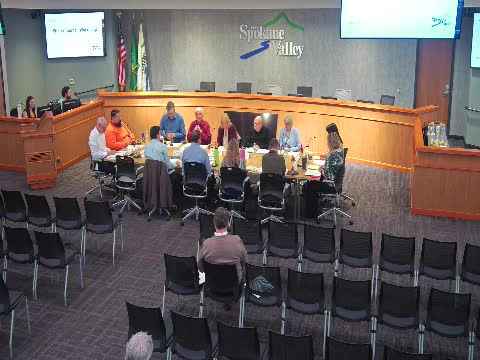
Spokane Valley City Council members spent the winter workshop on a wide-ranging briefing about the 2026 budget, with staff warning that a state data error and recently settled law-enforcement pay increases will tighten available revenue and likely require choices on service levels and new revenue options.
City Manager John Holman reminded the council of its six adopted budget priorities — led by increasing public-safety response and prioritizing infrastructure maintenance — and said staff were seeking direction as they prepare the first draft of the 2026 budget for a June workshop. "Your number one budget priority was to increase public safety response to ensure everyone feels safe in Spokane Valley," Holman said.
Why it matters: Spokane Valley relies heavily on sales tax and a new Transportation Benefit District (TBD) vehicle-license fee to fund street maintenance and to free up general fund dollars for public safety. Staff told the council that both revenue and cost drivers are moving in the wrong direction for 2026, and that reserves and one-time balances used in 2024–25 will not be a sustainable long-term solution.
Transportation Benefit District shortfall
Eric (staff member) told the council that the state Department of Licensing (DOL) provided incorrect vehicle-count estimates used to model TBD license-fee revenue. "I'm gonna be the spoiler here. It's not good. We're about a million dollars short from what we were estimating for the '25 budget," Eric said, summarizing the staff analysis.
Staff had built the 2025 budget assuming roughly 140,676 vehicles eligible for renewal and annual TBD revenue of about $2.7 million. After DOL's corrected estimate of 90,895 vehicles, staff said the city’s expected TBD receipts fall by roughly $986,000 — a reduction staff described as about a 35% decrease from the original projection. Chelsea (staff member) said collections to date align with the lower estimate.
Those TBD receipts flow into the city’s street fund to pay for crack sealing, pothole repair, winter maintenance and similar work. Staff said recurring expenditures in the street fund exceed recurring revenues by about $738,000 for 2025; the fund balance can cover the shortfall this year but not on an ongoing basis. Staff estimated TBD collections of about $1.8 million for 2025 under the revised data.
Collective bargaining and law-enforcement costs
Council members heard a separate briefing on recent collective bargaining outcomes affecting deputies, captains and lieutenants whose pay and benefits are negotiated through multi-year contracts. Staff provided preliminary cost estimates for the sheriff's office agreement that include Spokane Valley's share.
Staff reported an estimated increase in total sheriff-office compensation costs of $2.3 million for 2025, with an additional $1.1 million in 2026 and $880,000 in 2027; the three-year total increase shown to the council was about $9.9 million. Staff estimated that Spokane Valley's portion of that increase is approximately 48%, or about $4.75 million over three years. "We're looking at dollars: $4,800,000 over the next three years," Eric said, noting those figures cover current officers and do not reflect additional staffing the council might authorize.
City staff said the city had included contingency planning in the 2025 budget — a $1.5 million contingency plus an assumed 5% adjustment — but cautioned that the preliminary county estimates still require itemization (salaries, specialty pay, benefits and indirect costs) before staff can present a final local impact.
Other drivers and timeline
Staff also flagged several additional cost pressures: flat to slightly declining sales-tax receipts (the city’s principal revenue source), rising insurance costs (average annual increases of about 14% since 2019, according to staff), higher medical contracts at detention services, and potential changes in public-defender funding. Chelsea said she is monitoring auto sales data and the state’s forecast and expects sales-tax receipts for the coming year to be "flat to declining ... just under 1 percent," but said March updates to state projections may change assumptions.
Holman and staff emphasized this meeting was a workshop to gather council direction, not a decision-making session. Staff said the first formal budget workshop is scheduled for June 10 and the council’s tentative adoption date is Nov. 18. Council members asked about public involvement and requested staff return with options and analysis to inform trade-offs between service reductions and revenue options, including revisiting whether to take the statutory 1% property-tax levy increase (estimated to yield roughly $140,000 annually).
What’s next
Staff will return with more detailed line-item impacts for the sheriff-office contract, refined revenue projections after updated state forecasts, and options to address the TBD shortfall and other structural imbalances. Councilmembers signaled differing views on budgeting approaches — some favoring an explicit zero-based review of programs — and staff said they will bring scenarios for council review in June.
Ending: The workshop made clear that Spokane Valley’s fiscal outlook for 2026 depends on external data corrections, finalized county contract detail and the council’s direction on whether to pursue new revenues or structural cuts. Staff warned that while one-time balances cover near-term gaps, the city must identify sustainable solutions before next year’s budget adoption.