Get Full Government Meeting Transcripts, Videos, & Alerts Forever!
Get email alerts on the Waste Management topic
No spam. Unsubscribe anytime.
City hears 2024 Opportunity to Recycle report; staff previews changes under Oregon Recycling Modernization Act
Summary
Thompson Sanitary presented Newport’s 2024 Opportunity to Recycle report, reviewed outreach materials and event diversion results, and discussed upcoming implementation steps for Oregon’s Recycling Modernization Act.
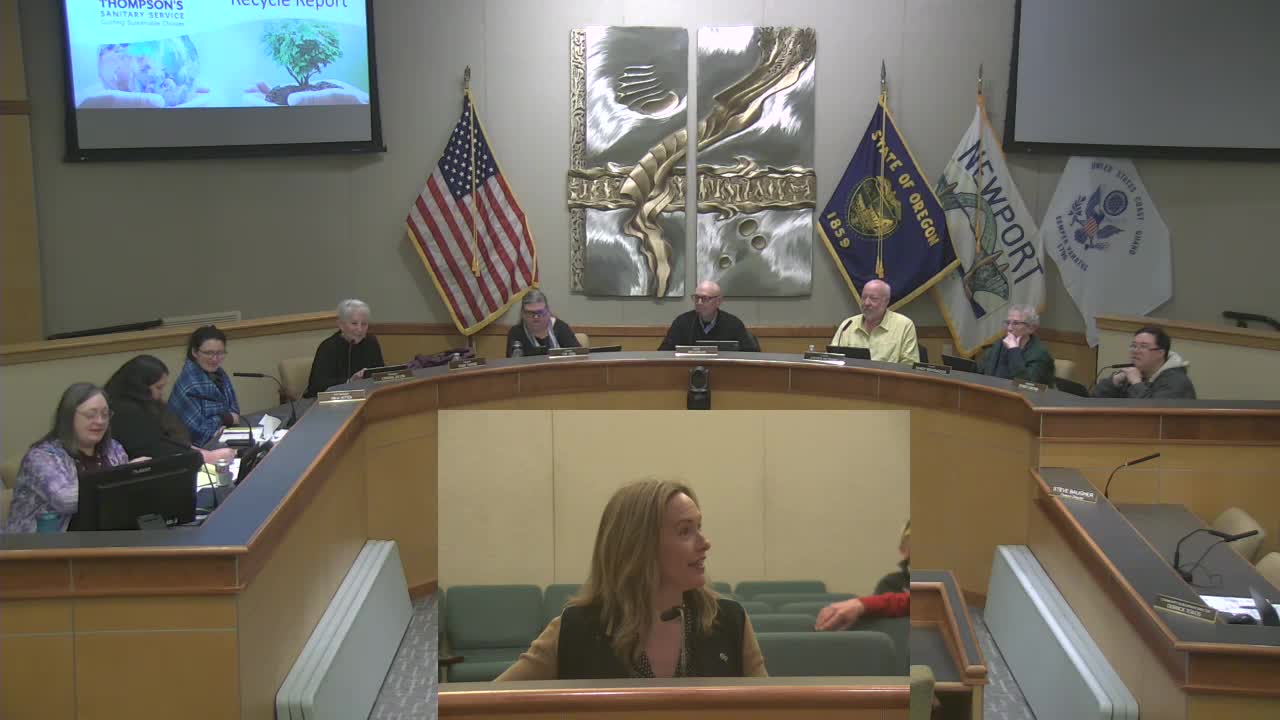
Thompson Sanitary representative Amy Thompson presented the City of Newport’s 2024 Opportunity to Recycle report, describing the city’s recycling, compost and hazardous‑waste services, public education efforts, and event diversion results.
The presentation summarized the materials and channels the sanitation provider uses to inform residents (print brochures, a Spanish translation, quarterly newsletters, a mobile app and social media), lists drop‑off services (glass, motor oil, paint, e‑waste, batteries, tires, appliances) and highlighted outreach events such as a compost giveaway and green‑team service at the Seafood & Wine Festival.
Thompson reported results from festival diversion efforts: in 2024 the green‑team recorded over 9,000 pounds of glass recycling, roughly 740 pounds of food waste and multiple bags of beverage containers diverted to community groups. For the most recent festival she reported 11,720 pounds of glass recycling, 1,700 pounds of food waste, 2,640 pounds of recycling and 23 bottle‑drop bags collected for a local graduation event. Thompson said vendor use of compostable serviceware and a volunteer corps of about 56 people helped raise diversion.
Thompson described a suite of new or expanded services: a dump‑trailer rental program (first dump free for customers), reduced bulky‑item collection prices, ongoing household hazardous waste events run by the county, wind‑latches on carts to reduce spillage, and partnerships with local training programs (Oregon Coast Community College) for CDL training. She also noted the city’s mobile app and said the app supports service alerts, material lookups and online bill pay; the presentation said the app has cumulative installs reported by the provider.
On the state Recycling Modernization Act (passed in 2021), Thompson said implementation will roll out in phases and that some changes will require additional funding and new markets before every new material can be accepted at curbside. Examples of items expected to be phased in are plastic tubs (e.g., yogurt containers) and expanded depot acceptance (expanded food‑service packaging, polystyrene and foam at depots). Thompson said producer‑responsibility funding (extended producer responsibility) will help underwrite market development and depot expansion, and that rural communities will be a focus of staged rollouts.
Council questions focused on multifamily recycling, grease collection for restaurants and funding for expanded services. Thompson said the act includes funding for outreach and that staff are awaiting program guidance on how multifamily generators will be notified and served. She also said grease‑collection services for large generators already exist and may be coordinated through the depot.
Why it matters
The Opportunity to Recycle report is required under state law and details how residents can access recycling and hazardous‑waste services. The Recycling Modernization Act will change what materials are collected, how programs are funded and which depots accept expanded materials; those changes could affect service levels and costs in rural and small coastal cities.
Ending
Councilors thanked Thompson for the report and invited Thompson Sanitary to return when the city prepares ordinances or communications needed to implement elements of the Recycling Modernization Act locally.