Get Full Government Meeting Transcripts, Videos, & Alerts Forever!
Get email alerts on the Public Safety Immigration topic
No spam. Unsubscribe anytime.
Commission ratifies MOU to align county detention with recent state law on immigration detainers
Summary
Miami-Dade commissioners voted to ratify an agreement under 8 U.S.C. §1357 and a recently passed state law requiring written agreements with ICE; opponents urged caution and sought a 180‑day cost and liability report.
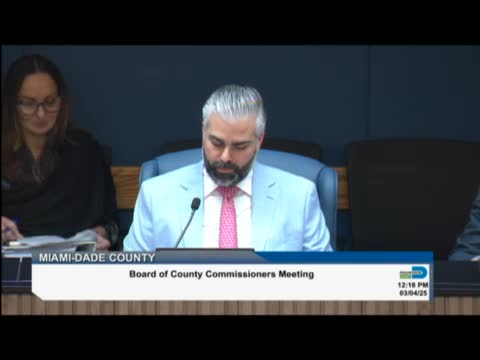
Miami-Dade County commissioners on March 4 ratified a memorandum of understanding that aligns the county’s detention practices with recently enacted state legislation and federal immigration authorities’ 287(g) arrangements, while several commissioners pressed for more information on costs, training and legal risk.
Commissioner [sponsor identified in transcript as Gonzales] introduced the item as a compliance measure following a recent state statute (referred to in the meeting as Senate Bill 2C) that addresses local cooperation with U.S. Immigration and Customs Enforcement. He told the commission the mayor had already signed the agreement and the board’s vote would ratify that action.
Commissioner Danielle Cohen Higgins asked detailed questions about fiscal exposure and training: how much the agreement will cost per day, how many corrections staff have been trained by ICE and whether the county can exit the agreement. Pat Jones Cummings, legal advisor for Corrections and Rehabilitation, said the county had not yet received training numbers and that, under the statutory framework described at the meeting, withdrawal is governed by procedures tied to the new state-level immigration board and the federal statute.
Cummings and county staff said county detention already interacts with ICE detainers in some circumstances and that the recently ratified state law requires the written agreement. Commissioners warned that honoring detainers can extend the time people stay in local custody and that could carry fiscal and legal risks; dissenting commissioners urged a careful, evidence-based approach and requested cost accounting and legal analysis of county liability.
Commissioner Gonzales said the MOU was not new policy but a ratification of ongoing practice: “This is not a controversial item,” he said, noting local practice since 2017. Commissioners who opposed or sought delay said the county should not commit to retroactive financial exposure without a clear program cost and training plan.
After debate, a motion to ratify the MOU was called to question and the commission voted to ratify the agreement. The transcript shows several commissioners asked staff to return with more information and at least one commissioner sought an amendment to require a 180‑day report on cost, training and liability; that amendment was not adopted.