Get Full Government Meeting Transcripts, Videos, & Alerts Forever!
Get email alerts on the Seamless Summer Option topic
No spam. Unsubscribe anytime.
Tennessee Department of Education gives sponsors step-by-step overview of Seamless Summer Option
Summary
State training reviewed eligibility tests, site types, meal-pattern requirements and TMAC application steps for the USDA Seamless Summer Option; the department emphasized HACCP plans, on-site monitoring and census- vs. school-level area eligibility.
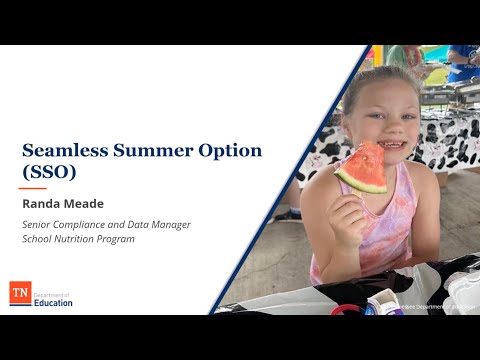
Rhonda Mead, senior compliance and data manager for the Tennessee Department of Education’s School Nutrition Program, led a virtual training session on the Seamless Summer Option (SSO), outlining eligibility tests, site types, meal-pattern requirements and the TMAC application process for sponsors.
Mead described SSO as "a streamlined option for providing summer meals" that continues to follow many National School Lunch Program and School Breakfast Program operational requirements, including meal patterns, meal counts and claims procedures. She emphasized state monitoring priorities and common findings, and said the department will host a follow-up training on rural noncongregate operations on April 1.
The training matters because SSO reimburses meals served to children through existing school nutrition mechanisms; sponsors must ensure sites meet area-eligibility rules, follow federal meal patterns and complete site monitoring and safety plans to receive USDA reimbursement. The Tennessee Department of Education (TDOE) outlined details sponsors must include in their TMAC applications and highlighted recurring compliance problems that can jeopardize reimbursement.
Mead reviewed how sponsors, sites and the state share responsibilities: the state recruits sponsors, provides training and processes claims; sponsors recruit and train sites and submit claims; and sites serve meals and maintain counts and safe environments. "You must keep accurate production records," Mead said, and she noted that Hazard Analysis and Critical Control Point (HACCP) plans "is one of our most common SSO findings," urging sponsors to ensure HACCP plans are in place for every site.
Area eligibility: school data versus census data
Mead explained two ways to establish area eligibility for open, restricted-open and closed-enrolled sites: school-level data and census-block data. Using school-level data, a site qualifies if it is located in the attendance area of a school where at least 50% of enrolled students are eligible for free or reduced-price meals; the specific site address need not itself report 50% eligibility if it lies within that school attendance area. Community Eligibility Provision (CEP) participants must use the site's individual student percentage (ISP) multiplied by 1.6 rather than the group free-claim percentage when determining eligibility.
By contrast, when using census data the exact site address must be in a census block (or a weighted average of up to three adjacent blocks) where at least 50% of children are eligible. Mead noted that any census block used in a weighted average must have at least 40% eligibility. She demonstrated USDA census maps and the No Kid Hungry combined map to show how sponsors can confirm block-level eligibility and obtain the GEO ID fields required in TMAC.
Site types, meal service and TMAC application details
Mead outlined site types and reimbursement rules: open/open-restricted sites serve all children through age 18 on a first-come, first-served basis and must be area eligible; closed-enrolled sites serve an identified group and may qualify by being area eligible or by having at least 50% of enrolled children eligible for free or reduced-price meals. Camps and migrant sites follow separate rules. She said open-restricted sites remain expected to "make meals available to the entire community" even when attendance is limited for safety reasons.
On the TMAC application, sponsors must create a four-character site number (schools should use their school site number when possible; noncongregate site numbers must start with "NC"). Sponsors list a site contact, street address (not a PO box) and the operation start/end dates and the number of operating days per month; the application days must be equal to or greater than the number of operating days reported on claims. Mead reminded sponsors that estimated operating days and meal-claim days must match the claim in TMAC (for example, if a claim shows 15 operating days, a claim cannot be filed later for 16 days).
Meal counting, monitoring and reviews
Mead reiterated that only meals served to children can be claimed for reimbursement and that meal counts must be taken at the point of service. She said sponsors may use existing point-of-sale systems or meal-count forms (tally sheets preferred to handheld clickers, which pose compliance challenges). "Each site must be monitored once during operation," she said, and monitoring must review meal counting, claiming, menu planning and food safety. For administrative reviews, SFAs operating SSO in the summer after their administrative review year will also be reviewed: congregate-only sponsors typically have one site reviewed; sponsors operating noncongregate and congregate modes may have one of each reviewed.
Key meal-pattern reminders
Mead summarized breakfast and lunch requirements that mirror school-year patterns: breakfast components include fruit, fluid milk and grains (meat/meat alternates optional), and no more than half the weekly fruit allowance may be juice. For lunch, sponsors must provide fruit, fluid milk, grains, vegetables and meat/meat alternates and must meet vegetable subgroup weekly requirements. She stressed portion minimums cited in the guidance: for K–8 the vegetable component is 3/4 cup (daily) and for grades 9–12 it is 1 cup. Offer versus serve is optional for SSO; when used, age-group selection rules apply.
Noncongregate, advertising and certification
Mead briefly described the noncongregate option and said the department will provide a deeper training on April 1 focused on rural noncongregate operations. The TMAC application includes noncongregate selectors for rural noncongregate, emergency feeding during unanticipated closures and (historically) excessive-heat waivers; sponsors must select the correct option for their planned service model. Open and restricted-open sites must be advertised to the public and must include the USDA nondiscrimination statement in advertising. The application also requires sponsors to indicate whether meals are prepared at the site or transported from a central kitchen.
Next steps
Mead closed by sharing contact information and promising a follow-up email with the training recording, materials, professional standards information and a survey link. She again noted a separate April 1 session for rural noncongregate operations and said the department will publish the links and materials in a recap.
Ending
The Tennessee Department of Education provided a high-level SSO overview, stressed compliance priorities — HACCP plans, point-of-service meal counts and required on-site monitoring — and walked sponsors through the TMAC site-application fields sponsors must complete to ensure area eligibility and correct claims.