Get Full Government Meeting Transcripts, Videos, & Alerts Forever!
Get email alerts on the Government Oversight topic
No spam. Unsubscribe anytime.
State auditors back bill to codify recommendations, warn committee of limited capacity for added performance audits
Summary
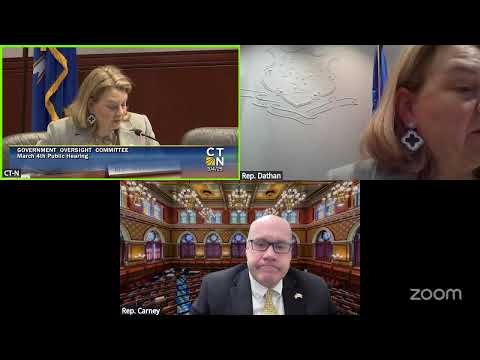
HARTFORD — The state Auditors of Public Accounts told the Government Oversight Committee on March 4 that they support legislation to implement recommendations from their annual reports but cautioned the panel that the office lacks capacity to take on a mandatory program of full performance audits without additional staff or narrower scopes.
HARTFORD — The state Auditors of Public Accounts told the Government Oversight Committee on March 4 that they support legislation to implement recommendations from their annual reports but cautioned the panel that the office lacks capacity to take on a mandatory program of full performance audits without additional staff or narrower scopes.
“Chair, members of the committee, ranking member, Sampson. Good morning. I’m joined here this morning. My name is Craig Miner. I’m the Republican auditor of public accounts, and I’m joined by my Democrat counterpart and longtime associate and friend, John Garagosian,” Craig Miner said as the auditors introduced themselves to the committee.
The auditors’ joint testimony covered four bills on the committee’s agenda: House Bill 7090 (timing and scope of audits), HB 7091 (audits of the Energy Assessment Program for homeowners), HB 7092 (implementing auditors’ recommendations) and Senate Bill 1408 (a study of state agencies’ FOIA response times). Much of the hearing focused on HB 7090 and HB 7092 and on statutory clarifications the auditors say would reduce ambiguity in current practice.
Why it matters: The auditors’ office plays the primary role in reviewing how state agencies use public funds and in following up on prior findings. Committee members said clearer statutory duties and regular audit schedules would help legislative oversight, while auditors warned that stronger mandates without added staff could lengthen audit timelines or reduce depth.
Major points from testimony
- Capacity and staffing: The auditors told the committee the office employs 26 people, including 11 auditors, and that only eight staffers currently perform performance audits. The office said performance examinations require substantially more planning and fieldwork than recurring departmental financial audits and estimated that adding large, new performance audits could require hiring roughly six new employees to meet demand without slowing other work. The auditors estimated the Department of Social Services (DSS) alone consumes about 11,000 hours annually on federal audit work and another roughly 6,000 hours on departmental audit work.
- Scheduling and timelines: HB 7090 would require the auditors to provide an audit schedule to the committee. The auditors said they already produce schedules tied to the fiscal year and asked the committee to move a proposed December 1 deadline to July 1 so schedules align with the state fiscal calendar and known federal audit deadlines.
- Follow-up and agency responses: The auditors recommended requiring agencies to submit follow-up plans and status updates after audits. They proposed that agencies provide a plan for implementation within six months of an audit’s issuance so the legislature and auditors can track corrective action. Committee members asked for clearer reporting on whether recommendations are in progress or completed.
- Statutory clarifications requested in HB 7092: The auditors supported several targeted changes in statute they say will reduce disputes and improve transparency: - Clarify Section 4-40b reporting requirements for settlements or separations at or above $50,000 so the governor and attorney general are asked to opine when a proposed payment or separation resembles a settlement scenario. - Require foundations that benefit from state colleges’ or universities’ employees to reimburse the state when foundation work displaces paid state employment. - Clarify which quasi-public entities must file annual audits with the Office of Policy and Management (OPM) and define the filing deadline relative to each entity’s fiscal year (auditors suggested filings within six months of an entity’s fiscal year end). - Remove a statutory requirement that the state comptroller co-sign the audit of the treasurer’s annual report when the comptroller’s office does not participate in the audit itself; auditors said the current sign-off causes confusion about roles. - Limit language that would allow certain quasi-public oversight boards to contract the auditors’ office to audit those same quasis, which the auditors said presents a conflict with the usual oversight model.
- Use of outside contracted auditors for technical work: The auditors told the committee that in technical areas (for example, lockup facility inspections or specialized energy audits) the auditors’ office may lack subject-matter expertise and that the statute should continue to permit agencies to obtain specialized auditors or to contract the work rather than require the Auditors of Public Accounts to develop every technical capability in-house.
- Quasi-public oversight and energy audits: Committee members asked about HB 7091, which would require an annual review of the energy assessment program administered by the Connecticut Green Bank. Auditors said their routine quasi-public audits follow the statutory checklist in place for quasis (payroll, personnel, affirmative action, expenditures, surplus funds and financial assistance) and do not automatically perform full programmatic performance audits unless specifically authorized or requested. They said a targeted, limited-scope examination of contracts and milestone-based payment controls could be feasible, but a deeper programmatic performance audit would require time and staff.
- Complaint and whistleblower logging: Auditors reported that some agencies do not consistently log complaints, investigations or resolutions, which hinders follow-up. The auditors recommended that agencies that regularly receive substantive complaints adopt a standard intake and tracking process so the auditors and the public can see whether concerns were investigated and resolved.
Committee response and next steps
Committee members thanked the auditors for the detail and pressed for lists of agencies where complaint tracking was weak. Legislators signaled interest in two patterns: (1) clarifying statutes to remove ambiguity about filing deadlines and responsibilities for quasi-public audits and (2) pursuing limited-scope or agreed-upon procedures when the legislature requests follow-up work rather than mandating broad performance audits without additional resources.
No formal votes were taken during the March 4 public hearing. Committee members said they will continue to work with the Auditors of Public Accounts and agency leaders to refine statutory language and to consider whether the legislature should appropriate additional resources if broader performance audit mandates are adopted.
Ending note
Auditors closed by describing an internal technology upgrade: the office is migrating from older auditing software to a SharePoint-based, custom workflow platform intended to improve workpaper management, whistleblower intake tracking and audit workflows. The auditors said they expect phased rollout beginning April 1 for departmental audits and additional modules by the end of the fiscal year.