
Committee lays over compensatory revenue fix; debate over forms, site hold‑harmless and mandate relief
Get AI-powered insights, summaries, and transcripts
Sign Up Free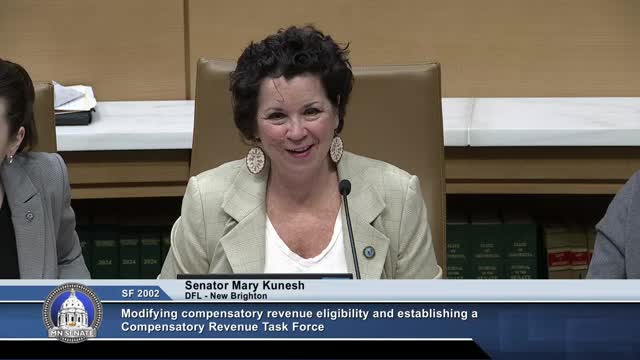
Summary
Senators on March 4 advanced a short‑term fix to Minnesota’s compensatory revenue calculations and discussion continued over broader mandate relief and a longer‑term technical review of the formula.
The Senate Education Finance Committee on March 4 took up Senate File 2002, a multi‑part bill aimed at stabilizing compensatory revenue calculations for fiscal year 2026 and restoring paper meal‑form counts to identify students who generate compensatory funding.
Senator Ann Clark (sponsor) said the bill accomplishes three primary goals: hold districts harmless at the site level for FY26 by using the greater of pupil unit counts from FY2024 or FY2026; increase a district’s flexibility to reallocate up to 40% (from 20%) of compensatory revenue between buildings; and restore paper meal‑application forms in perpetuity to supplement direct certification so that students who need compensatory services are counted. “By identifying through both direct certification and paper forms, we can close the on average 12 to 14% gap that exists now,” Clark said.
Supporters and fiscal context: Matt Shaver, senior policy director at Ed Allies, told the committee compensatory revenue is the state’s main lever for targeting resources to schools serving high‑need students and urged lawmakers to ensure funds generated at a school site are spent principally at that site. Shaver said adding meal forms back into the count would restore identification for students not captured through direct certification and offered alternate technical approaches (for example, scaling direct certification counts) but said the bill’s short‑term fix was supportable.
MDE response and a recommended working group: Sami Rajab, assistant director of government relations at the Minnesota Department of Education, said MDE supports the short‑term fix to use the FY25 definition for FY26 (forms plus direct certification) and the governor’s parallel proposal but recommended the committee retain a working group to analyze compensatory formula changes more thoroughly. Rajab noted changes in direct certification between the pandemic and post‑pandemic years — and possible Medicaid eligibility impacts — need a fuller evaluation before permanent formula changes.
Mandate‑relief amendment failed: Senator Lang offered an A‑3 amendment that would have given districts broader budget and mandate relief for up to three years, including expanded internal fund transfer authority and temporary deltas for several statutory requirements the amendment listed. The amendment prompted substantial debate: supporters said the relief would give districts needed flexibility as they manage budgets and the new compensatory calculations; opponents warned the amendment could roll back recent education reforms and delay interventions such as Read Act implementation. The committee conducted a voice vote; supporters responded “aye” and opponents “no” and the chair announced the amendment did not pass.
Superintendent testimony: Dr. Stevenowski, superintendent of Richfield Public Schools, told the committee that direct certification shifts have caused large year‑to‑year swings in compensatory aid in some districts — in Richfield’s case, changes of roughly $1.7 million in revenue across recent years — and urged both site‑level hold harmless protections and a long‑term formula review to stabilize funding.
Committee action and next steps: The committee accepted the sponsor’s A‑1 amendment to place the bill in the sponsor’s preferred form, declined the broader A‑3 mandate‑relief amendment, and laid Senate File 2002 over as amended for possible inclusion in a future omnibus bill; MDE’s suggestion for a working group to examine longer‑term formula changes remained under discussion.
Why this matters: Compensatory revenue funds are intended to provide additional resources where student needs concentrate. Lawmakers said they wanted short‑term stability for schools while also considering whether longer‑term technical reforms or validation exercises are needed to correct distortions resulting from pandemic‑era counts and changes to direct certification.