Get Full Government Meeting Transcripts, Videos, & Alerts Forever!
Get email alerts on the Department Of Children Youth And Families Overview topic
No spam. Unsubscribe anytime.
New Department of Children, Youth and Families outlines programs, federal funding reliance
Summary
Minnesota's Department of Children, Youth, and Families (DCYF) gave the Senate Education Finance Committee an overview of its programs, transfers from other agencies, and funding makeup — including an estimated 60% reliance on federal dollars and a $27 million federal preschool development grant supporting early childhood coaching and workforce.
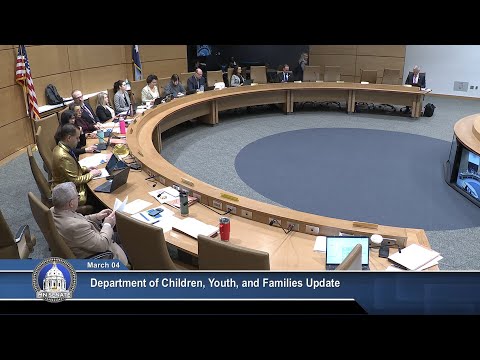
The Minnesota Department of Children, Youth, and Families (DCYF) told the Senate Education Finance Committee on March 4 that the agency, launched July 1, 2024, consolidates numerous early‑childhood programs from multiple state agencies and will rely substantially on federal funding to operate.
DCYF Assistant Commissioner of Early Childhood Diane Halsey said the agency’s vision is to create a “clear front door” to services for children and families and to coordinate funding and programs now housed across the Departments of Education, Human Services, Health and Public Safety. “Young children thrive and develop when their families are also thriving and supported,” Halsey told the committee.
The presentation explained that DCYF now administers programs ranging from voluntary prekindergarten (VPK) and Early Childhood Family Education (ECFE) to Head Start partnerships, child care assistance, and Part C early intervention services under the federal Individuals with Disabilities Education Act (IDEA). Halsey said DCYF’s early childhood administration combines units previously in multiple state agencies to reduce administrative burden and improve coordination of supports delivered in schools, child care and community settings.
Why this matters: Many of the programs DCYF described provide direct services to young children and their families and feed into K‑12 readiness measures and special education referrals. The committee was also told that a large share of the department’s budget comes from federal sources, a point lawmakers flagged as a fiscal risk.
Key program and funding details described to the committee: - Voluntary prekindergarten (VPK): Minnesota’s VPK program funds a fixed number of seats statewide (12,360 seats after the 2023 Legislature increase). The program funds up to 0.6 average daily membership (60% of a full day) per funded seat and is not universal; eligibility includes factors such as free or reduced‑price meals, English‑learner status, recent homelessness and foster care status. Halsey noted a teacher licensure change for school‑based early learning programs will go into effect in 2028. - School readiness: A fixed annual appropriation “just under $34,000,000” supports 3‑ and 4‑year‑olds in school‑based programming. Many districts receive less than $50,000 per year from this line, which Halsey said makes meeting quality indicators (for example, a 1:10 teacher ratio supervised by licensed staff) difficult without additional local or scholarship funds. - ECFE (Early Childhood Family Education): Nearly all districts (324 of 327) operate ECFE programs; ECFE is designed to teach parents/caregivers how to support early learning and requires district community needs assessments. - Part C (IDEA early intervention): Halsey described Minnesota as a “birth mandate” state for Part C with services delivered through local school districts. With DCYF’s creation, programmatic interagency responsibility shifted to DCYF while MDE (the Department of Education) retains fiscal and monitoring duties; Help Me Grow remains the statewide referral system. - Screening and grants: DCYF described the state’s early childhood health and development screening reimbursement (tiered to encourage screening younger children), a current $500,000/year general‑fund grant to align early childhood curriculum at higher‑education institutions administered by the Office of Higher Education with DCYF support, and a $27,000,000 federal Preschool Development Grant (PDG B‑5) available 2024–2027 to support mixed‑delivery systems, coaching, and entry pathways into the early‑education workforce.
On federal funding risk: When committee chair asked how much of DCYF’s budget is federal, Halsey said, “the number that I have heard is that we have about 60% of our funding is federal at DCYF.” When pressed about contingency planning if federal dollars were reduced, Halsey said agency staff were still analyzing precise impacts but acknowledged any significant loss of federal funding would “have tremendous impact on the children and families in Minnesota.” She also said DCYF was monitoring federal communications closely.
Committee staff and fiscal analysts also briefed the committee on how appropriations that formerly flowed through the Department of Education will be divided between the Education Finance Committee and the Health and Human Services Committee now that programs have moved. Jenna Hoffer of Senate nonpartisan fiscal analysis described a spreadsheet in committee materials showing program appropriations and noted statute and funding formulas guided many of the jurisdictional divisions; some line items (for example certain K‑12 payment flows and levy components) will remain in Education Finance and flow through MDE systems.
The department’s presentation prompted questions about staffing and meeting federally required timelines for referrals, especially for early intervention (Part C) services, and about the need to coordinate supports between schools, child care, Head Start and families. Halsey and committee members also discussed that some programs (for example, an after‑school community grant) will transfer to DCYF only if additional funding is appropriated.
What’s next: DCYF officials said they are available for follow‑up with the committee as programs continue transferring and as the agency refines fiscal projections. Committee members asked for more detailed federal/local funding breakdowns during future briefings.