Get Full Government Meeting Transcripts, Videos, & Alerts Forever!
Get email alerts on the Overdose Prevention topic
No spam. Unsubscribe anytime.
Senate approves measure requiring opioid antagonists at public college residential facilities
Summary
The committee passed Senate File 164 to require Minnesota State and University of Minnesota residential facilities to maintain at least two doses of a nasal opioid antagonist (naloxone) on site; sponsors and testifiers said the change would expand overdose response capacity on campuses.
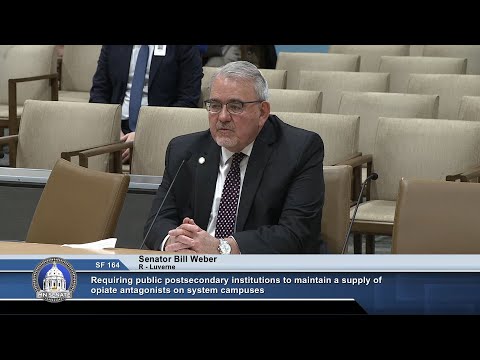
Senator Weber introduced Senate File 164, asking the Health and Human Services Finance and Policy Committee to require Minnesota’s public postsecondary institutions to keep opioid antagonists on site and provide at least two doses of a nasal antagonist at each campus residential facility.
Weber said the bill responds to rising fentanyl use and overdose risk among college‑age students and that the measure is intended to reduce preventable deaths by making naloxone widely available in residence halls. Will Rops, testifying by Zoom, described losing his brother to a fentanyl overdose and urged lawmakers to “save lives” by ensuring campus access to naloxone. “By choosing not to keep naloxone in residence halls, we’re basically subjecting students to unjustifiable death sentences,” he said.
Elena Dahlquist of the National Safety Council also testified in support, saying naloxone is safe, effective and now available over the counter and that workplaces and campuses should include opioid antagonists in emergency response plans.
Senators expressed bipartisan support. Senator Abler and others characterized implementation costs as small, with Abler suggesting the physical installation costs (“hang up the box”) should not drive the fiscal note. The committee adopted a voice vote: Senator Abler moved that Senate File 164 be recommended to pass and be referred to the Committee on Higher Education; the motion prevailed and the bill was passed out of the committee and referred to Higher Education.
The committee record shows the bill was passed and referred; the hearing record does not include a roll‑call tally, only a voice vote.