
Nevada disability adjudication office seeks federal-funded staff to reduce backlog
Get AI-powered insights, summaries, and transcripts
Sign Up Free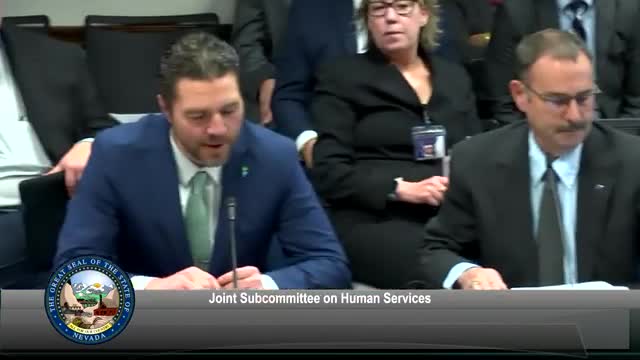
Summary
The Bureau of Disability Adjudication requested dozens of federally funded positions to handle rising workloads and shrink a backlog of disability benefit claims; legislators pressed officials about hiring authority from the Social Security Administration and reliance on contractors for medical exams.
The Bureau of Disability Adjudication, part of Nevada's Department of Employment, Training and Rehabilitation, requested additional federally funded staff Thursday as officials said the unit needs more adjudicators and support personnel to maintain improved processing times and respond to potential surges in claims.
The bureau asked the Joint Subcommittee on Human Services for decision units that together would add front-line adjudicators, supervisors and support staff. For the biennium officials said the bureau's total request for its account is roughly $60 million and that the agency currently counts about 145 full-time equivalent positions in its base budget. The bureau described a package of enhancement decision units that includes E305 — about $2.4 million for 15 positions including 10 disability adjudicators and 2 supervisors — and related support positions in other decision units that together are intended to handle increased volumes and reduce aged claims.
Why it matters: Nevada's disability adjudication unit makes medical-administrative determinations for Social Security Disability Insurance and Supplemental Security Income. Officials told lawmakers that long processing times and a national backlog at the Social Security Administration (SSA) have driven requests for staffing increases; adding adjudicators and support staff is the bureau’s principal strategy to keep Nevada’s processing times below national averages and to be ready when federal hiring authority is available.
Officials gave details and constraints. Jana Vaughn, deputy administrator for the Bureau of Disability Adjudication, said the unit is “about 91% fully staffed at this time” but that hiring depends on periodic “hiring authority” from the SSA. Drosnal (identified in the transcript as Drosnal) explained that even after the Legislature authorizes positions the bureau cannot immediately hire until SSA grants hiring authority; that authority has varied year to year and has been unavailable in the most recent federal fiscal year. Jocelyn Ellis, administrator of the Rehabilitation Division, said SSA provided a letter of support for the staffing request but has not issued an unconditional instruction to Nevada to add the positions.
Lawmakers pressed for specifics on how requested staffing would affect backlog and processing time. Vaughn said BDA’s historical backlog has fluctuated — at times up to 4,000 pending claimants — and that the bureau is currently “about 1,200” pending. She said an adjudicator typically takes about 70 to 80 days on average to reach a decision once a claim is assigned to an adjudicator. Committee members cited national processing benchmarks shown on the bureau’s slides: the nation's average processing time was about 232 days for the cited period while Nevada’s was about 166 days.
On contractor use and medical staff: the bureau proposed eliminating five existing state FTEs (two licensed psychologists and three senior physicians) in enhanced unit E600, citing that Nevada has not received hiring authority from SSA in recent years and instead uses contracted medical consultants. Vaughn said contractors are used to perform medical and psychological examinations while the hiring authority situation remains uncertain.
Training and support functions: officials said they also are seeking two training officers (E308) to provide dedicated initial and continuing training for adjudicators, and additional administrative, IT and call-center support positions tied to the 10 adjudicators requested in E305. Vaughn explained that adjudication training is complex and that supervisors currently provide training in addition to managing caseloads.
What legislators asked: members sought assurance the positions are federally funded and asked whether SSA’s recent reorganization and layoffs will affect Nevada’s program. Vaughn said recent SSA reorganization did not, at the time of the hearing, change the bureau’s staffing approvals. Senators also asked whether Nevada had relied on out-of-state help; Vaughn said Nevada previously received assistance but had not needed it for the current federal fiscal year because Nevada’s productivity had improved.
Data and numbers cited at the hearing include: a roughly $60 million biennial request for BDA, about 145 FTE in the base, E305 ~ $2.4 million for 15 FTE (including 10 adjudicators), E307 roughly $1.5 million for 11 FTE (support positions), E308 roughly $350,000 for 2 training officers, and an enhanced unit E600 showing an approximate saving of $2.5 million from eliminating five medical FTE and continuing use of contractors (all figures as presented by the bureau). The office emphasized that all requested positions tied to adjudication are 100% federally funded by the Social Security Administration.
Ending: Bureau leaders said the requested staffing would position the office to keep reducing aged claims and to be ready to hire quickly when SSA authorizes hiring. They also cautioned that timing depends on federal hiring allocations and that, until Nevada receives authorization, contracted medical consultants will continue to perform examinations and evaluations.