Get Full Government Meeting Transcripts, Videos, & Alerts Forever!
Get email alerts on the Transportation Funding topic
No spam. Unsubscribe anytime.
California lawmakers warned of looming transportation funding shortfall as fuel-tax revenues fall
Summary
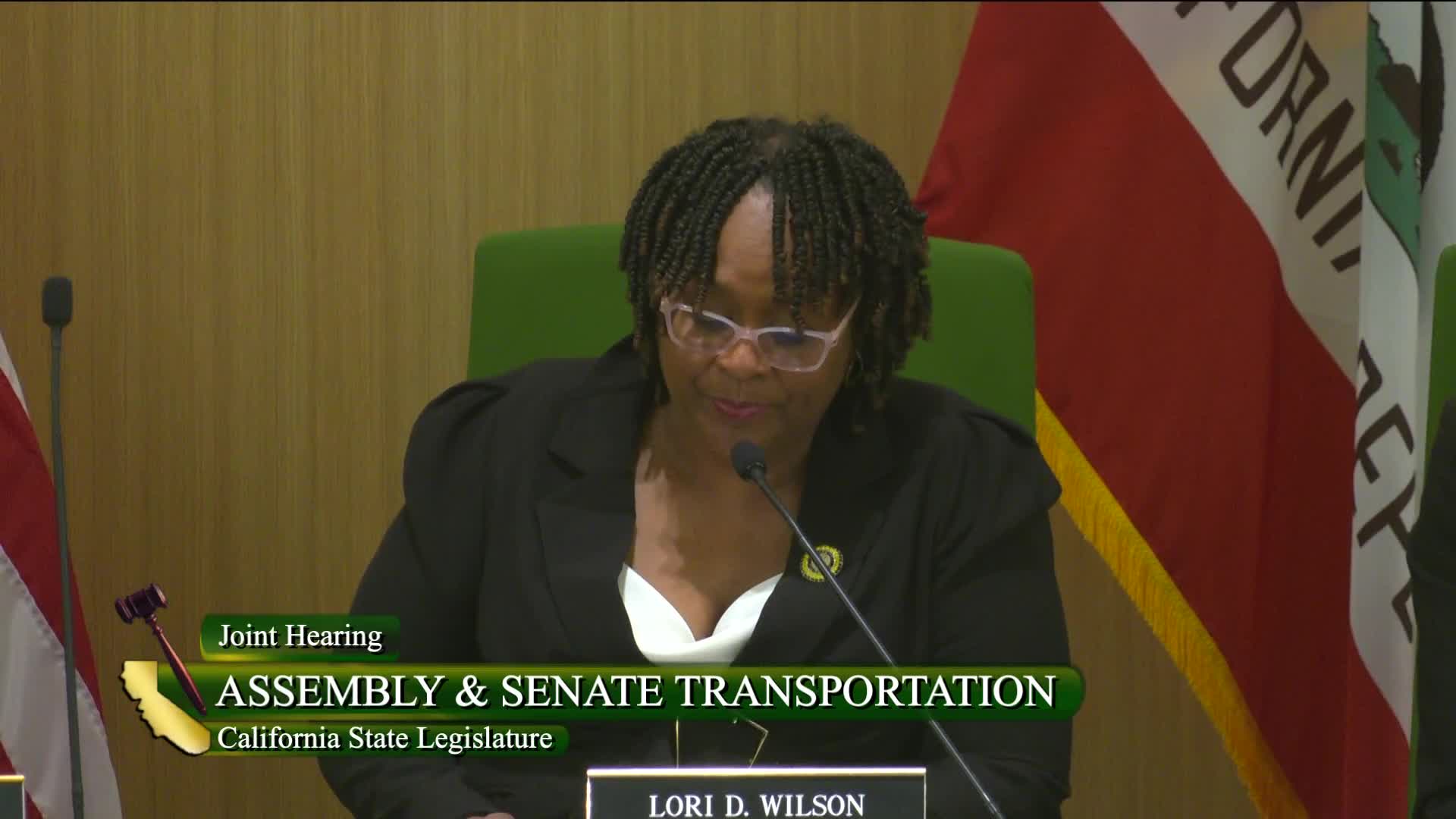
At a joint informational hearing of the Assembly transportation committee, analysts and transportation officials said California faces a substantial, multiyear shortfall in funding for roads, bridges and transit because revenues tied to burning fuel are falling as vehicles become more fuel efficient and zero‑emission vehicles increase in the fleet.
At a joint informational hearing of the Assembly transportation committee, analysts and transportation officials said California faces a substantial, multiyear shortfall in funding for roads, bridges and transit because revenues tied to burning fuel are falling as vehicles become more fuel efficient and zero‑emission vehicles (ZEVs) increase in the fleet.
The hearing, convened by committee leadership, included presentations from Frank Jimenez of the Legislative Analyst’s Office (LAO); Brian D. Taylor, professor at the UCLA Institute of Transportation Studies; Asha Weinstein Agrawal of the Mineta Transportation Institute; Tanisha Taylor, executive director of the California Transportation Commission (CTC); and regional representatives including James Corless of the Sacramento Area Council of Governments (SACOG).
Why it matters: transportation funding supports state highways, local streets and roads, and transit systems. Several witnesses said the current package of fuel taxes and vehicle fees—augmented after Senate Bill 1 (SB 1) in 2017—is eroding because it ties revenue to gallons of fuel sold. A shift toward ZEVs and greater vehicle fuel efficiency reduces the fuel tax base and, absent new revenue, will mean less money for core maintenance and safety programs.
What the witnesses said
Frank Jimenez, legislative analyst, summarized how California finances transportation: federal, state and local sources together funded roughly $44 billion in 2023; state fuel taxes and vehicle fees were estimated to generate about $14.4 billion in 2024–25. Jimenez detailed the largest state sources: the gasoline excise tax (about $7.9 billion in 2024–25), the Transportation Improvement Fee (TIF, about $2.4 billion) and smaller amounts from the Road Improvement Fee (RIF) charged on ZEVs and other levies. He noted the state also uses continuous appropriations from the Greenhouse Gas Reduction Fund (GGRF) and has provided multiyear general‑fund augmentations in recent budgets.
Asha Weinstein Agrawal of San José State’s Mineta Transportation Institute presented a scenario analysis through 2040 showing that, under a range of plausible futures, combined revenues tied to fuel and current vehicle fees decline in real dollars. “All the lines go down,” she said, describing eight scenarios that vary vehicle miles traveled and the pace of ZEV adoption; in the most extreme scenarios state annual revenue from these sources could fall from roughly $13 billion to about $5 billion by 2040.
Brian D. Taylor of UCLA urged policymakers to recognize tradeoffs between revenue, fairness and behavior. “The transportation needs and raising revenues, charging fairly, and influencing behavior are all linked together,” Taylor said, arguing that some revenue designs (for example, a road‑usage charge) preserve the link between who uses roads and who pays, while other approaches (such as broad sales taxes) break that connection and can increase system needs.
Tanisha Taylor, executive director of the California Transportation Commission, described how declining gas‑tax revenues will affect CTC programs. The commission allocates nearly $8 billion per year through programs that include the State Transportation Improvement Program (STIP), the Senate Bill 1 Local Streets and Roads program (about $1.2 billion per year distributed to cities and counties), and the State Highway Operation and Protection Program (SHOP). She warned that continued declines would reduce funding for large maintenance programs and could reverse progress made since SB 1; the CTC’s draft 2025 needs assessment estimates roughly $758 billion in 10‑year needs for the state and local transportation system and about $541 billion in available revenues, yielding a projected 10‑year shortfall of about $217 billion.
Regional officials highlighted local impacts. James Corless, executive director of SACOG, said regional plans count on state fuel‑tax revenues for roughly one‑third of the Greater Sacramento long‑range plan; without new state action, regions face program cuts, reduced transit operations and deferred maintenance.
Options and near‑term choices
Speakers and public commenters outlined a menu of policy choices without recommending a single path. Options discussed include: raising existing fuel taxes; increasing registration or per‑vehicle fees (the RIF for ZEVs and the TIF for all light vehicles are already part of the mix); indexing rates; adding fees on electric‑vehicle charging or hydrogen (technical and fairness challenges were noted); and adopting a road‑user or mileage‑based charge. Many panelists said a two‑track approach—short‑term revenue steps plus a long‑term transition to a usage‑based system—merits consideration. The LAO urged the legislature to weigh priorities and whether to rely on the general fund, new user charges, or program cuts.
Equity and design concerns
Panelists repeatedly emphasized equity and implementation issues. A flat annual fee on ZEVs (the existing RIF) can be regressive for low‑income drivers and does not align payments with miles driven. A road‑usage charge preserves a user‑pays principle but raises technical, privacy and rural‑equity questions; many witnesses urged pilots, means‑tested discounts or exemptions for long rural commutes, and staged implementation. Speakers also noted administrative limits: most residential EV charging occurs at home, making collection of charging‑based fees technically and politically difficult.
Public‑commenters from construction, labor and goods‑movement groups urged protecting investments in goods‑movement corridors and local maintenance; tribal representatives raised concerns about how replacing a state gas tax with mileage fees could affect tribal taxation and revenues from fuel sales.
What was not decided
The hearing was informational; committee chairs and panelists said no formal policy or vote occurred. Several witnesses said the legislature and state agencies should continue scenario modelling, pilot projects and oversight to design equitable, durable revenue mechanisms.
Ending
Committee leaders closed by saying the hearing was the start of a series of briefings and policy conversations. Many panelists urged early legislative work to avoid a prolonged decline in available dollars.