Get Full Government Meeting Transcripts, Videos, & Alerts Forever!
Get email alerts on the Healthcare Affordability topic
No spam. Unsubscribe anytime.
Office of Healthcare Affordability sets a 3.5% statewide spending growth target; hospitals contest proposed tighter hospital sector targets
Summary
The Office of Health Care Affordability told lawmakers it has set a five‑year statewide health‑spending growth target beginning at 3.5% in 2025, and proposed a hospital sector targeting method to identify disproportionately high‑cost hospitals for lower growth targets; hospitals and public systems warned the proposal could threaten access and investment if not adjusted for unavoidable local costs.
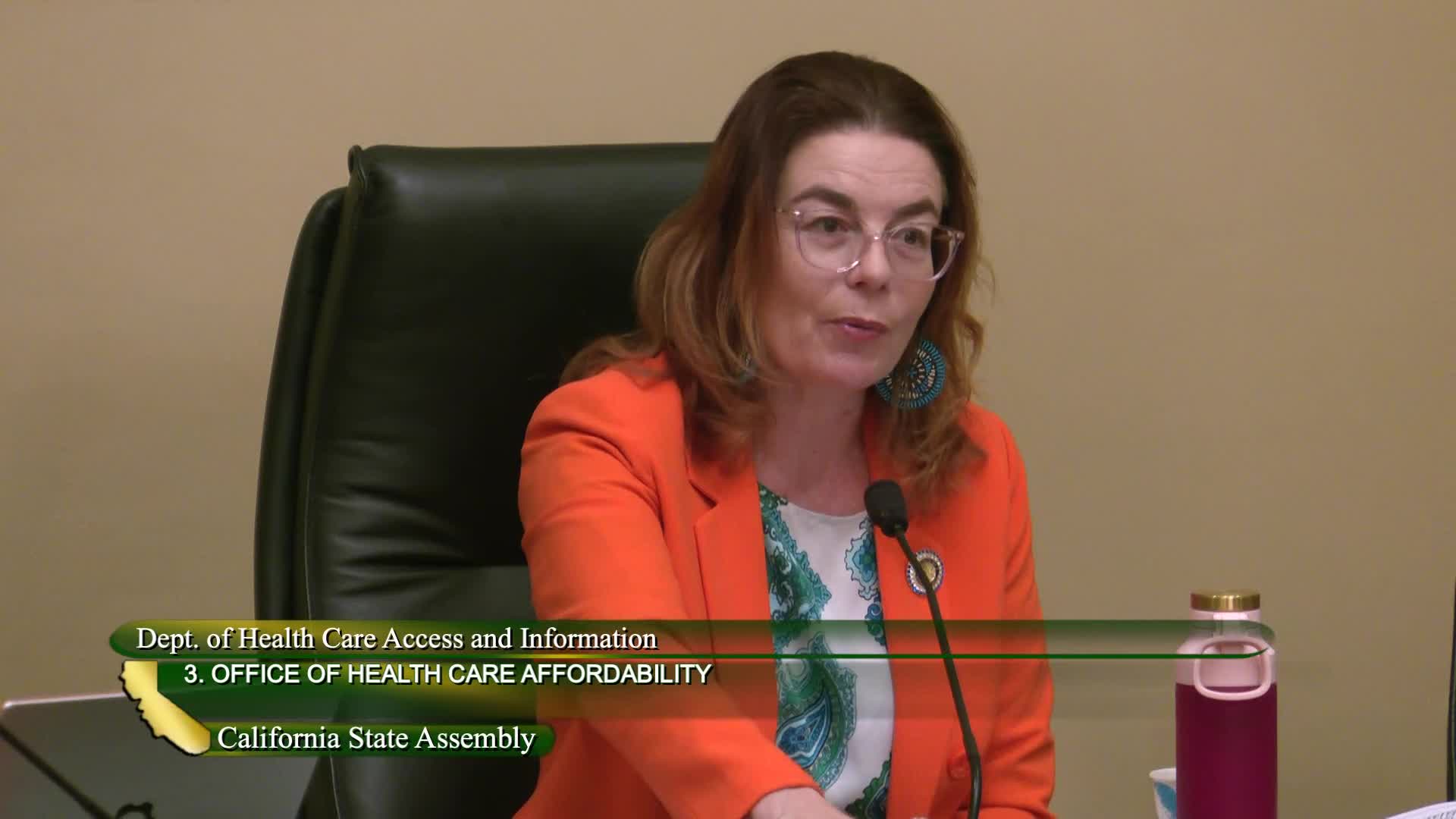
The Office of Health Care Affordability (OCA), operating within the Department of Health Care Access and Information, briefed the Assembly Budget Subcommittee No. 1 on Health on its first statewide spending growth target and a hospital sector‑target methodology intended to address widely varying hospital prices.
OCA staff told the committee the Health Care Affordability Board in April adopted a five‑year statewide spending growth target that starts at 3.5% in 2025 and declines to 3.0% by 2029. "The target for this year is 3.5%, and then it goes down progressively to 3%, by 2029," OCA staff said during the hearing. The target measures annual per‑capita total health‑care spending growth — the combined payments to health plans, providers and for medications — and is tied to household income growth to ensure limits are commensurate with the ability of families to pay.
OCA also presented a hospital sector methodology to identify disproportionately high‑cost hospitals using measures such as net patient revenue per case‑mix adjusted unit and a commercial‑to‑Medicare payment ratio. The office proposed lower growth targets for the identified high‑cost hospitals; in committee questions OCA staff described a proposed target formula that in some cases would yield a target near 1.8% for those facilities.
OCA staff emphasized the board’s intention is to moderate spending growth rather than set price caps, and said the office will adopt equity and quality guardrails to avoid a “race to the bottom.” "What we don't want is a race to the bottom," one OCA official said, noting the office is developing companion equity and quality measures and a primary‑care spending benchmark (targeting 15% of health dollars to primary and preventive care by 2034).
The timeline stressed by OCA: 2025 is treated as a baseline year (non‑enforceable); 2026 is the first year with an enforceable target; the office will not have complete 2026 data until September 2027; a progressive four‑step enforcement regime would begin only after data reviews and performance‑improvement plan steps, and penalties would be considered only for entities that fail to comply with an agreed improvement plan. OCA officials told members that this temporal sequencing means penalties would likely not be imposed until 2028 at the earliest.
The proposal prompted immediate pushback. Representatives of the California Hospital Association, public hospital systems, academic medical centers and dozens of hospital operators warned that the proposed targets — particularly the narrower hospital sector target and the identification of certain high‑cost hospitals — risk undermining access, harming workforce stability and forcing cutbacks in capital investments. Mark Farouk of the California Hospital Association said the target is "unrealistic" and raised concerns the office moved toward a hospital sector target before completing impact analysis. Public hospital systems and university medical centers noted that government hospitals and academic centers carry disproportionate shares of complex, high‑cost clinical work and uncompensated care that the methodology may not fully capture.
Labor and consumer advocates strongly supported the OCA’s mission to curb spending growth. Unions and consumer groups told the committee that hospital prices are a major driver of unaffordability for families and that oversight is needed to reduce premium growth and medical debt.
Committee members asked detailed questions about the hospital list and methodology, how unavoidable cost drivers (such as inflation, wage increases, investments in technology or state mandates such as seismic compliance) would be reflected in the back‑end review, and what time frames would be allowed for performance improvement plans. OCA officials said the office will evaluate allowable exceptions and that workforce stability and quality measures will factor into back‑end analyses.
Why this matters: hospitals account for roughly 40 percent of health‑care spending and have wide variation in commercial prices. The office’s targets are intended to slow spending growth statewide and, if successful, to put downward pressure on premiums and out‑of‑pocket costs over time. But stakeholders emphasized the need for careful calibration to avoid unintended effects on access, quality and workforce retention.
What comes next: OCA will publish a baseline report and continue stakeholder engagement. Entities identified as exceeding targets will enter a data review and performance‑improvement planning process before any monetary penalties are considered. The committee asked OCA and HCAI for follow‑up briefings and for more hospital‑level dialogue; several members urged OCA staff to visit hospitals on the proposed high‑cost list before finalizing targets.
Ending note: OCA described the targets as a long‑run structural reform that will be implemented gradually; opponents urged more analysis and safeguards to ensure services for vulnerable patients and investments in complex care are not jeopardized.