Get Full Government Meeting Transcripts, Videos, & Alerts Forever!
Get email alerts on the Public Safety topic
No spam. Unsubscribe anytime.
WMATA says serious incidents down, points to expanded police academy and crisis intervention teams
Summary
WMATA reported a year‑over‑year reduction in serious incidents, said it opened an internal police training academy and has added crisis intervention teams and special police officers; the authority said the changes aim to boost visible presence and safety across the system.
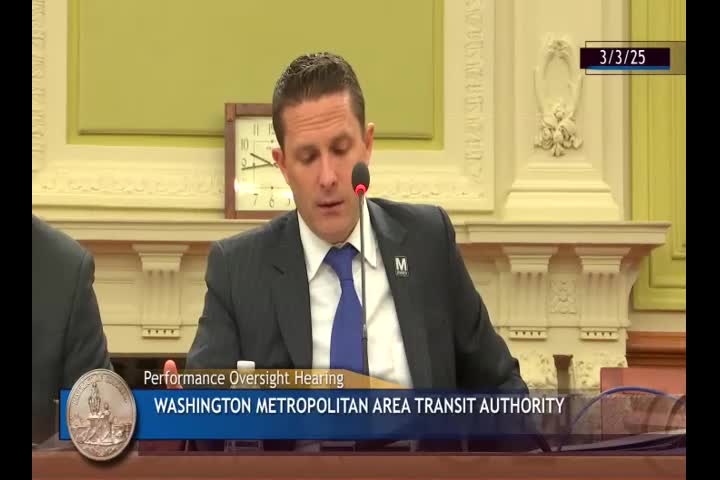
WMATA briefed the committee on public‑safety trends and staffing on March 3, saying serious incidents have fallen and that the authority has increased recruiting and training for transit police and crisis intervention teams.
General Manager Randy Clark told the committee that calendar year 2024 serious incidents were down roughly 40% year‑over‑year and that early 2025 data indicate the lowest levels in seven years for some safety metrics. He credited a combination of police, crisis intervention teams and technology (video and telematics) for part of that trend.
WMATA also told the committee it has established its own Metro Police Training Academy to shorten and centralize officer training for the agency's three‑jurisdiction force, and that a recent collective bargaining agreement and a special post‑retirement program (DROP) have helped retention. WMATA said it has increased hiring and that the Chief of Transit Police is focused on continuing to grow headcount by several dozen officers over the next two years.
Crisis intervention and visibility
- Crisis intervention: WMATA said it now deploys crisis intervention specialists and non‑uniformed teams on the system to connect riders in crisis to social services; the authority said the program is complementary to uniformed police presence.
- Body‑worn cameras and video: WMATA told the committee that nearly every public interaction is recorded either via onboard cameras or officer body cameras and that the new control center integrates video and telematics to speed response.
Why this matters: Public safety perception drives ridership. The committee pressed WMATA to balance visible enforcement with protections for riders' rights and to maintain transparent complaint and review mechanisms.
Key followups requested by the committee
- WMATA to return on headcount numbers and the pace of hires for transit police and crisis staff.
- WMATA and the committee discussed oversight mechanisms including internal affairs, body‑worn camera policies, and public complaint channels to prevent excessive force or inappropriate enforcement.
Ending
WMATA emphasized the combination of uniformed presence, crisis intervention teams and technology as its safety strategy and promised additional follow‑up on hiring, training and oversight metrics for police and crisis staff.