Get Full Government Meeting Transcripts, Videos, & Alerts Forever!
Get email alerts on the Physician Workforce topic
No spam. Unsubscribe anytime.
UC and HCAI warn residency funding is strained as Proposition 56 revenues fall
Summary
University of California and HCAI officials told lawmakers that state graduate medical education funding has expanded residency positions but funding sources are shrinking, leaving existing residency programs at risk and impeding new program development in shortage areas.
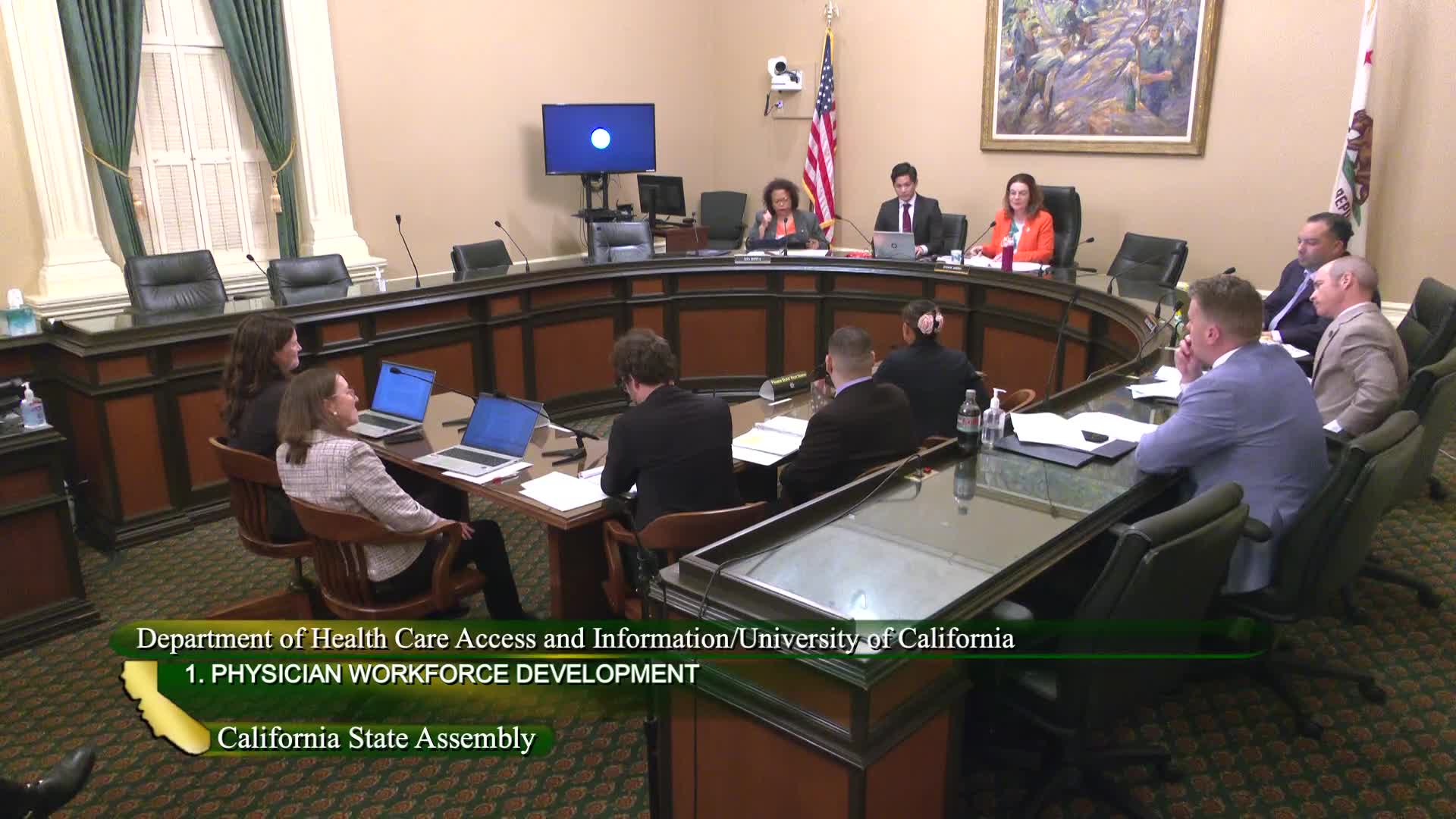
University of California and Department of Health Care Access and Information leaders briefed the Assembly Budget Subcommittee No. 1 on Health about California’s physician workforce programs and the financial pressures facing graduate medical education (GME).
Dina McCrae, associate vice president for academic health sciences at the University of California Office of the President, said California has expanded residency capacity in recent years — noting roughly a 60 percent increase in residents in the past decade and more than 1,300 CalMedforce positions supported by Proposition 56 and related state funds since 2018. "Since 2018, CalMedForce has awarded more than $255,000,000 to support 1,366 resident positions in 180 residency programs," McCrae said.
But McCrae and HCAI staff warned funds are tightening. McCrae told the committee Proposition 56 revenues have declined, and the annual award pool that had averaged about $38 million in prior cycles fell to roughly $25 million for academic year 2024–25. "This current year, 24 to 25, the award funds were substantially reduced to approximately $25,000,000," she said. That drop, she and HCAI officials said, threatens existing residency programs — particularly in rural and underserved areas — and makes creating new programs more difficult.
HCAI Director Elizabeth Landsberg described the Song Brown Primary Care Residency Program, the state’s long‑running primary care GME program, and recent activity: from 2017–2024, Song Brown supported 1,603 existing slots and created 436 new primary care residency slots; HCAI funded 29 new family medicine programs from 2019–2024 and currently funds predominantly programs that train residents in shortage areas. Libby Abbott, HCAI’s workforce deputy, said 100 percent of the awards in the last two fiscal years went to programs in federally designated health‑workforce shortage areas.
Committee and LAO staff asked about oversight and outcomes. Jason Constanturos of the Legislative Analyst’s Office suggested refining outcome metrics and considering long‑term allocations carefully given limited ongoing general fund capacity. He noted that Proposition 35 (the MCO tax measure enacted recently) provides funding for new residency and fellowship positions, but that different programs have overlapping objectives and the Legislature should review coordination and efficiency.
Why this matters: physician distribution and retention determine access to primary care in regions that remain underserved — in particular the Inland Empire, San Joaquin Valley and Northern rural California. McCrae cited retention figures showing 78.5 percent of physicians who complete training in California remain in the state, and higher retention when graduates complete both medical school and residency in California.
What comes next: witnesses urged the Legislature to prioritize sustained, flexible funding that stabilizes existing residency programs while supporting targeted growth in shortage areas. LAO and HCAI offered to help develop outcome metrics to judge program impact and guide future allocations.
Ending note: officials emphasized that training more physicians is necessary but not sufficient; retention depends on pipeline programs, loan repayment, clinical training sites and stable reimbursement policies that affect both health systems and graduate medical education funding.