Get Full Government Meeting Transcripts, Videos, & Alerts Forever!
Get email alerts on the Distressed Hospitals topic
No spam. Unsubscribe anytime.
State treasury, HCAI describe stopgap financing and loan modifications for distressed hospitals
Summary
California State Treasurer Fiona Ma and officials from the Department of Health Care Access and Information said the state has deployed loans, grants and tax‑exempt bond financing to support financially distressed hospitals, but many facilities remain in fragile condition despite assistance.
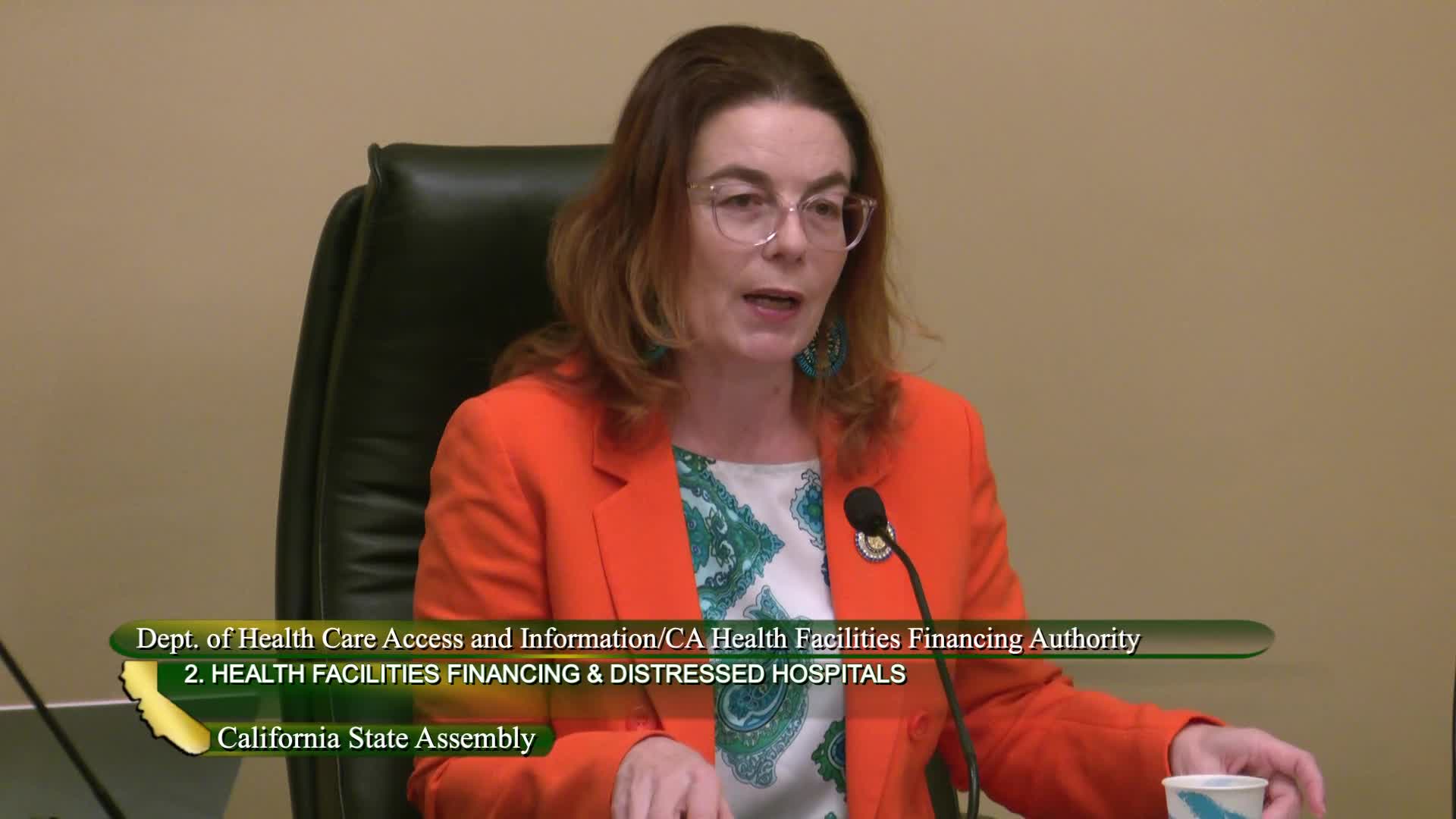
California State Treasurer Fiona Ma and officials from the Department of Health Care Access and Information (HCAI) told the Assembly Budget Subcommittee No. 1 on Health that the state has delivered a complex mix of loans, grants and tax‑exempt bond financing to help hospitals facing financial distress, but that significant gaps remain.
At the hearing Treasurer Fiona Ma described a multi‑pronged state response that included $300 million set aside by the governor and Legislature for a Distressed Hospital Loan Program (DHLP), short‑term low‑interest loans, zero‑interest fire relief loans for facilities damaged in recent wildfires, and multiple bond financing and grant programs administered by the California Health Facilities Financing Authority (CHFFA). "Compared to 8%, we're offering these loans for about 2 to 3%," Ma said, explaining the competitive advantage of the state's loan terms. She added that the administration rolled out 16 different programs to support troubled hospitals.
HCAI Director Elizabeth Landsberg told the committee the DHLP used $300 million (split roughly equally between general fund and MCO tax proceeds) to provide working capital for hospitals implementing turnaround plans. Two hospitals that received DHLP assistance — Madera Community Hospital and Hazel Hawkins — have exited bankruptcy, and none of the other DHLP participants have filed for bankruptcy or closed since receiving help, Landsberg said. But she added that most DHLP hospitals continue to show negative or declining financial metrics and that turnaround plans have frequently been delayed or modified.
To give struggling hospitals more time, HCAI and CHFFA released a DHLP loan modification application in January. "The loan modification program gives hospitals more time to implement their financial turnaround plans and every opportunity to repay their loans," Landsberg said. As of the hearing three hospitals had applied for loan modification.
HCAI and CHFFA staff identified recurring drivers of hospital distress: thin or negative operating margins, dependence on nonoperating revenue streams such as quality assurance fees and intergovernmental transfers (which can require upfront matching funds), cost overruns or delays on capital projects, workforce shortages, and the need to invest in technology. HCAI and CHFFA noted that hospitals with stable clinical workforce pipelines, such as those with residency programs or nursing schools, tend to fare better in turnarounds; conversely, management turnover is a frequent cause of delay.
Carolyn Abubachara, executive director at CHFFA, briefed members on the financing side and said CHFFA issued about $2.4 billion in bond transactions in 2024 to roughly nine health facilities across a range of provider types. She described CHFFA as a "one‑stop shop" for loans, bonds and grants for a spectrum of facilities, from mental‑health and developmental‑disability centers to hospitals.
Public commenters representing district and municipal hospitals and hospital associations thanked the Legislature and the administration for programs that ‘‘came at a critical time’’ but emphasized continuing vulnerability. Connie Delgado of the District Hospital Leadership Forum said 30 percent of district hospitals received DHLP loans and remain on a long road to recovery. Mark Farouk of the California Hospital Association echoed appreciation but warned many hospitals still face unsustainable conditions.
The committee asked whether hospitals could qualify for loan forgiveness. Landsberg described a structured approach: hospitals first must seek loan modification (usually a 12‑month extension), and if still not viable they may return to request further modifications; only after demonstrating inability to recover would the administration consider forgiveness, using financial indicators such as days cash on hand, debt service coverage ratio, and current ratio.
Treasury and HCAI officials also outlined special programs: a zero‑percent interest loan program for facilities damaged or destroyed in recent fires, and continuing work on children’s hospital loans funded by past voter bonds. CHFFA and HCAI said they are coordinating technical assistance, including structural engineering support for seismic compliance grants aimed at small and rural hospitals, and are engaged in outreach — a recent webinar drew more than 150 attendees.
Why this matters: hospitals provide critical access to inpatient and emergency care across California. State loan and grant programs are designed to prevent closures, but hearing testimony signaled that underlying structural problems — payer mix, workforce shortages, capital needs and dependence on intergovernmental transfers — are not resolved by short‑term cash infusions alone. Committee members and hospital representatives said ongoing monitoring, technical assistance and flexibility in repayment terms will be necessary to preserve services in communities at risk of losing local hospital capacity.
What comes next: HCAI and CHFFA will continue processing loan modification requests and working with hospitals on seismic grants and other capital projects. The committee did not vote on any measures during the presentation; members asked HCAI and CHFFA for more data on program outcomes and for continued outreach to rural and district hospitals.
Ending note: officials repeatedly cautioned that potential federal reductions to Medicaid (Medi‑Cal) and related programs could worsen hospitals’ finances. Treasurer Ma and HCAI staff said the programs’ viability depends heavily on federal Medicaid and Medicare rules and on state ability to continue offering low‑cost financing options.