Get Full Government Meeting Transcripts, Videos, & Alerts Forever!
Get email alerts on the Forest Health And Timber topic
No spam. Unsubscribe anytime.
Officials urge faster use of Good Neighbor Authority as beetles, fires increase tree mortality
Summary
State and federal forestry officials told the joint Agriculture, State & Public Lands & Water Resources Committee at a forest‑health briefing that insect outbreaks, drought stress and last year’s large wildfires have raised tree mortality across Wyoming and that expanding use of Good Neighbor Authority and acting on recent federal executive orders could speed timber sales and fuels treatments needed to reduce wildfire risk.
State and federal forestry officials told the joint Agriculture, State & Public Lands & Water Resources Committee at a forest‑health briefing that insect outbreaks, drought stress and last year’s large wildfires have raised tree mortality across Wyoming and that expanding use of Good Neighbor Authority and acting on recent federal executive orders could speed timber sales and fuels treatments needed to reduce wildfire risk.
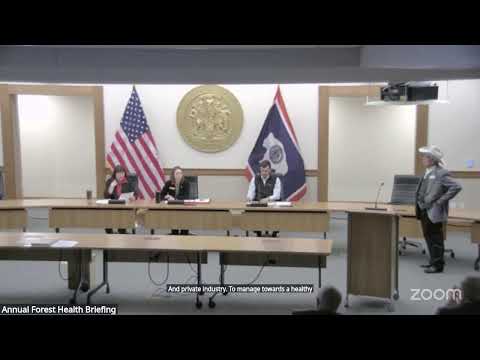
The briefing, led by Wyoming State Forester Kelly Norris and attended by U.S. Forest Service and Bureau of Land Management officials, outlined survey results and management priorities for 2024 and described steps the agencies say are needed to move projects on the ground more quickly. “In 2024, approximately 17 and a half million acres of forested lands were surveyed for forest health threats,” Norris said. Of that acreage, she told the committee, roughly 79,000 acres showed insect, disease or abiotic problems, excluding fire.
Why this matters: committee members, mill owners and local foresters said mills are operating at reduced capacity and that a faster timeline for contracting and timber administration is needed to keep the local industry viable and to remove hazard fuels before more severe fires. Mill owner Jim Nyman told the committee the situation for regional sawmills is urgent: “We’re at a point we need emergency action. We need support from the house and senate to help Kelly out on Good Neighbor.”
Most important facts - Officials reported a heavy 2024 fire year in Wyoming, with state briefings describing multiple large fires on federal and state forests and a difficult season for suppression and post‑fire recovery. The briefing listed the Pack Trail/ Fish Creek, Elk, Happy Jack and Pleasant Valley fires among the largest incidents discussed. - Federal and state foresters emphasized two pest threats by acreage: western spruce budworm (native defoliator) and mountain pine beetle. Norris said budworm damage increased in Lincoln and Teton counties, while mountain pine beetle pockets grew on the eastern Bighorns and in the Black Hills. - Agencies outlined capacity and funding actions: state forestry said it sold about 3.5 million board feet of timber on state trust lands in FY2024 and contracted forest health projects; the Forest Service described roughly 70 million board feet sold across Wyoming in 2024 in its numbers for multiple national forests.
Discussion and agency plans Kelly Norris and U.S. Forest Service Regional Forester Troy Heidecker described stepped‑up cooperation under Good Neighbor Authority (GNA), a mechanism that allows states to use their contracting systems to implement work on federal lands. Norris said GNA was specifically cited in recent federal executive orders directing an “immediate expansion of American timber production,” and she and Heidecker said the orders aim to streamline permitting and consultation processes and increase use of state contracting where appropriate.
Heidecker said the regional offices and state partners completed a multi‑forest timber strategy and risk assessment to prioritize where limited staff and funds will have the greatest short‑term effect. “We put together a pretty comprehensive risk assessment,” he said, describing effort to balance timber production, mill availability and fuels‑reduction priorities across forests.
Staffing, funding and limits Both state and federal officials emphasized capacity constraints. Norris said state forestry is near its authorized hiring limit under House Bill 43 and may need the legislature to revisit those limits if GNA work expands. She told the committee the state had previously received GNA funding in an earlier biennium but not in the most recent one.
Heidecker and BLM State Forester Heidi Rogers warned that some administrative steps—hiring seasonal staff, completing NEPA and consulting under the Endangered Species Act—can lengthen timelines. Heidecker gave one example: “That process takes 9 months for us to hire people now,” and said the agencies are seeking efficiencies but must still meet legal requirements.
Timber industry and local impacts Several mill owners and operators testified about economic strain and loss of feedstock. Jim Nyman, owner of Nyman Enterprises, said mills are operating on short contracts and that rapid, on‑the‑ground work is needed to keep facilities open and people employed. Gary Irvin of Saratoga Forest Management described local dependence on mill payrolls and supported quicker implementation of GNA projects.
Bureau of Land Management activities Heidi Rogers said BLM Wyoming sold 2.4 million board feet in FY2024 and targeted 4.5 million board feet for offer in FY2025 as a byproduct of fuels and forest health treatments. She reported the BLM treated thousands of acres for hazardous fuels in 2024 and used GNA on several projects to scale work across boundaries.
Pests, drought and post‑fire outlook Officials warned that drought‑stressed trees are more vulnerable to insects and that some post‑fire landscapes can see increased beetle activity. Norris and Heidecker said wildfires that burn through large patches of dead trees or live forest can change future beetle risk and warrant long‑term monitoring and targeted mitigation.
Committee follow‑up and next steps Legislators asked for more detail on where GNA could be expanded, what additional state funding would be needed and how to ensure that NEPA and species consultations can be completed more quickly without removing legal protections. Norris said state forestry will likely ask the legislature to revisit hiring authority under House Bill 43 if GNA expands. No formal motions or votes were recorded at the briefing; the committee concluded after questions and public comment.
Ending The joint committee thanked the presenters and closed the briefing after roughly 100 minutes of presentations and questions. Officials said they will continue coordination with counties, conservation districts, mills and federal partners to prioritize projects and funding.