Get Full Government Meeting Transcripts, Videos, & Alerts Forever!
Get email alerts on the Historic Preservation topic
No spam. Unsubscribe anytime.
Commission designates Central City Plaza as historic district after public testimony and staff report
Summary
The Milwaukee Historic Preservation Commission voted to designate the Central City Plaza complex and its associated landscaping and parking as a historic district under multiple staff criteria after a lengthy staff report and public testimony; the motion passed 5–1.
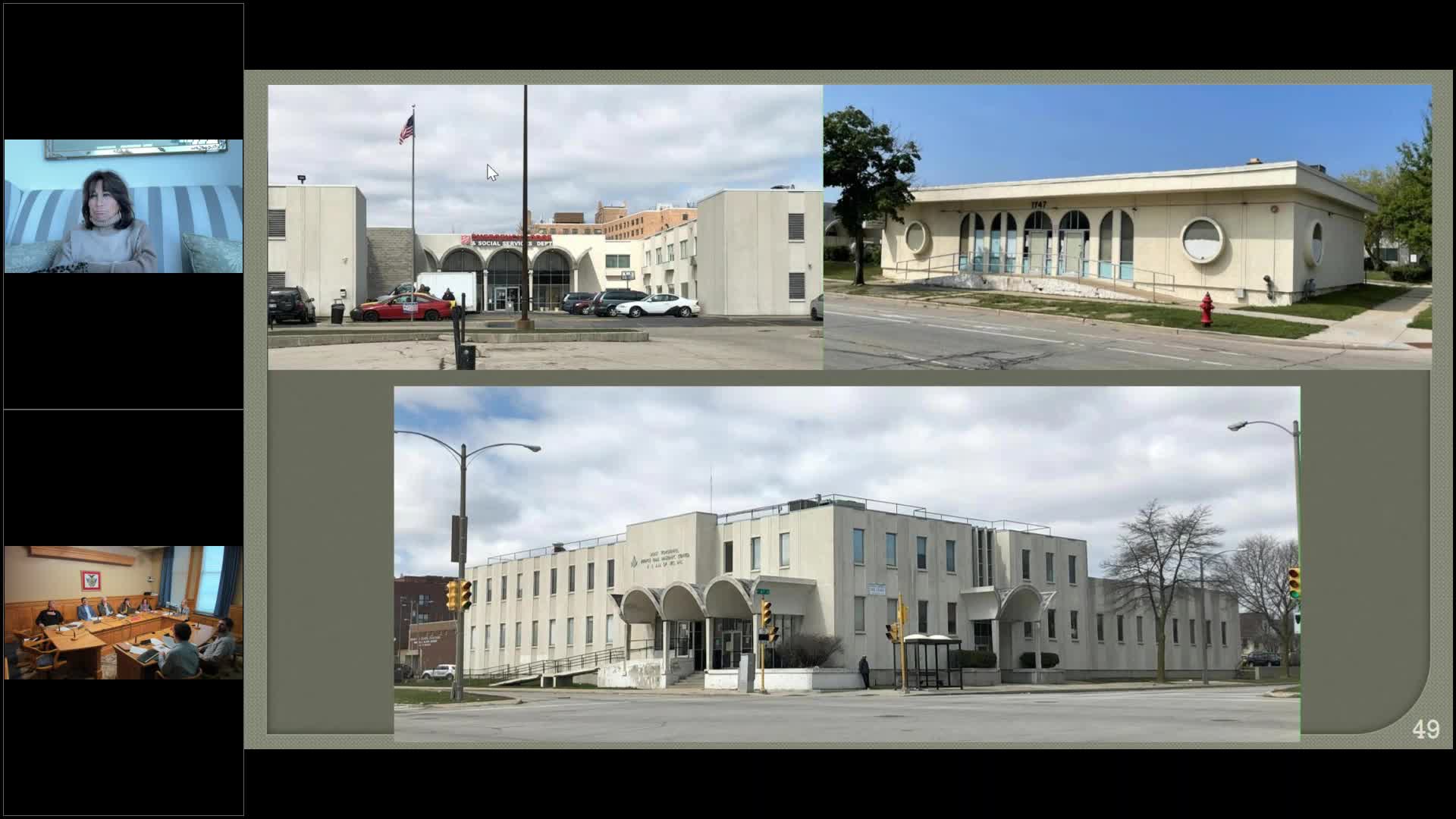
The Milwaukee Historic Preservation Commission voted to grant permanent historic-district status to Central City Plaza — a three‑building commercial complex at the northwest corner of Sixth and Walnut — after hearing a staff report and public testimony that highlighted the site’s importance to Black entrepreneurship and architecture.
Staff presented research tracing the complex’s origins to urban‑renewal projects of the 1960s and 1970s and argued the development was the first known Black‑conceived, -designed, -owned and -operated shopping center in Wisconsin. The staff report said Central City Plaza housed as many as 14 Black‑owned businesses and provided significant employment and commercial opportunity during an era when Black businesses represented a tiny share of the state’s firms.
The nomination cited multiple designation criteria, including association with persons who contributed to the city (developers and leaders Chaney and Robinson), a distinctive example of a late mid‑century modern commercial style, and the property’s continued visual prominence on the Walnut Street corridor. Staff recommended designation under several criteria, and commissioners discussed the report at length.
Public commenters included descendants and longtime neighborhood leaders who described the plaza as part of a larger effort to rebuild and sustain a Black commercial corridor after mid‑20th‑century displacement. Rachel Statter of the Salvation Army, which operates in one of the buildings, said the organization had been a steward of its building for more than 40 years and expressed concern about the operational constraints a designation could impose on nonprofit services, including limits on alterations needed to accommodate donated hospital beds.
Christopher (nominator) told the commission he is an architect experienced in adaptive reuse and argued the property meets the criteria for designation. Jim Robinson Sr., son of architect Alonzo Robinson, also spoke in favor, noting the complex’ significance for Black entrepreneurship and community life. Several commissioners urged that designation can be paired with future collaborative work to find practical, flexible ways for service providers and owners to adapt buildings while preserving historic character.
After discussion, a commissioner moved to designate the district under the staff‑recommended criteria; the motion passed with five votes in favor and one opposed.
The commission’s action covers all three buildings, associated landscape and the parking configuration that staff said remains essentially unchanged since the complex opened. The designation now moves to subsequent administrative steps, including formal recording of the designation and notification of affected owners and agencies.
Votes at a glance: the motion to adopt the staff recommendation and designate Central City Plaza passed 5–1.
Context: Commissioners and commenters repeatedly framed the designation as recognition of both architectural significance (a coherent set of late mid‑century commercial buildings by architect Alonzo Robinson) and an important episode in Milwaukee’s Black commercial history. Several speakers urged coordinated follow‑up between preservationists, property owners and nonprofit operators to reconcile preservation requirements with continued community services.