Get Full Government Meeting Transcripts, Videos, & Alerts Forever!
Manhattan Solid Waste Advisory Board briefs Community Board 2 on organics rollout, participation and enforcement ahead of April fines
Summary
Eric Dixon, a member of the Manhattan Solid Waste Advisory Board, briefed Community Board 2’s Activity & Resiliency Committee in March 2025 on the city’s curbside organics rollout, noting that mandatory participation enforcement is scheduled to begin April 1, 2025.
Eric Dixon, a member of the Manhattan Solid Waste Advisory Board (MSWAB), told Community Board 2's Activity & Resiliency Committee in March 2025 that New York City's curbside organics collection is now established in Manhattan and that enforcement for mandatory participation is scheduled to begin April 1, 2025.
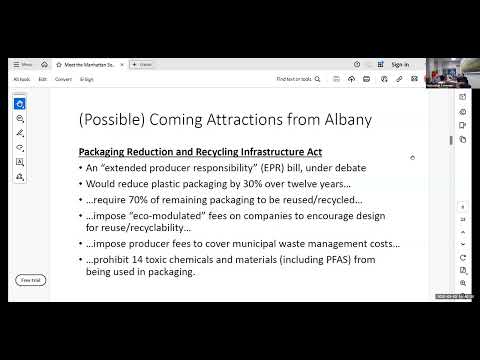
Dixon described MSWAB's role—created under Local Law 19 (1989) as borough-level advisory boards to the city—and said the board offers policy advice, testimony and public education on sanitation issues. He outlined state and city developments affecting waste streams, including an extended producer responsibility (EPR) bill being debated in Albany (referred to during the meeting as the Packaging Reduction and Recycling Infrastructure Act) and proposals to raise the bottle-deposit refund from 5¢ to 10¢ and expand covered containers.
Why it matters: city officials and volunteer advisory boards see organics diversion as a near-term, cost-effective way to reduce landfill methane emissions and to lower New York City's roughly half‑billion‑dollar annual bill to ship trash out of the city. Dixon said the curbside program is intended both to reduce greenhouse gases and to save hauling costs.
Key program details and timeline
- The city-wide curbside organics program uses brown bins collected once a week in sync with recycling pickup; public participation is mandatory and city enforcement was stated in the meeting to begin April 1, 2025. Dixon said, “enforcement hasn't started yet, but that's coming on April first of 2025.” - DSNY's publicly posted fine structure cited during the meeting: for dwellings under nine units, first/second/third+ offenses are $25/$50/$100; for buildings with nine or more units, the fines are $100/$200/$300, according to Dixon's summary of DSNY guidance. How strictly fines will be applied in practice, he said, will depend on enforcement resources. - The brown‑bin stream is routed primarily to anaerobic co‑digestion facilities (Dixon said roughly 85% of brown‑bin material is processed this way in the current rollout), which produce biogas that is often combusted rather than allowed to vent as methane. A Staten Island composting facility was described as expandable to accept more material; Dixon said it had been enlarged in a prior…
Already have an account? Log in
Subscribe to keep reading
Unlock the rest of this article — and every article on Citizen Portal.
- Unlimited articles
- AI-powered breakdowns of topics, speakers, decisions, and budgets
- Instant alerts when your location has a new meeting
- Follow topics and more locations
- 1,000 AI Insights / month, plus AI Chat