Get Full Government Meeting Transcripts, Videos, & Alerts Forever!
Get email alerts on the Curbside Organics topic
No spam. Unsubscribe anytime.
Manhattan Solid Waste Advisory Board briefs Community Board 2 on organics rollout, participation and enforcement ahead of April fines
Summary
Eric Dixon, a member of the Manhattan Solid Waste Advisory Board, briefed Community Board 2’s Activity & Resiliency Committee in March 2025 on the city’s curbside organics rollout, noting that mandatory participation enforcement is scheduled to begin April 1, 2025.
Eric Dixon, a member of the Manhattan Solid Waste Advisory Board (MSWAB), told Community Board 2's Activity & Resiliency Committee in March 2025 that New York City's curbside organics collection is now established in Manhattan and that enforcement for mandatory participation is scheduled to begin April 1, 2025.
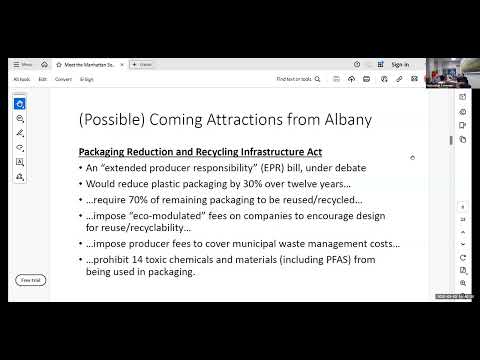
Dixon described MSWAB's role—created under Local Law 19 (1989) as borough-level advisory boards to the city—and said the board offers policy advice, testimony and public education on sanitation issues. He outlined state and city developments affecting waste streams, including an extended producer responsibility (EPR) bill being debated in Albany (referred to during the meeting as the Packaging Reduction and Recycling Infrastructure Act) and proposals to raise the bottle-deposit refund from 5¢ to 10¢ and expand covered containers.
Why it matters: city officials and volunteer advisory boards see organics diversion as a near-term, cost-effective way to reduce landfill methane emissions and to lower New York City's roughly half‑billion‑dollar annual bill to ship trash out of the city. Dixon said the curbside program is intended both to reduce greenhouse gases and to save hauling costs.
Key program details and timeline
- The city-wide curbside organics program uses brown bins collected once a week in sync with recycling pickup; public participation is mandatory and city enforcement was stated in the meeting to begin April 1, 2025. Dixon said, “enforcement hasn't started yet, but that's coming on April first of 2025.” - DSNY's publicly posted fine structure cited during the meeting: for dwellings under nine units, first/second/third+ offenses are $25/$50/$100; for buildings with nine or more units, the fines are $100/$200/$300, according to Dixon's summary of DSNY guidance. How strictly fines will be applied in practice, he said, will depend on enforcement resources. - The brown‑bin stream is routed primarily to anaerobic co‑digestion facilities (Dixon said roughly 85% of brown‑bin material is processed this way in the current rollout), which produce biogas that is often combusted rather than allowed to vent as methane. A Staten Island composting facility was described as expandable to accept more material; Dixon said it had been enlarged in a prior city initiative. - The city previously distributed some brown bins for free; currently bins are available for purchase from bins.nyc (Dixon quoted a current price of $43.47) or residents can use a lockable container and request a free sticker.
Participation and performance
Dixon and the committee discussed capture rates and program cost effectiveness. Using public DSNY data and third‑party analysis, he said Manhattan capture rates for organics remain in the high single digits (Dixon cited a 6–8% range at the community district level during the rollout). He described the brown‑bin program's operating budget at roughly $20–30 million annually and said that about 40% of New York City's current export and disposal costs relate to organics, implying significant potential savings if diversion rates rise.
State policy context
Dixon summarized two Albany priorities that MSWAB tracks: (1) an extended producer responsibility (EPR) proposal to force packaging reduction and set producer fees that would incentivize reusable/recyclable packaging; and (2) legislation to increase and broaden the bottle deposit (moving the deposit from 5¢ to 10¢ and expanding covered containers, while keeping some exemptions such as milk and pure juice). He said the EPR concept is to shift part of municipal waste management costs back to producers.
Questions from committee members and public commenters
Committee members and attendees raised practical concerns that arose repeatedly in the discussion: - Who will be fined when tenants fail to separate organics? A building owner who spoke during the meeting said building staff sometimes must sort trash and that asking employees to pull organics raises health and dignity concerns; Dixon acknowledged the point and said tenant education and outreach are central to DSNY and MSWAB strategies. - Rat proofing and container durability: a building owner questioned whether the provided plastic brown bins are “ratproof.” Dixon responded that bins are substantially more difficult for rodents to get into than exposed bags; he called them closer to a “platonic ideal” of ratproofing while acknowledging rodents can damage many materials over time. - Food scraps and allowable materials: Dixon emphasized that the city's program accepts a broad range of organic materials—meat, dairy, food‑soiled paper and paperboard (pizza boxes) are allowed in brown bins.
Outreach and MSWAB activities
Dixon urged neighborhood outreach and described MSWAB’s experiments with messaging and its surveys of co‑ops, condos and building managers to identify roadblocks. He said MSWAB holds monthly meetings with guest speakers and is recruiting new volunteer members; he noted applications were due by March 14 (information posted on MSWAB's website).
What the meeting did not decide
No formal policy change or binding municipal action was taken by Community Board 2 during the presentation; the session was informational and focused on outreach, clarification and community Q&A. The committee and members asked MSWAB to continue engagement and to share slides and contact information for follow‑up.
Clarifying details (from the meeting)
- DSNY fines cited (from DSNY guidance quoted by the presenter): buildings under nine units: $25/$50/$100 (first/second/third+); nine or more units: $100/$200/$300 (first/second/third+). (source: Eric Dixon) - Brown‑bin program operating cost mentioned by presenter: roughly $20–30 million per year. (source: Eric Dixon) - Organics capture in Manhattan (community district level during rollout): high single digits (roughly 6–8% cited). (source: Eric Dixon) - Approx. 85% of brown‑bin organic waste is routed to anaerobic co‑digestion facilities (presenter cited Newtown Creek facility as a common endpoint). (source: Eric Dixon)
Speakers (attribution whitelist)
- Will Benish — Chair, Community Board 2 Activity & Resiliency Committee (first referenced at ~00:05:68). (affiliation_type: government) - Eric Dixon — Member, Manhattan Solid Waste Advisory Board; professor, Politics Department, NYU (first referenced at ~00:95:67). (affiliation_type: nonprofit/academic) - Ryder Kessler — Committee member (present; introduced by chair). (affiliation_type: government) - Bridal Olsen — Vice chair, Street Activity Resiliency Committee (introduced). (affiliation_type: government) - Eddie Siegel — Committee member (introduced). (affiliation_type: government) - Rocio — Resident / commenter who demonstrated a countertop compost container and raised tenant/landlord concerns (first referenced in Q&A ~00:2175). (affiliation_type: citizen) - Amy — Resident/commenter who asked about large building enforcement and bin distribution (first referenced ~00:1300). (affiliation_type: citizen)
Authorities referenced
- Local Law 19 (1989) — creation of borough‑level Solid Waste Advisory Boards (referenced by Eric Dixon). (referenced_by: ["mswab-curbside-organics-manhattan-2025-03"]) - Packaging Reduction and Recycling Infrastructure Act (described during the meeting as an extended‑producer‑responsibility bill under consideration in Albany) (referenced_by: ["mswab-curbside-organics-manhattan-2025-03"]) - New York bottle‑deposit statute / bottle bill (discussed in the meeting with proposed changes to deposit level and covered containers) (referenced_by: ["mswab-curbside-organics-manhattan-2025-03"]) - New York City Department of Sanitation (DSNY) public guidance on organics separation and fines (referenced_by: ["mswab-curbside-organics-manhattan-2025-03"])
Community relevance
- Geographies: Manhattan; Community District 2; citywide implications for boroughs and Staten Island (discussed). - Impact groups: tenants in multi‑unit buildings; building staff and supers; small landlords and co‑op/condo associations; sanitation workers.
Salience and recommended follow‑up
- Overall salience: 0.80 — The organics program and enforcement affect many residents, building managers and municipal budgets; the subject raised immediate compliance and equity questions. - Recommended follow‑up: MSWAB/DSNY to provide explicit guidance to building owners about enforcement thresholds and to share outreach materials with Community Board 2; committee requested MSWAB slides and contact information for neighborhood outreach.
Provenance (transcript evidence spans)
- topicintro: {"block_id":"t95.67","local_start":0,"local_end":96,"evidence_excerpt":"I'm Eric Dixon, I'm a member of the Manhattan Solid Waste Advisory Board. And my day job is as a professor in the politics department at NYU."} - topfinish: {"block_id":"t2681.61","local_start":0,"local_end":64,"evidence_excerpt":"Help us find venues where we can spread the word, help us shape the policy advice that we offer to the city council, and any ideas you have for outreach, messaging... here's contact information both for me, and for the Manhattan Solid Waste Advisory Board."}