Get Full Government Meeting Transcripts, Videos, & Alerts Forever!
Get email alerts on the Solar Development topic
No spam. Unsubscribe anytime.
Greene County adopts two-year moratorium on new solar-farm special-use permits after public safety, decommissioning and notice concerns
Summary
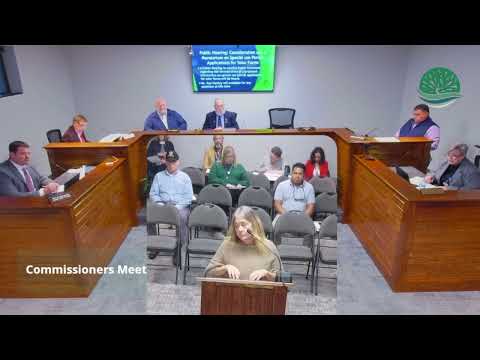
After a public hearing marked by resident concerns about fire response, decommissioning and lack of advance notice, the Greene County Board of Commissioners approved a two-year moratorium on accepting special-use permit applications for solar farms to allow review and revision of the county ordinance.
The Greene County Board of Commissioners on a voice vote approved a two-year moratorium on accepting new special-use permit applications for solar farms, saying the pause will give the county time to review and update its ordinance and consult outside experts.
The moratorium will not be retroactive, County Attorney (name not specified) told the public, meaning solar projects already permitted under existing county ordinance and state law would not be affected. The measure passed after an extended public hearing that included residents’ accounts of trespass, concerns about fire response to battery storage units, and complaints that nearby landowners learned of development plans only after private company outreach several years earlier.
Residents said they were worried about fire risk and long-term environmental effects of large battery installations tied to solar farms. “What am I gonna do? Y’all gonna burn up my pine trees that I planted 20 years ago,” said Christy Riles, a local landowner, during public comment. Riles also said she had questions about decommissioning and whether equipment and buried wiring would be removed when a project ends.
The county attorney explained that decommissioning requirements and some aspects of solar development are governed by North Carolina state law and that the county cannot override state requirements. “Decommissioning is regulated by the state of North Carolina,” the county attorney said during the hearing, and the moratorium would give the county time to “review the ordinance and update it, add anything that needs to be added to it, or take anything away from it.”
Several speakers urged clearer public notification earlier in the process. “They turned in the paperwork. They’ve done everything they needed to do, but the public did not know it till December,” resident Bobby Joan Muver said, describing outreach that occurred years before county permitting. Commissioners acknowledged gaps in public notice and said changes to the county’s communication process will be a focus of the ordinance review.
Public safety questions centered on large battery storage attached to some solar projects. A speaker identifying himself as representing local fire services said crews are training to respond but described current protocol as allowing certain battery fires to burn while mitigation continues. The sheriff (name not specified) told a resident who alleged timber was cut on her land that she should file a report so the sheriff’s office could investigate potential trespass.
During the hearing the county repeatedly emphasized that the moratorium would halt acceptance of new special-use permit applications for approximately two years to allow the county to hire third-party consultants, review state law and county ordinance, and develop improved public outreach and notification procedures. Several commissioners said they wanted third-party technical and policy advice to inform any ordinance changes.
The moratorium was moved, seconded and approved by voice vote. The county attorney clarified again before the vote that the moratorium would not apply to facilities already built under existing permits.