Get Full Government Meeting Transcripts, Videos, & Alerts Forever!
Get email alerts on the Sanctuary Policy topic
No spam. Unsubscribe anytime.
Cambridge Council unanimously reaffirms sanctuary status to explicitly include transgender and nonbinary people
Summary
After extensive public comment from residents and advocacy groups, the Cambridge City Council voted to amend its sanctuary-city reaffirmation to explicitly extend protections to transgender and nonbinary people and to request follow-up actions addressing housing and health-care access.
The Cambridge City Council voted unanimously on March 3 to reaffirm the city’s sanctuary status and explicitly extend that protection to transgender and nonbinary residents.
The resolution, sponsored and discussed by several councilors and supported by dozens of public commenters, affirms Cambridge’s commitment to protect marginalized communities and asks city staff to take steps to safeguard access to housing and gender-affirming health care.
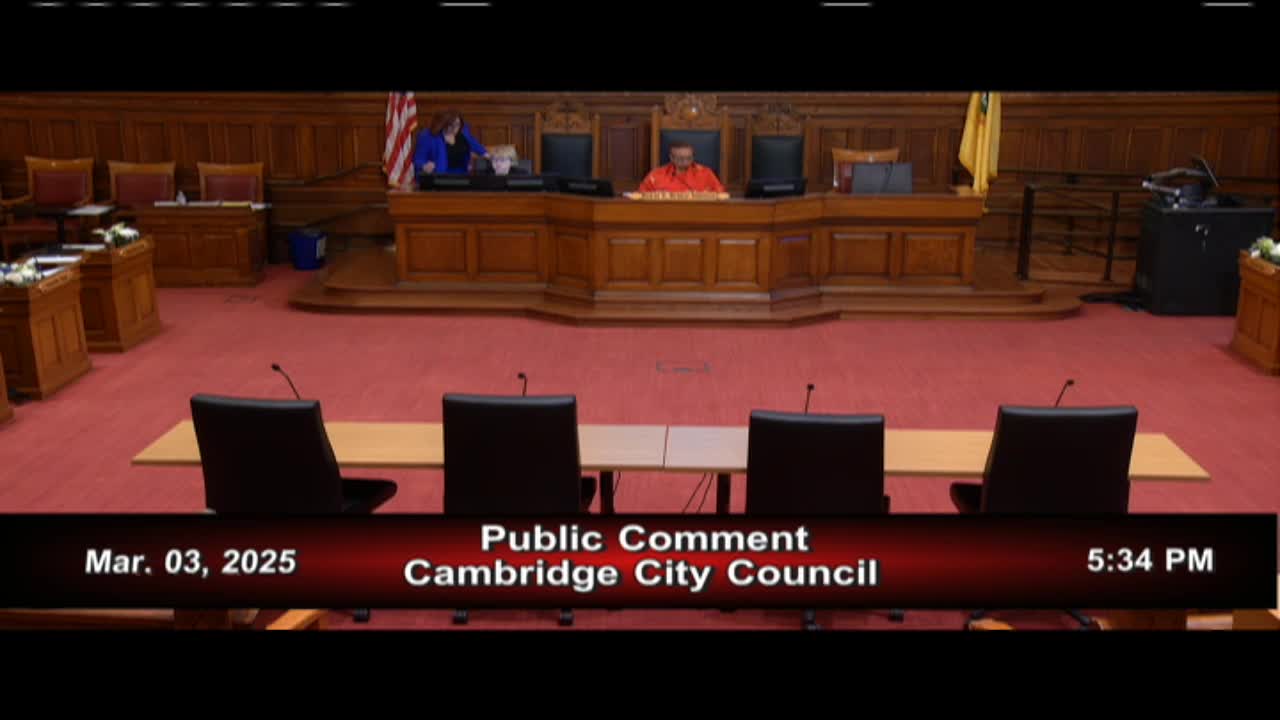
Public comment at the meeting ran more than an hour and included dozens of speakers who urged the council to act. Speakers described rising federal actions they said threaten transgender people, highlighted local needs for low‑threshold shelter and transitional services, and asked the council to find ways to keep the city’s Transitional Wellness Center open. Several commenters noted that transgender people face elevated rates of homelessness and housing instability and urged the council to consider that context when crafting local responses.
Councilors framed the vote as both a symbolic and operational action. Members said the resolution is a public statement of values and a starting point for follow-up work to protect access to services. The resolution as adopted directs the city manager and relevant departments to identify steps the city can take to uphold protections and coordinate with community partners; it also lists partner organizations to receive copies and encouragement to engage in outreach and education.
The vote on the amended resolution was recorded as nine votes in favor, zero opposed. The council also asked staff to report back on concrete next steps to help at‑risk residents, including housing supports and ensuring access to health services.
The action followed broader city debate over services for unhoused and gender‑diverse residents, with multiple speakers urging the city to find ways to continue funding flexible, low‑threshold shelter and transitional housing options and to preserve existing short‑term programs that some residents rely on.
The council did not direct a specific budget change at the meeting; instead members asked staff to return with recommendations and potential resource implications for future consideration.