Get Full Government Meeting Transcripts, Videos, & Alerts Forever!
Get email alerts on the Public Safety topic
No spam. Unsubscribe anytime.
City Council adopts resolution to require two paramedics on rescue units amid heated debate
Summary
The Albuquerque City Council on March 3 approved R‑122 to codify a two‑paramedic minimum on rescue apparatus, overriding administration objections and drawing hours of testimony from firefighters, union leaders and city officials.
The Albuquerque City Council on March 3 passed Resolution R‑122, requiring a minimum of two paramedics on rescue apparatus citywide, with a 7–2 vote.
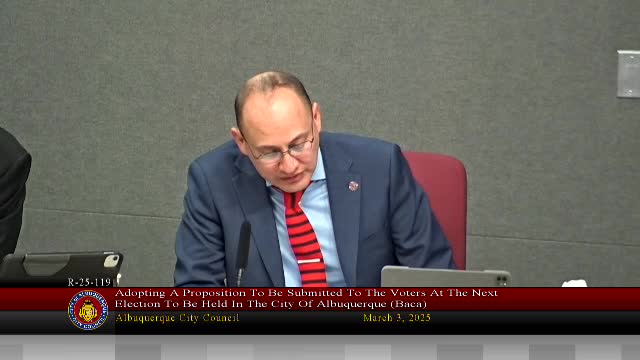
Councilors Lewis and Baca sponsored the resolution and said it was intended to preserve a long‑standing standard of prehospital care after the administration proposed operational changes that would place paramedics on both engines and rescues rather than keeping two paramedics together on rescue transport units.
Supporters said the two‑paramedic configuration is the city’s ‘‘gold standard’’ for life‑saving care and argued that diluting paramedic staffing would increase risk to patients and to first responders. Dozens of Albuquerque Fire Rescue (AFR) members, retirees and representatives of International Association of Fire Fighters (IAFF) Local 244 urged the council to adopt the resolution. Firefighters described clinical scenarios where two paramedics provide simultaneous interventions — advanced airway management, cardiac rhythm interpretation, medication dosing and electrical therapy — that a single paramedic working with an EMT basic cannot safely deliver.
Opponents, including AFR leadership and the city administration, said the resolution intrudes on executive staffing authority and called for more time to collaborate with labor and medical leadership. AFR Chief Jaramillo described a plan the department had begun implementing at two stations and later expanded to four additional stations; she said the change was intended to distribute advanced life‑support capabilities across apparatus and to address recruitment and retention challenges for paramedic licensure. Dr. Kimberly Pruett, the city’s medical director, told the council paramedics are trained to operate independently but said the department’s revised deployment model still delivers two‑paramedic responses for high‑acuity calls.
Council debate centered on safety, separation of powers and whether the city should legislate staffing that administration leaders say belongs to the chief and is subject to collective‑bargaining processes. City legal staff warned of potential conflicts with the city’s labor‑management ordinance and that disputes over bargaining and operational authority were already pending before the municipal labor board.
After several hours of public testimony and council discussion, the council approved the resolution. The motion to pass R‑122 was made by Councilor Lewis, seconded by Councilor Baca; the motion carried 7 in favor and 2 opposed. The administration and union signaled the dispute could continue through established labor‑management and legal channels if either side pursued formal complaints.
Council action caps a divisive multiweek process that drew large public turnout and extensive testimony from AFR personnel. The resolution requires the city to retain the two‑paramedic minimum on rescue units; precise implementation details and associated policy and bidding changes will be subject to follow‑up work between AFR leadership, council staff and labor representatives.
The council’s action does not itself change the collective bargaining agreement; administration attorneys advised the council that questions about bargaining and management’s rights could be raised with the municipal labor board or in court.