Get Full Government Meeting Transcripts, Videos, & Alerts Forever!
Get email alerts on the Housing Development topic
No spam. Unsubscribe anytime.
PAB recommends adoption of D.R. Horton land‑use amendment for 115 homes near Homestead
Summary
The Planning Advisory Board recommended adoption of application CDMP2024003, a CDMP amendment and concurrent zoning to allow up to 115 single‑family homes on about 22 acres; staff and the applicant proffered restrictions addressing urban design, agricultural adjacency and stormwater.
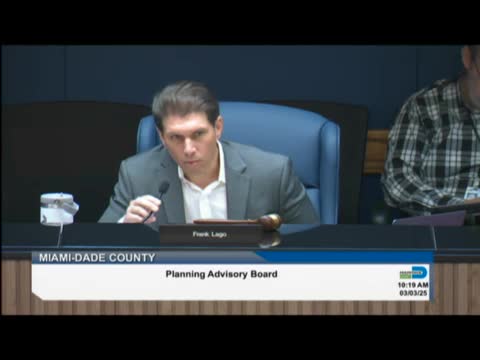
The Miami‑Dade County Planning Advisory Board on March 3 recommended adoption of CDMP2024003, a Comprehensive Development Master Plan amendment filed by D.R. Horton to allow a higher residential density on a roughly 22‑acre parcel near Southwest 190th Avenue and Southwest 320th Street.
Rosa Davis, Planning Section supervisor with the county’s Department of Regulatory and Economic Resources (RER), summarized staff’s recommendation to adopt the change with acceptance of a proffered declaration of restrictions. The applicant has revised its request to limit development to a maximum of 115 residential units and has committed to “urban design principles” intended to ensure the project integrates with surrounding development and protects adjacent agricultural uses, Davis said.
The proffered restrictions and staff report include several site‑specific mitigations: a requirement to provide notice to future residents about nearby agricultural activities (noise, smells and prescribed burning near the Navy Wells Pylon Preserve), a commitment to minimize perimeter lighting on parcels abutting agricultural (AU) zoned land, a 25‑foot landscape buffer along the UDB (urban development boundary), stormwater measures designed to contain a 25‑year, 3‑day event on site (staff and applicant said further refinement was under discussion), and a proportionate‑share payment for improvements to Chrome Avenue because Chrome is a hurricane evacuation route even though staff estimated the project’s roadway impact below the typical 5% mitigation threshold.
Applicant attorney Maritza Haro and representatives from D.R. Horton described plans to connect the project to county water and sewer (the developer will fund and construct a pump station), to comply with the county urban design manual, and to limit units to the 115 cap memorialized in a declaration of restrictions. The applicant provided an impact‑fee estimate during the presentation: total impact fees were estimated at about $2.5 million, with roughly $1.2 million toward county mobility improvements, about $500,000 to Miami‑Dade County Public Schools, about $350,000 to county parks and roughly $250,000 toward water and sewer connection charges. The applicant said the development would also add an estimated $1 million in annual ad valorem taxes to county revenues, including about $400,000 to schools and $650,000 to the county annually.
During public comment several neighbors raised concerns about lot sizes, school capacity and traffic. Longtime Redland resident Mary Waters urged the board to recommend denial, saying she believed the proposed lots would be smaller than advertised and expressing concern about school level‑of‑service and whether impact fees would be spent nearby. Other commenters living near the site said existing roads are remote, used for agriculture, and currently inconsistent with higher density development.
Board members asked staff and the applicant follow‑up questions about outreach, impact fees and stormwater analysis. Staff said impact fees are allocated by statute and county regulation and do not automatically get spent only in the immediate neighborhood; the county has discussed mechanisms to target fees locally but code does not currently guarantee that. On stormwater, RER staff said the county must verify the proposed project meets CDMP level‑of‑service standards and that unresolved stormwater questions could change recommendations later in the review process.
Board member Horatio Huembez moved to recommend adoption with acceptance of the proffered declaration of restrictions; the motion was seconded by board member J. W. Morris and passed unanimously on roll call. The PAB’s recommendation will be transmitted to the Board of County Commissioners.