Get Full Government Meeting Transcripts, Videos, & Alerts Forever!
Get email alerts on the Victim Assistance topic
No spam. Unsubscribe anytime.
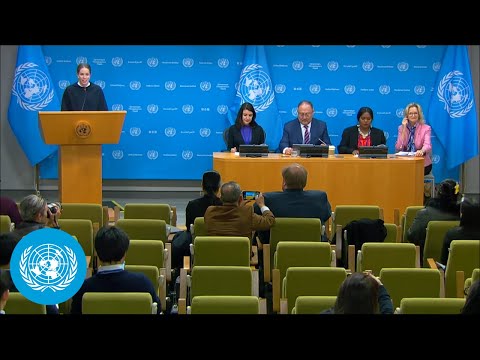
ICAN and ICRC at TPNW meeting warn of catastrophic humanitarian consequences, press for victim assistance
Summary
Speakers from the International Campaign to Abolish Nuclear Weapons and the International Committee of the Red Cross told a UN press briefing the treaty is the primary international instrument to address humanitarian harm from nuclear weapons and urged states to implement victim assistance and environmental remediation obligations.
Speakers from civil society and the International Committee of the Red Cross urged meeting participants to treat the Treaty on the Prohibition of Nuclear Weapons as the primary international framework for addressing the humanitarian harm caused by nuclear weapons.
"This treaty provides the only international framework for addressing these harms to people and the environment and for ensuring that they never happen again," said Melissa Park, executive director of the International Campaign to Abolish Nuclear Weapons (ICAN), citing the treaty’s focus on elimination and prevention of use.
Park noted that the meeting is taking place in an anniversary year for the Trinity test and the atomic bombings of Hiroshima and Nagasaki, and emphasized that "so long as any country has nuclear weapons and insist they are essential for their security, others will want them," adding that elimination of the weapons is the only way to eliminate the risk of their use.
Irini Georgiou, legal adviser for the International Committee of the Red Cross, told the briefing that nuclear weapons’ humanitarian impacts are unprecedented and long-lasting. "Mitigating the tremendous harm caused by nuclear weapons use and testing is an important element of achieving a nuclear weapon free world," Georgiou said, and she described victim assistance and environmental remediation as "robust obligations" the treaty seeks to establish.
Georgiou also said it is "extremely doubtful that nuclear weapons could ever be used in compliance with international humanitarian law," and called on states to refrain from nuclear threats, saying such threats "fuel tensions, trigger an arms race, and increase the risk of actual use."
Both speakers emphasized that the treaty is not simply aspirational. Park said the treaty is producing measurable signals—parliamentarians, cities and investors are engaging with the disarmament agenda—and that civil society participation at the meeting is substantial. Georgiou said the ICRC will continue to work with states parties and other states to advance humanitarian objectives and implementation.