Get Full Government Meeting Transcripts, Videos, & Alerts Forever!
Get email alerts on the Land Use Zoning topic
No spam. Unsubscribe anytime.
Howard County Council rejects zoning amendment aimed at restricting certain R&D activities in PEC
Summary
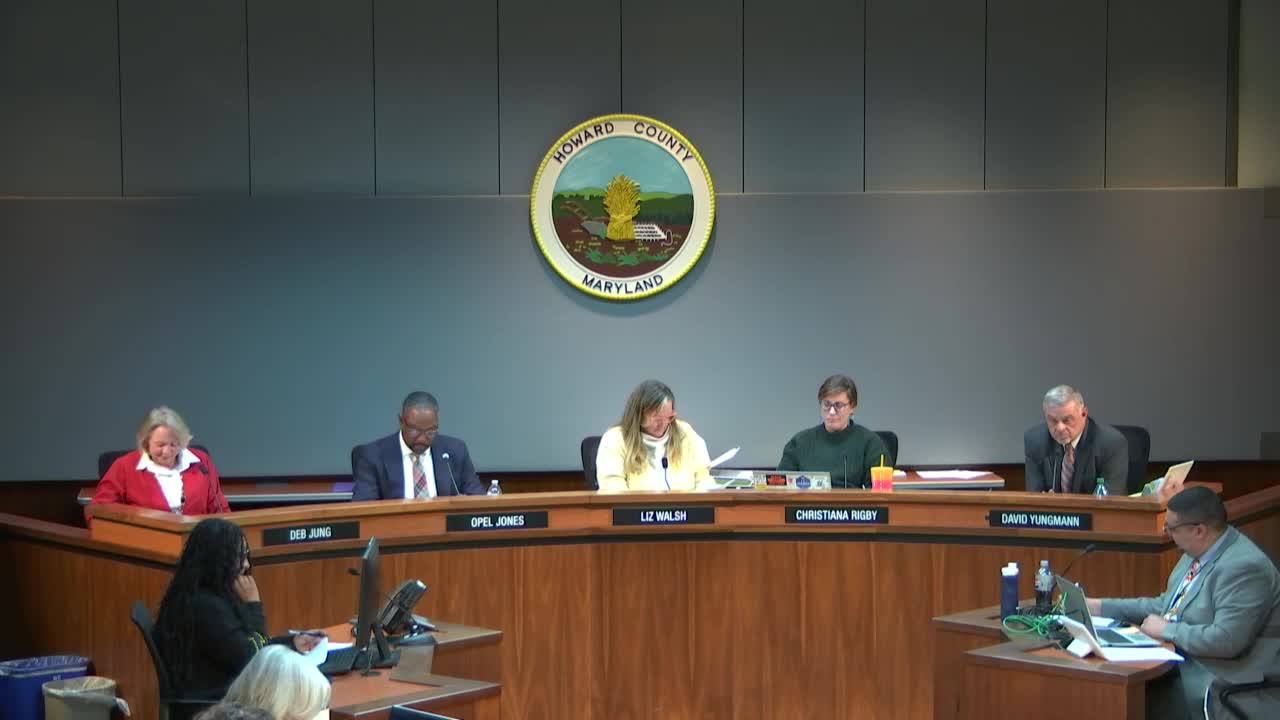
The Howard County Council on March 2025 voted down Zoning Regulation Amendment ZRA 2-11, an ordinance proposed to change how certain research-and-development activities are regulated in Planned Employment Center (PEC) zoning districts.
The Howard County Council on March 2025 voted down Zoning Regulation Amendment ZRA 2-11, an ordinance proposed to change how certain research-and-development activities are regulated in Planned Employment Center (PEC) zoning districts.
Supporters said the change was needed to prevent small-scale manufacturing activities that they said could create health risks near neighborhoods; opponents and several councilmembers said the amendment resembled a “special law” targeted at a single property and could be overturned in court. After votes on two amendments to the measure, the council concluded with a final vote announcing that CB 11 20 25 as amended failed.
The measure drew more than 100 public comments over two hearings, with residents, families and community groups urging limits on the siting of pilot plants near homes. Councilmembers expressed sharply different views about whether the council, rather than state regulators or the planning process, was the proper venue to address the safety and compatibility concerns raised by residents.
Councilmember Deb Young, the bill sponsor, framed the proposal as a response to resident concerns about a pilot plastics-to-fuel operation near the Cedar Creek neighborhood. “A pilot plant converting plastics into oil and gas next to residences is simply a special evil that requires legislative action,” Young said during debate, arguing the council must put “people over profits.”
Other councilmembers urged caution. One member cited the Maryland Constitution’s prohibition on special laws—Article 3, paragraph 33—and said evidence indicated the amendment would be vulnerable to challenge and undoing in court. That member said the county should not enact legislation it could not legally defend and risk diverting funds to litigation instead of public services.
Council debate also focused on process questions raised by residents: whether the planning board had reviewed the final language, whether the Maryland Department of the Environment (MDE) had completed its technical review of the project, and how to weigh conflicting technical testimony offered by experts and residents. Several councilmembers relayed that they had reviewed written testimony and attended community meetings, but they reached different conclusions about whether zoning action was appropriate at the council level.
Amendment votes altered the bill before the final vote. Amendment 1, which clarified how the county treats certain enlargement and nonconforming-use rules, passed. Amendment 2, which added several “whereas” clauses and additional clarifying language—including language opponents said appeared to single out a single company and site—failed on a council vote. After the amendments, the council voted on the full measure and the motion failed.
The council did not adopt the zoning change, and members urged ongoing engagement. Several councilmembers encouraged residents to continue using administrative and regulatory channels—permitting reviews, planning-board processes and MDE technical reviews—to seek remedies and to remain involved in follow-up work.
The ordinance text and the full public record, including written testimony and the planning office’s materials, remain available through the county clerk’s office and the council website; MDE technical review and any pending permit decisions are handled by the state agency and were not resolved at the time of the vote.
The failure of CB 11 leaves existing PEC zoning and the county’s development-review processes in place; proponents and opponents signaled they will continue advocacy and technical review through other channels.