Get Full Government Meeting Transcripts, Videos, & Alerts Forever!
Get email alerts on the Climate Energy Resilience topic
No spam. Unsubscribe anytime.
DEEP urges lawmakers to approve broad climate, energy and resilience package
Summary
Connecticut Department of Energy and Environmental Protection (DEEP) leaders told the Environment Committee they support HB 5004 and related bills that set updated greenhouse gas targets, expand heat pump adoption, strengthen appliance efficiency standards and fund resilience; DEEP emphasized designs that address affordability and public safety.
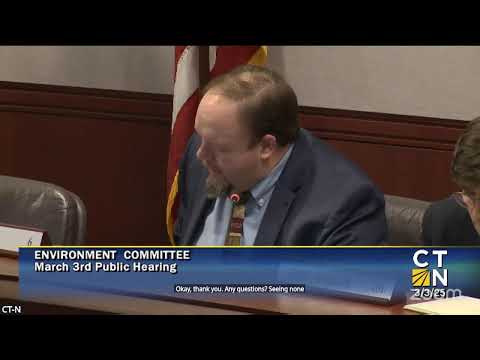
Connecticut Department of Energy and Environmental Protection (DEEP) leaders told the Environment Committee on Oct. 27 that they support a broad package of bills aimed at cutting greenhouse gas emissions and expanding resilience funding and clean-energy deployment. DEEP Commissioner Katie Dykes told lawmakers she backed the governor—s climate bill and the suite of proposals in House Bill 5004 as a set of practical steps to reduce emissions while lowering consumer energy costs and protecting public safety.
Dykes said the bills include measures DEEP has urged for years: economywide targets tied to planning, improved permitting predictability, and programs to accelerate electrification and efficient heating and cooling. "Climate change is impacting communities," she told the panel, urging lawmakers to approve measures that pair greenhouse gas reductions with affordability measures for households and businesses.
DEEP staff outlined key pieces of the package in detail. The department—s energy team described the bill—s appliance- and equipment-efficiency provisions as an inexpensive way to lower utility bills for all customers and urged adoption of updated standards already in force in neighboring states. Bureau of Energy and Technology Policy staff explained how conservation and targeted incentives for heat pump adoption can reduce electric use and avoid the need for higher-cost supply investments.
DEEP officials also described provisions that would clarify the agency—s authority to invest in larger clean-thermal and distribution projects and to pilot coordinated programs that pair solar canopies, battery storage and thermal networks. "We believe the combination of these elements can reduce greenhouse gas emissions while improving reliability and affordability," one DEEP official said.
Lawmakers pressed DEEP on details, including how appliance standards and heat-pump programs would be implemented without adding unaffordable new charges on ratepayers. DEEP officials said many provisions are designed to target savings to households that can gain the most from electrification and efficiency upgrades, and pointed to federal funding streams such as EPA grants and the Inflation Reduction Act that can support pilot grants and customer incentives.
Dykes and her staff also reiterated support for a resilience planning bill that would expand geospatial mapping, boost technical assistance for councils of governments and make state funding available for community-level adaptation projects. The commissioner said towns and cities have already experienced substantial rainfall, storms and wildfire seasons that justify coordinated state action.
Committee members thanked the agency for a detailed briefing and signaled they will continue to scrutinize costs and implementation details as the bills move through the legislature. DEEP staff urged lawmakers to keep timing and program design flexible so municipalities and ratepayers can capture federal funds while protecting low- and moderate-income households.
While DEEP expressed support for most of the measures, the agency and several legislators acknowledged outstanding differences on some permitting and land-conservation provisions. Those sections drew separate testimony from municipal leaders, conservation groups and industry representatives later in the hearing.
The committee did not take final votes on any bills during the hearing. DEEP officials said they would provide additional written materials and financial detail for several proposals as requested by committee members.