Get Full Government Meeting Transcripts, Videos, & Alerts Forever!
Get email alerts on the Transgender Athlete Policy topic
No spam. Unsubscribe anytime.
Minnesota House tables bill to restrict girls' sports to biological females (House File 12)
Summary
The Minnesota House debated House File 12 on Feb. 20, 2025, a bill that would define “female” in statute and restrict girls-only scholastic athletic teams to biological females, then laid the bill on the table after close roll-call votes and a motion to reconsider.
ST. PAUL, Minn. — The Minnesota House debated House File 12, a bill that would define “female” in statute and limit girls-only school sports to biological females, before ultimately laying the bill on the table on Feb. 20, 2025.
The measure, carried by Representative Scott, prompted hours of floor debate that drew parents, coaches and fellow legislators into a broader argument about fairness, safety and civil rights in school sports. Supporters said the bill protects girls’ opportunities; opponents said it would stigmatize and endanger transgender, nonbinary and Two-Spirit youth and could invite invasive enforcement.
House File 12 would add a statutory definition for “female” to Minnesota law and direct athletic programs and schools to limit certain teams and competitions accordingly. Representative Scott told the House the bill was intended to “protect and preserve girls sports teams for only girls” and cited Minnesota Statutes chapter 121A and earlier Title IX–style protections as the basis for the legislation.
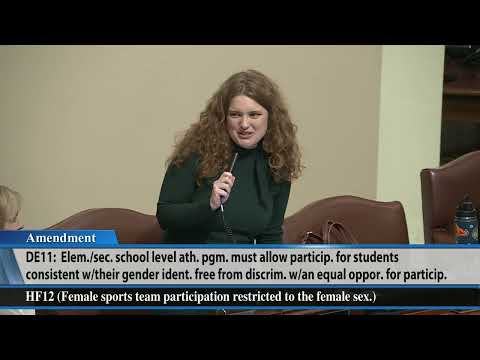
Opponents repeatedly raised concerns about how the law would be enforced and the risks to students’ privacy and safety. Representative Falconer, a coach and parent, said her amendment sought to prevent “unnecessary and invasive medical examinations,” arguing the bill’s practical effect could require medically unnecessary exams to resolve eligibility questions. Representative Jordan offered an amendment (DE11) that would have codified the Minnesota State High School League’s existing participation policy — allowing students to play on the team matching their gender identity — and said “kids can play on the sports team that they identify with. This is our current policy in Minnesota.”
The House first considered DE11; following a roll call, the amendment failed on a close vote, with 66 recorded ayes and 67 nays. Representative Scott opposed the amendment, saying the Jordan amendment “erases girls’ sports. I encourage a no vote.”
Lawmakers also debated a motion by Representative Liebling to re-refer the bill to the House Judiciary Committee on the grounds that it implicates the Minnesota Human Rights Act and related statutes; that motion failed on a roll call, 66–67.
On the bill’s third reading the House initially recorded a 66–67 result against passage. Representative Nisga moved to reconsider; that motion on the floor was approved, and the House subsequently recorded a 67–66 tally on the reconsideration. Immediately after, Representative Nisga moved to lay House File 12 on the table; the House approved the motion to table by voice vote, a non-debatable parliamentary action that leaves the bill off the active calendar.
Speakers on both sides presented personal and procedural arguments. Representative Kozlowski, who identified as Two-Spirit, framed the measure as part of a broader pattern of exclusion, saying lawmakers were using the legislative process to “erase trans girls, non binary, and Two Spirit kids” from public life. Representative Rarick, speaking for supporters, cited studies and international reports on physical differences and safety concerns in contact sports and urged protection of girls’ competitive opportunities. Several legislators recounted constituent emails and testimony from student athletes on both sides of the issue.
Several secondary amendments were offered during floor debate. Representative Falconer withdrew an amendment she said did not go far enough to address her concerns; Representative Freiberg’s vaccination-related amendment was ruled out of order on germaneness grounds. No secondary amendment was adopted.
The House’s action to lay the bill on the table means House File 12 will not advance at this time. The House proceedings included repeated references to Minnesota’s Human Rights Act, the state’s education and data statutes, and existing Minnesota State High School League policy; speakers differed on whether those laws already provided sufficient guidance or whether the matter required statutory clarification.
The debate highlighted both procedural points — which committees should have jurisdiction and how statutes interact — and substantive disagreements about student safety, privacy and equal opportunity. Lawmakers on the floor urged colleagues to consider the consequences for student athletes across Minnesota; the bill’s ultimate placement on the table ended the immediate legislative movement on the measure.
The House also conducted other routine orders of business on Feb. 20, including readings of multiple bills and several referral motions unrelated to House File 12.