Get Full Government Meeting Transcripts, Videos, & Alerts Forever!
Get email alerts on the Suicide Prevention Bridge Barriers topic
No spam. Unsubscribe anytime.
Committee advances bill to fund permanent suicide-prevention barriers on Washington Avenue Bridge
Summary
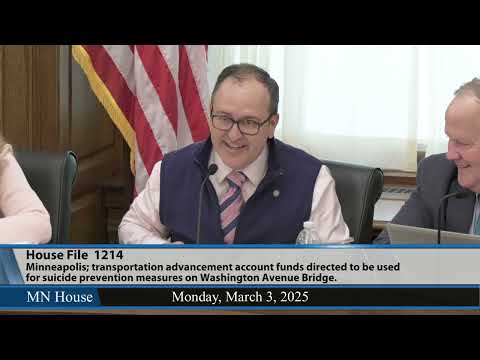
The House Transportation Committee voted to refer House File 12-14, which would fund permanent suicide-prevention barriers on the Washington Avenue Bridge, to the General Register after adopting an amendment clarifying the funding source.
The House Transportation Committee voted to refer House File 12-14, as amended, to the General Register after adopting an amendment that changes the funding source to Hennepin County’s county transportation sales and use tax.
The bill, carried in committee by Representative Hansen, would fund permanent suicide-prevention barriers on the Washington Avenue Bridge in Minneapolis. Committee members adopted an A1 amendment to change the source of funds from the transportation advancement account to the county transportation sales and use tax described in Minnesota Statutes 297A.993. The motion to refer the bill passed on a roll call: 15 ayes, 0 nays.
Supporters told the committee the bridge has been a recurring site for suicide attempts and that temporary fencing installed by the University of Minnesota has already reduced incidents. "On 11/09/2023, Kayla chose death by suicide on the Washington Avenue Bridge, leaving behind a 2 year old son and 3 year old daughter," testified MJ Weiss Blair, identifying herself as the mother of Kayla Gable. She said advocates formed "Kayla's Hope" and worked with suicide-prevention groups and the university to get a temporary chain-link fence in place.
Eric Mishke, CEO of SAVE (Suicide Awareness Voices of Education), told the committee, "The data is clear. Barriers work." Mishke cited examples where barriers have been followed by dramatic drops in suicides—naming the Natchez Trace, the Sunshine Skyway Bridge in Florida, and the Golden Gate Bridge—and argued that barriers interrupt suicidal impulsivity by giving people time to reconsider and allowing others to intervene.
University of Minnesota students who testified said they have seen peers die after falling from the bridge and urged lawmakers to back permanent measures. Riley Hetland, an undergraduate student government director, said two people died in one week last fall and that temporary measures should be made permanent. William Luther, representing undergraduate students, said the bridge’s existing four-foot railings are not sufficient and that barriers would also improve safety for the thousands of pedestrians who use the crossing daily.
Jeff Lundy, identified as a Hennepin County commissioner, told the committee the county owns the structure and has worked with the university and families to install a temporary fence. Lundy said the county supports a permanent solution and prefers capital investment (preservation) funding, but acknowledged the university and county were coordinating on funding and design.
Representative Olson requested a roll-call vote, which was recorded: Chair Kosnick — Aye; Vice Chair Myers — Aye; Representative Anderson — Aye; Representative Berg — Aye; Representative Fogelman — Yes; Representative Green — Aye; Representative Jones — Aye; Representative Joy — Aye; Representative Kraft — Aye; Representative Murphy — Aye; Representative Olson — Aye; Representative Sensamura — Aye; Representative Scraba — Aye; Representative Tabke — Aye. The committee reported the bill with 15 ayes and 0 nays.
What’s next: The bill will appear on the General Register for further consideration by the full House. Committee discussion stressed the urgency of a permanent solution and ongoing work to agree on a funding package and technical design details.