Get Full Government Meeting Transcripts, Videos, & Alerts Forever!
Get email alerts on the Housing topic
No spam. Unsubscribe anytime.
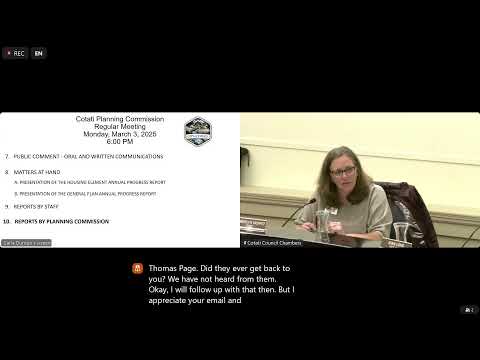
Cotati planning commission reviews 2024 Housing Element annual progress report
Summary
City staff presented the 2024 Housing Element Annual Progress Report, outlined state law changes affecting reporting and impact fees, and described the local pipeline of 234 RHNA units and additional projects in various stages; staff recommended the commission review and file the report for future discussion.
Planning staff presented the City of Cotati’s 2024 Housing Element Annual Progress Report (APR) and asked the Planning Commission to review the document and file it for future discussion.
“The housing element is one of the seven required elements of the general plan,” Planning Technician Eli Adeola told the commission, noting that the city must submit APRs each year to the Department of Housing and Community Development (HCD) and the Governor’s Office of Planning and Research by April 1.
The report summarizes local progress toward the city’s Regional Housing Needs Allocation (RHNA) and implementation of housing-element programs. Adeola said Cotati’s sixth-cycle RHNA is apportioned by income: 60 very low-income units, 34 low-income units, 39 moderate-income units and 101 market-rate units — a total of 234 units. He also told commissioners that only 16 units shown in one reporting table currently count toward RHNA because a unit counts only after a building permit is issued.
Adeola and Director of Community Development Hausch highlighted recent state laws that affect local procedures. Staff summarized the changes as described in the packet: SB 937 (limits collection of impact fees prior to a certificate of occupancy), AB 2729 (18-month entitlement extensions for developments with entitlements issued before Jan. 1, 2024, and expiring before Dec. 31, 2025 — staff said this would apply to the Cotati Station apartments entitlements) and AB 2667 (beginning with the 2025 APR, cities must report approvals and disapprovals within opportunity areas as defined by the California Tax Credit Allocation Committee and HCD opportunity map). Adeola also noted AB 3093, which the staff described as defining extremely low and acutely low income levels for future RHNA reporting.
Staff walked commissioners through the local pipeline and how different stages are counted. Adeola said the city has a substantial number of units in the permitting pipeline: projects entitled, in permitting, or proposed. He described three examples discussed in the packet: 65 Lasker Lane (a proposal described as 12 duplexes with accessory dwelling units for a total of 36 units), a 120 East Cotati site where the city used housing funds to buy the site and seek a mix of very low and low-income units, and earlier-entitled projects that are not yet being built because a private developer has prioritized other regional work.
Commissioners asked for clarification on how federal, state and local funding sources and developer interest affect which income categories get built. Hausch said the city has tried several approaches: using city housing funds to require mixes of affordability on sites where the city has leverage; adopting a local density-bonus ordinance that gives staff flexibility to “target some of our efforts, to get just beyond the very low income,” and outreach to developers. Hausch also cautioned that market dynamics — interest rates, construction costs and labor availability — influence whether projects move to construction.
Commissioners pressed staff on reporting details and legal consequences of RHNA shortfalls. Hausch and Adeola said they would research the application of the builder’s-remedy and recent legislation that might allow jurisdictions to count certain unit types across categories; staff agreed to report back by email or at a future meeting.
Staff recommended the commission identify any concerns or direction for staff and file the Housing Element APR for future discussion. According to the transcript, staff characterized the item as a receiving/file item rather than one requiring a formal motion or vote.
Ending: Staff invited further questions and public comment; no formal action on the Housing Element APR was recorded in the meeting transcript. The presentation and related packet materials will be included in the city’s APR submission to HCD and the Governor’s Office of Planning and Research by the April 1 deadline.