Get Full Government Meeting Transcripts, Videos, & Alerts Forever!
Get email alerts on the Public Safety Equipment topic
No spam. Unsubscribe anytime.
Huron defers decision to begin 1033 turn-in process for MRAP, robot and other federal-surplus equipment
Summary
Police Chief Derek Lehi sought permission to start federal 1033 turn-in procedures for an EOD robot, eight reflex sites, and an MRAP armored vehicle; the commission voted to defer the item to the next meeting while staff obtains more information on costs and logistics.
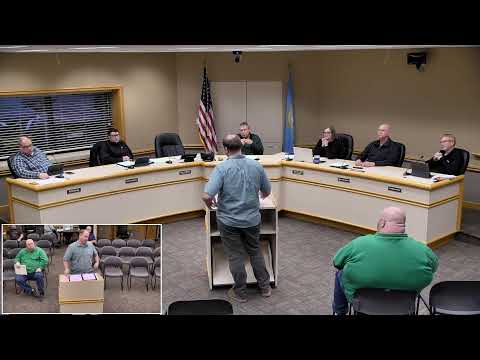
HURON, S.D. — The City Commission on March 3 deferred a decision on whether to start the federal 1033 turn-in process for three items the police department still holds, including an MRAP armored vehicle, after a lengthy staff presentation and discussion.
Police Chief Derek Lehi told the commission the city’s remaining federal-surplus items include eight reflex sites (simple items to be shipped back), an explosive-ordnance-disposal (EOD) robot and an MRAP (Mine-Resistant Ambush Protected) armored vehicle. Lehi said the reflex sites can be returned easily, but the robot and MRAP require administrative processing through the federal 1033 program and that once the turn-in process is started the city could be responsible for shipping costs.
"The big one, and I know this is something we've talked about for a couple years here, is an MRAP armored vehicle," Lehi said, describing it as a heavily armored, nonoperational vehicle that "we have never used." He told the commission the vehicle weighs roughly "40 plus thousand pounds," is decommissioned and currently does not run. Lehi said previous informal estimates for returning the vehicle to the military base from which it originated ranged around $12,000 for transport, while an estimate to repair it to operational condition had been about $20,000.
Lehi recommended the commission authorize staff to begin the federal administrative process that would make the items available for transfer to other agencies; the federal program would then match the items to other agencies or, if none request them, the city would be responsible for shipping to the federal-designated return location. Several commissioners raised concerns about where the vehicle is stored and the city’s insurance requirements; Lehi said the MRAP is currently stored indoors in a building owned by the Greater Huron Development Corporation and that the signed federal agreement requires indoor storage.
After extended discussion about storage requirements, transport logistics, uncertain shipping costs and possible insurance implications, the commission voted to defer the item to the next meeting so staff could gather additional cost estimates and logistical details, including truck quotes. A motion to defer passed on a roll-call vote.
Why it matters
The 1033 program allows local law enforcement agencies to receive surplus federal equipment; items remain the property of the federal government and, when turned in, the federal agency typically reassigns them. Large items such as MRAPs present storage, insurance and transport challenges and can expose local governments to potentially significant one-time costs if no receiving agency is identified.
What staff told the commission
- The MRAP was acquired about seven to eight years ago for a special response team but was delivered decommissioned and has never been operational. - The MRAP cannot be declared surplus locally and must be processed through the federal 1033 administrative return pathway. - Prior informal cost estimates include roughly $12,000 for transport back to the originating region and about $20,000 to make the vehicle operational; those figures were described as rough estimates and not formal quotes. - Chief Lehi said that if the commission authorizes the turn-in process, there is "really no backing out of that," and the city would then be responsible for any required shipping costs.
Commission direction and next steps
The commission directed staff to obtain firm shipping and logistics quotes and to report back at the next public meeting. Staff identified Tim Oakman as the city official who administers the 10-33/1033 inventory process for the department and said staff would consult trucking firms and review storage and insurance options. The commission indicated general preference for resolving the inventory but asked for clearer cost estimates before committing to the turn-in process.
No final transfer or disposition decision was made on March 3; the commission’s deferral requires staff follow-up and a return report.