Get Full Government Meeting Transcripts, Videos, & Alerts Forever!
Get email alerts on the Student Assessments topic
No spam. Unsubscribe anytime.
Fox Chapel director reports high PSSA, Keystone and AP outcomes; board discusses testing timing and curriculum
Summary
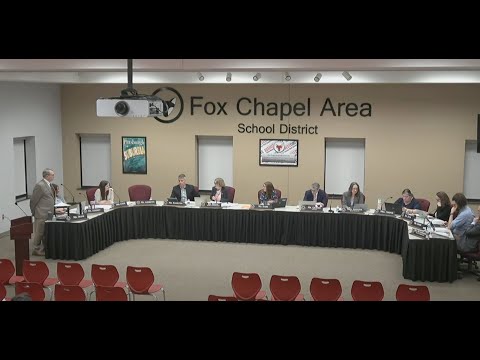
At a Fox Chapel Area School District board meeting, Director of Student Achievement Dr. Steven Edwards presented district assessment results showing substantially higher proficiency and advanced rates than statewide averages and recommended using growth projections to consider earlier Keystone testing and curriculum adjustments.
Dr. Steven Edwards, director of student achievement and instructional verification for Fox Chapel Area School District, presented a year-end review of student assessment data and academic trends to the school board.
Edwards told the board that elementary English language arts and mathematics PSSA results have been strong, with the district generally in the mid-80s percent proficient or advanced in grades 3–5—well above statewide levels. "You can see we far outpace the state as far as proficient and advanced," Edwards said, citing long-term gains and increased numbers of students scoring in the advanced category.
The presentation highlighted specific points of data the district is tracking: a roughly 85% proficiency rate at elementary grades compared with about 55% statewide on PSSA English language arts; a 56.1% advanced rate for fourth-grade ELA in the most recent year; a 56.8% advanced rate for fifth-grade math noted as "phenomenal" by Edwards; and a science assessment result where overall proficiency was near 95% with 77.1% of students scoring advanced on the science PSSA where reported. At the middle school (DMS), math proficiency and advanced rates rose substantially over several years; Edwards attributed part of that growth to adopting the Reveal Math curriculum and schedule changes that created remediation opportunities.
Edwards described the district's use of projection and growth tools (PBOS/PVAAS) to identify students who are ready earlier than the district typically administers certain statewide exams. The board discussed whether moving some Keystone Literature testing from the usual sophomore trigger course into ninth grade for students who show readiness would capture students earlier and open pathway opportunities. Edwards explained the district must declare a "trigger course" to the Pennsylvania Information Management System and that changing the timing is permitted but affects course coding and reporting.
Board members and administrators discussed the implications of so-called "ceiling effects" on growth measures at high-performing districts and how growth metrics interpret high-achieving students. Edwards said the district compares multiple measures — state assessments, PBOS projections, internal common assessments and STAR data — before changing practice. He told the board he would provide building-level breakdowns and additional comparative benchmarks on request and would look up a detailed count of individual students who sat for AP assessments last year.
The presentation also covered advanced course offerings and college-credit pathways: the district offers a broad AP program, reporting 27 AP course offerings last year with roughly 1,090 student enrollments and 821 AP assessments administered; about 74% of those assessments earned scores of 4 or 5. Edwards and board members discussed the district's approach to AP as both a college-credit pathway and a college-readiness experience, fee waivers, and how to track whether students intend to take an AP exam when they enroll in the course.
Other items Edwards cited: recent rankings (Pittsburgh Business Times, US News, Niche) and an education recovery scorecard showing the district among those with notable recovery in learning since 2019. Charter enrollment and cohort tracking were also shown (about 47 students enrolled in charter schools this year, up from pandemic peaks). Edwards closed by noting that state science assessments are being field-tested under new standards this year and will shift grade alignments.
Board members asked for additional variance metrics (standard errors/standard deviations) and for comparable-district benchmarks; Edwards said the underlying data are public and that he would supply requested breakdowns to the board.
The discussion ended with the board and staff agreeing to continue data review, to consider whether targeted shifts in when a Keystone assessment is given would help students, and to use multiple measures before making curriculum or scheduling changes.