Get Full Government Meeting Transcripts, Videos, & Alerts Forever!
Get email alerts on the Land Use Zoning Housing topic
No spam. Unsubscribe anytime.
Land Use Committee continues Central SoMa, Transit Center zoning changes to allow more housing while retaining key site benefits
Summary
The San Francisco Land Use and Transportation Committee continued two ordinances that would remove mandatory commercial development ratios in Central SoMa and the Transit Center District, with sponsors and staff saying the change aims to unlock housing while preserving previously negotiated on-site community benefits on key sites.
The Land Use and Transportation Committee of the San Francisco Board of Supervisors on March 3 continued two related ordinances that would remove mandatory commercial development requirements in the Central SoMa Special Use District and the Transit Center District subarea, while directing staff to return with amendments that retain previously negotiated community benefits.
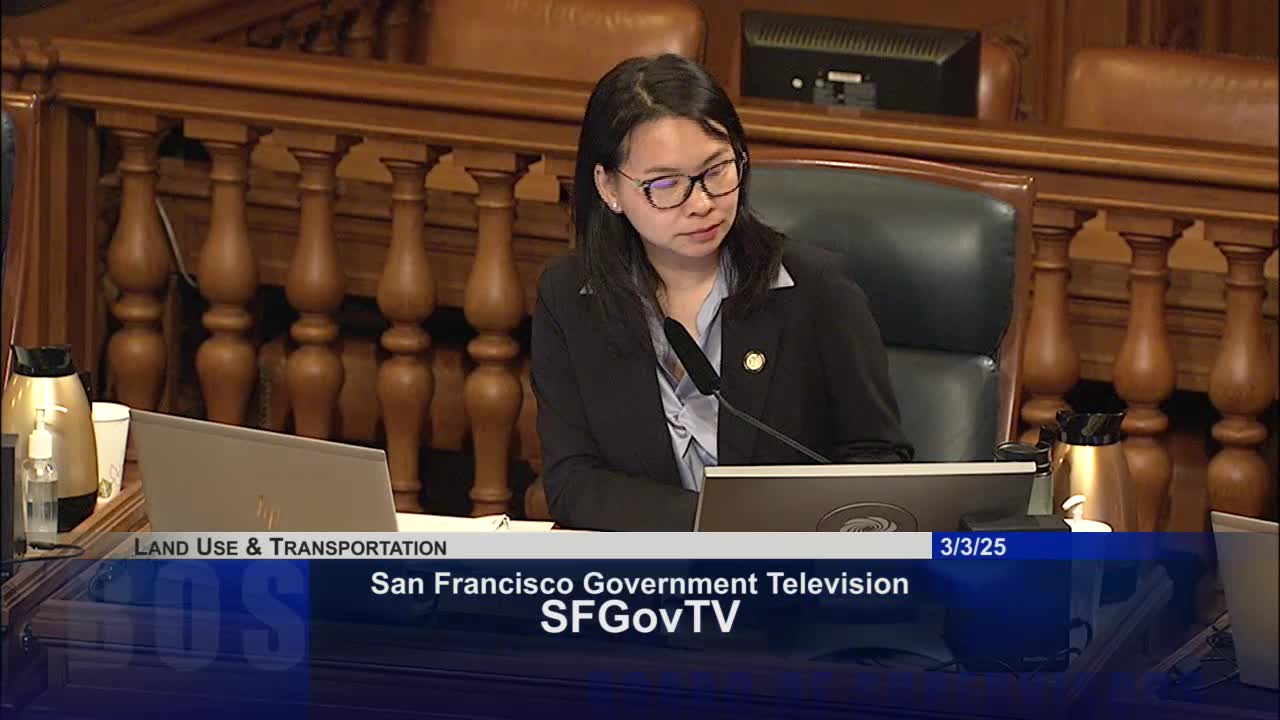
Committee Vice Chair Supervisor Cheyenne Chen presided over the hearing, and Supervisor Matt Dorsey, a sponsor of the legislation, said the package is aimed at "reimagining this sub-neighborhood of downtown and to unlock more housing." Planning staff and the controller's Office of Economic Analysis presented background and economic modeling, and the committee voted to continue the items to the March 10, 2025 meeting.
The two items called together would: remove an existing requirement that a large-site project in Central SoMa dedicate a specified share of gross floor area to nonresidential uses; delete the Transit Center C-30-SD commercial special use district; and amend corresponding area-plan policies so those policies encourage rather than require commercial development. Planning Department staff and the sponsor said the change responds to long-term declines in office demand and high office vacancy rates since the COVID-19 pandemic.
Planning Department deputy director Joshua Switsky summarized the history of the Central SoMa plan, adopted in 2018, noting the rezoning created capacity roughly for under 9,000 housing units and about 32,000 jobs and that the plan emphasized job growth on several unusually large "key sites." Audrey Marloney of the Planning Department explained that the Planning Commission recommended modifications at its November 7 hearing, including retaining site-specific community benefits for key sites and applying reasonable physical parameters for exceptions. Marloney said staff and the city attorney have been drafting amendments and requested the committee continue both items to March 10 so those amendments can be filed.
Asim Khan of the controller's Office of Economic Analysis presented modeling that estimated removing the commercial requirements would raise the odds of residential development on the large sites. The office reported pre-pandemic downtown office vacancy of about 5.2% rising to roughly 34.3% in the fourth quarter of 2024, and said office value estimates fell from about $800 per square foot to under $500 per square foot. Using a logistic regression model and a 20-year forecast, the office estimated the policy change could increase development on key sites from an expected 44 units under the baseline to 369 units under the proposal (a difference of 325 units), and modeled a modest average annual GDP impact of about $38 million and roughly 200 jobs over the forecast horizon. The controller's office presented these as model-based estimates, not guarantees.
Public comment included a mix of neighborhood and labor groups, affordable-housing developers and private-site owners. Speakers representing Soma Pilipinas, Young Community Developers, Housing Action Coalition, the San Francisco Building and Construction Trades Council and several developers said they support the policy pivot to allow more housing so long as the previously negotiated commitments on the five large key sites—such as land dedication for 100% affordable housing, public open space, and other community benefits—remain protected. Developer and property-owner speakers said current office market conditions make speculative new office construction difficult and that flexibility to pursue residential projects is desirable.
Supervisor Dorsey said the committee expects amendments that would, among other things, limit the new exemption to projects 600 feet in height or lower and retain agreed site-specific benefits (complete streets, open space, recreational facilities and affordable housing on key sites). After public comment the committee voted to continue both ordinances to the March 10, 2025 Land Use and Transportation Committee meeting. The roll call showed Supervisors Dorsey, Mahmood and Chen voting aye; the motion to continue passed.
The committee did not adopt the ordinances on March 3; staff and the sponsor reiterated that finalized amendments would be filed before the continued hearing. The Planning Department and the city attorney, the presentation said, are working with the sponsor's office to prepare those amendments that reflect the Planning Commission's recommendations and the community concerns expressed during the hearing.
The committee also took a separate roll-call vote early in the hearing to excuse Supervisor Melgar from the meeting; that motion passed with three ayes.
With the hearing continued, the committee directed staff to return with the amended ordinance language and related general-plan changes on March 10 so the committee can act or forward recommendations to the full Board of Supervisors. The offices presenting told the committee they would be available to answer questions at the continued hearing.