Get Full Government Meeting Transcripts, Videos, & Alerts Forever!
Get email alerts on the Natural Capital Accounting topic
No spam. Unsubscribe anytime.
Yale economist briefs Miami committee on "natural capital" accounting; committee identifies pilot opportunities
Summary
Dr. Eli Fenichel presented natural-capital accounting to the City of Miami Climate Resilience Committee, suggesting municipalities can put natural assets on balance sheets to inform fiscal planning. Committee members identified Biscayne Bay and urban trees as potential pilot accounts and asked staff to explore next steps.
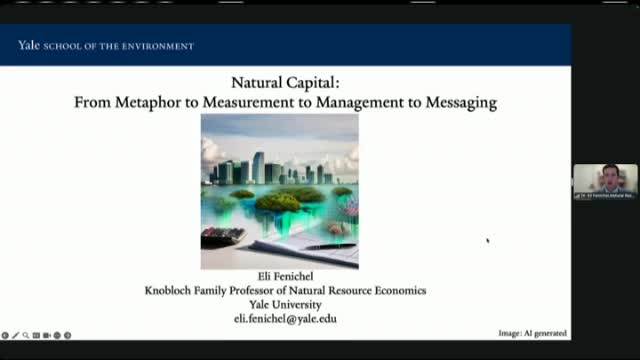
The City of Miami Climate Resilience Committee received a remote presentation from Eli Fenichel, Nablag Family Professor of Natural Resource Economics at Yale University, on piloting natural-capital accounting for municipal assets such as mangroves, beaches, urban trees and groundwater.
Fenichel told the committee that natural assets provide services that feed municipal tax bases and budgets, and that better accounting can reveal fiscal risks and opportunities. He described how changes in natural capital can affect tax revenue and municipal bond spreads, and recommended starting with a small number of high-quality, repeatable accounts rather than trying to value every asset at once.
Why it matters: accounting for natural assets can reveal previously uncounted contributions to municipal revenue and can make the fiscal case for conservation and restoration. Fenichel said that when natural assets contribute to production and revenue flows, changes in those assets translate into fiscal impacts.
Fenichel outlined a practical approach: select one or a few material assets, tie each account to measurable service flows (for example flood reduction, recreation or tourism), assemble repeatable measurement workflows using existing datasets (lidar, housing transactions, ecological surveys), and produce balance-sheet-style accounts that can inform budgeting, permitting and borrowing. He cited international and national efforts to standardize natural-asset accounting and described earlier projects he has worked on, including groundwater accounting in Kansas and species-loss case studies that linked ecological change to local fiscal outcomes.
Committee members referenced recent local work already underway: the Biscayne Bay economic assessment and the city's developing tree inventory/GIS. Members asked whether the city's tree inventory, mangrove valuation, or beach/dune accounts could be early pilots. Fenichel advised focusing on assets with good data and clear municipal services (for Miami, he said mangroves, beaches and urban canopy are sensible starting points) and building a high-quality, repeatable workflow that other municipalities and bond investors can understand.
No formal motion was adopted. Committee members asked staff to consider the recommendation, to consult with county and state colleagues where relevant, and to report back with a short list of recommended pilot accounts and a proposed public timeline for developing them.
Evidence in the record: Fenichel said, "natural assets are often viewed as a cost center in the municipality's fiscal position" and described how translated service flows can be captured in accounts that "sit on a balance sheet in a section under nonfinancial, nonproduced assets right now." The presentation and slides will be available to staff for follow-up and potential pilot scoping.