Get Full Government Meeting Transcripts, Videos, & Alerts Forever!
Get email alerts on the Solid Waste Recycling topic
No spam. Unsubscribe anytime.
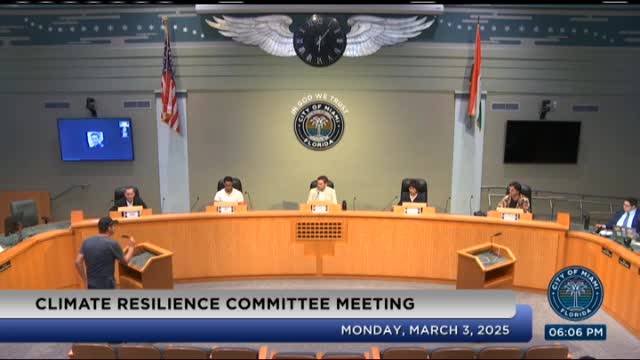
Miami resilience committee urges stronger recycling, punts formal resolution to next month
Summary
At a March meeting, the City of Miami Climate Resilience Committee heard public comment and a technical presentation on the county'wide waste crisis, endorsed pursuing several low-cost actions and asked staff to return with a refined resolution focused on special-event waste reduction and franchisee contract language.
The City of Miami Climate Resilience Committee on an evening meeting reviewed public comments and a presentation on recycling and solid-waste best practices, and voted to ask staff to forward the presentation to the Solid Waste Department and return next month with a refined proposal focused on special-event waste reduction and supplier (pouring) contract opportunities.
The committee heard multiple public commenters and a 45-minute technical briefing from volunteer organizer Dave Dobler about Miami-Dade's recycling performance and near-term landfill capacity limits. Committee members said they wanted the Solid Waste Department invited to the next meeting and asked staff to draft a targeted resolution on special events and pouring contracts rather than a broad package this month.
Why it matters: county and municipal recycling and disposal policy affects landfill use, disposal costs and future building permits. Dobler said Miami-Dade generates high amounts of solid waste and that improving diversion is urgent because local landfill capacity is limited and the county's incinerator is out of service.
Dobler, co-founder of VolunteerCleanup.org, told the committee Miami-Dade ' which he said he was treating as the regional frame for the presentation ' generated about 8.4 pounds of trash per capita per day and recycled roughly 20% of material. He said the county's recycling stream carried a roughly 40% contamination rate and that ' after the county's waste-to-energy facility burned down ' the county currently sends more material to landfills and by rail to distant disposal sites. Dobler said: "we create way too much waste, and shipping it off to Central Florida is not sustainable."
Public commenters asked for changes ranging from a departmental name change to specific program design. Steven Leitner, a Bay Harbor Islands resident, urged consideration of pay-as-you-throw systems, saying simply: "pay as you throw." Marcelo Balladares, speaking for the Sierra Club, and Maddie Kaufman, program director of Debris Free Oceans, urged neighborhood-targeted outreach and enforcement; Kaufman noted a 2021 circularity assessment and that "the MRF staff noted that the cleanest recyclables and lowest contamination rates always come from communities in Miami Dade that do have fines for bin contamination." Resident Noel Cleveland said "there's nothing resilient about throwing garbage away," urging innovation rather than program elimination.
Dobler and committee members discussed several operational levers the city and county can use: standardized, pictorial labeling on roll-out carts and commercial dumpsters; bin-level audits and camera screening for high contamination; transparency in chain-of-custody/tipping receipts so haulers demonstrate delivery to a sorting facility; and targeted requirements for special-event permits. Dobler described North Bay Village contract clauses that require multilingual labels, audit services, maintenance standards for trucks and audit-based follow-ups when contamination is high.
Committee action and next steps: committee member Silvio Pupo moved a motion "to support just this in general ... with a special emphasis on special events being a quick win and the pouring contract being a potential economic opportunity." The committee did not adopt a final resolution at the meeting; instead members asked staff to forward Dobler's presentation and the meeting recording to Solid Waste staff, invite Solid Waste to the next CRC meeting for discussion, and bring back a refined proposal (including a draft resolution for special events) for deliberation the following month. The committee also unanimously approved the CRC minutes from the previous meeting earlier in the session.
Context and constraints: Dobler repeatedly referenced Florida law (Statute 403.706) and Miami-Dade ordinance language requiring local recycling programs and listing target materials; he said the state goal was 75% diversion by December 2020, a target the county has not reached. Committee members stressed the role of franchise contract language and procurement (pouring contracts) as levers to change material input streams for events and public venues.
The committee flagged several additional near-term items for staff follow-up: (1) require or incentivize special events to include waste-reduction, composting and sorting plans as part of permitting; (2) require franchisees to provide customer lists and contamination/audit data so the city can identify noncompliant multifamily and commercial sites; (3) pursue standardized bin labels and hauler maintenance requirements in contracts; and (4) explore pilot programs (pay-as-you-throw pilots, targeted enforcement, event permit conditions) that could be included in next year's budget deliberations.
The discussion brought multiple speakers and organizations into the record and concluded with a plan to return the topic to the CRC agenda after staff and Solid Waste staff have had time to review the community proposals and draft language.