Get Full Government Meeting Transcripts, Videos, & Alerts Forever!
Get email alerts on the Ethics Procedures Training topic
No spam. Unsubscribe anytime.
Deputy city attorney trains National City planning commissioners on conflicts, campaign contributions and ex parte contacts
Summary
Deputy City Attorney Ashlyn Lutz gave a refresher to the planning commission on the Political Reform Act, Government Code section 87100, the Levine Act's $500 contribution limit, ex parte communications and meeting procedures.
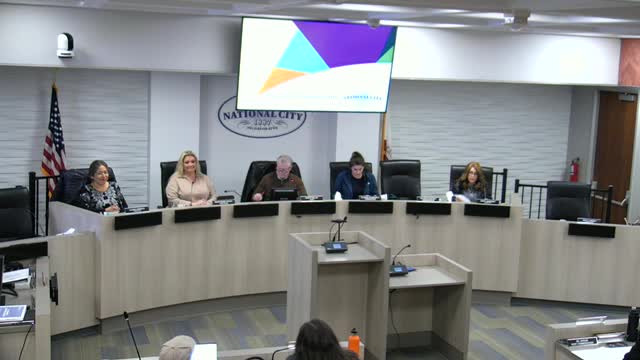
At the March 3 National City Planning Commission meeting, Deputy City Attorney Ashlyn Lutz presented a refresher on conflict-of-interest rules, campaign contribution restrictions and disclosure requirements for commissioners.
Lutz outlined the Political Reform Act and Government Code section 87100, explaining that an official must not take part in a governmental decision when the decision reasonably is foreseeable to have a material financial effect on the official's interests. She explained materiality standards for business entities and real property, including the presumption of conflict for real property within 500 feet.
On campaign contributions, Lutz reviewed the Levine Act rule that an official may not solicit or accept a contribution greater than $500 from a party or participant with a financial interest while a land-use matter is pending and for 12 months after a final decision. "Sometimes you may not know that someone who donated to the campaign has a project in the pipeline," Lutz said, and explained the options of disclosing and recusing or returning a contribution within 30 days.
Lutz also discussed ex parte communications — site visits, conversations with parties or outside research — and said commissioners should disclose summaries of such contacts so applicants and the public know what information and sources the commissioner relied upon. She described that disclosures allow applicants and the public to respond to outside information and noted that site visits should be reported as such.
On meeting procedure, Lutz reviewed Rosenberg's Rules of Order and three kinds of motions (basic motion, motion to amend, substitute motion) and explained the order of taking motions. She reviewed voting practice and the commission's local treatment of abstentions: "If you've seen from a vote, your vote will in the record will go will be support will be, sorry, how do I phrase this? Will be counted in the majority vote of the quorum," she said, adding that abstentions are appropriate in limited circumstances such as when a commissioner was not present for prior hearings on an item and did not review the record.
Commissioners asked clarifying questions about the $500 Levine Act threshold (Lutz confirmed the threshold increased to $500 effective Jan. 1 of the year and applies to contributions going forward) and about how utility easements and site visits should be treated for disclosure. Lutz said she would be available for individualized conflict-of-interest consultations.
Lutz said upcoming trainings will include a CEQA overview and updates. "I'm always here if you guys wanna reach out to me for questions," she said.