Get Full Government Meeting Transcripts, Videos, & Alerts Forever!
Get email alerts on the Use Variance Residential topic
No spam. Unsubscribe anytime.
Owner seeks use variance so 182 Grand Avenue can be lawful two‑family; board asks for financial proof
Summary
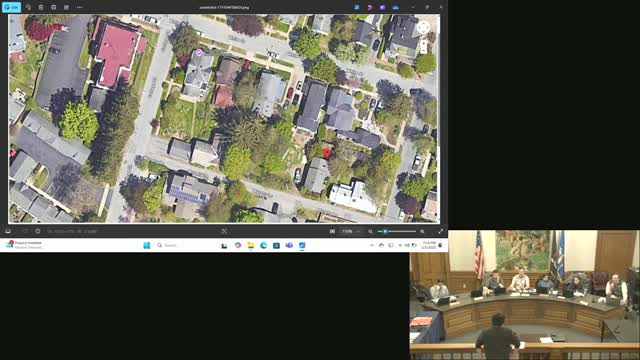
A new owner of 182 Grand Avenue asked the Saratoga Springs Zoning Board of Appeals on March 3 for a use variance to legalize two‑family occupancy, saying the building has historically functioned as multifamily and that current single‑family zoning makes the property financially unsustainable.
Xiaomei Wang, represented by Jofei Lin, requested a use variance on March 3 to reclassify 182 Grand Avenue as lawful two‑family. Lin told the Zoning Board that his mother purchased the property Jan. 28 for about $330,000 after being told by a real estate agent that it was a multi‑family property and that the building historically served as more than one unit.
The applicant said the building is dilapidated and needs roughly $200,000 in rehabilitation; without lawfully permitting two units the owner cannot generate enough rental income to cover mortgages, taxes, maintenance and insurance. Lin and the owner asked the board to consider precedent on similar properties that are taxed or assessed as multi‑family despite single‑family zoning.
Board members reviewed the four legal criteria for a use variance — financial hardship for any permitted use, uniqueness of the hardship, compatibility with neighborhood character, and whether the hardship was self‑created — and told the applicant the first criterion requires detailed financial documentation. The board asked for:
• An appraisal or current market evidence showing what the property would sell for “as is” today;
• Contractor estimates for converting the property into a compliant single‑family use and for rehabilitating it as a two‑family unit;
• Documentation of expected rental income (market comparables), current taxes and insurance costs, mortgage payments and any title or closing materials that bear on what the buyer was told about zoning at closing.
Board members explained they must see numbers demonstrating the owner cannot realize a reasonable return from permitted uses before they can consider the variance. Several members noted the city assessment (noted in the record) and the short time between purchase and application; the board asked whether the buyer had title insurance and whether the purchase disclosures stated single‑family zoning.
Neighbors spoke to the property’s poor condition and described it as a long‑time “zombie” house that needs substantial work. One neighbor who lives next door said nearby single‑family sales show that single‑family rehabilitation can fetch higher prices in the neighborhood and cautioned that rental income is not guaranteed.
The Zoning Board left the public hearing open and asked the applicant to work with staff to provide the financial documentation and contractor quotes; the board suggested professional appraisals and comparable sales be submitted before the board will consider a vote. The applicant was also told that evidence that the hardship was not self‑created — for example, representations by sellers or real estate agents and county tax records — will be relevant to criterion four of the use‑variance test.