Get Full Government Meeting Transcripts, Videos, & Alerts Forever!
Get email alerts on the Residential Lighting Variance topic
No spam. Unsubscribe anytime.
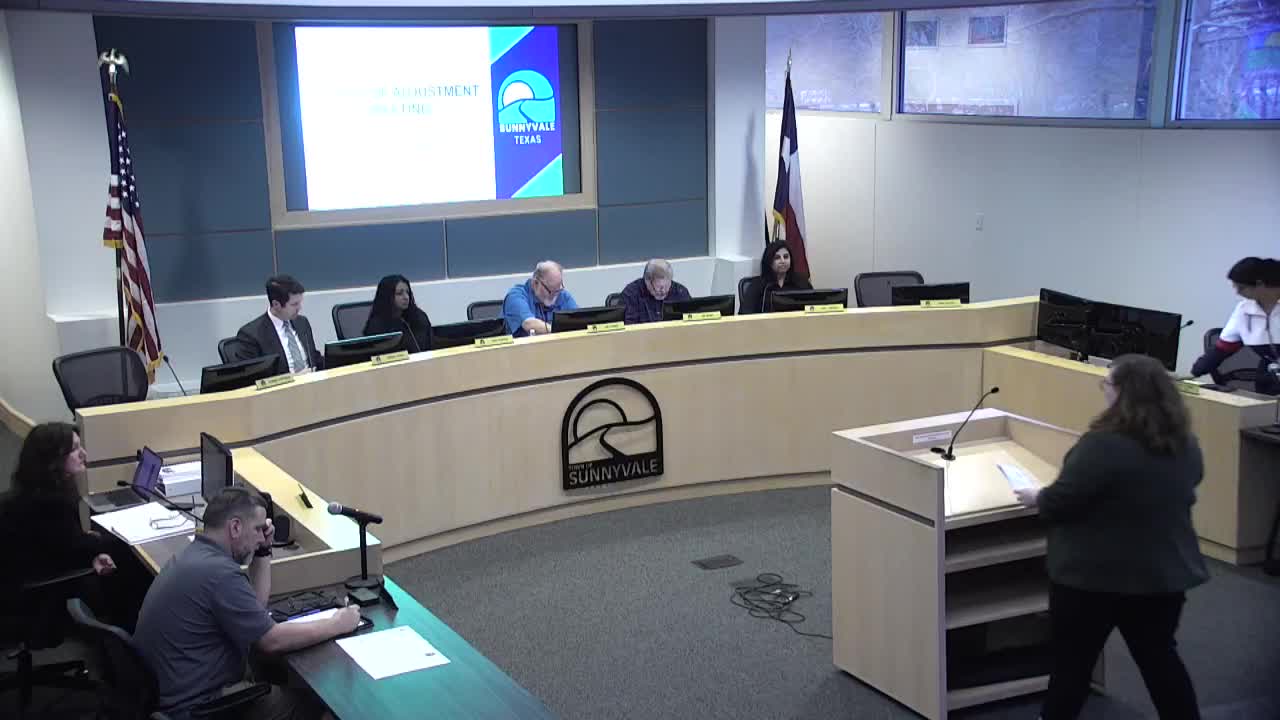
Sunnyvale Board of Adjustments denies variance for 16-foot sports-court lights at 642 East Berkeley Circle
Summary
The Sunnyvale Board of Adjustments denied a variance request to place six 16-foot light poles inside required setbacks at 642 East Berkeley Circle, citing lack of hardship, potential light trespass and UDO conflicts. Staff and neighbors urged alternatives and staff offered to work with the homeowner on options.
The Sunnyvale Board of Adjustments on Wednesday denied a variance request to allow six 16-foot-tall light poles to be installed inside required setback and buffer areas at 642 East Berkeley Circle.
The variance request, presented by planning staff, sought an exception to Section 3.0607 of the town—Unified Development Ordinance (lighting standards) to permit light poles within setbacks and buffered areas; staff recommended denial, saying the request represented a self-imposed hardship and raised concerns about light pollution in a residential area.
The board—hearing included neighbors—comments and testimony from the homeowner. Barbara Rogers, whose property abuts the east fence line of the lot in question, told the board she keeps beehives and cited studies and local conservation concerns, saying the proposed lighting "will impact the migration of birds" and "will impact the pollination of bees." She told the board the lights "will bleed right into our driveway, into our garage, and into our backyard." The homeowner, Musa Albano, said the yard and sports court were installed for his children and that he would not pursue lighting if immediate neighbors objected: "If the neighbors have a problem with it, I don't want to do it."
Planning staff showed site plans and aerials indicating the rear-yard setback of 120 feet for the SF-1 zoning district and explained why the proposed pole locations did not meet the ordinance—requirements. Staff said the applicant originally submitted for a special-use permit (SUP) for residential sports-court lighting but could not proceed to the SUP stage because the poles, treated as structures, are prohibited in the required setbacks. Staff told the board that, if a variance were granted, the SUP process would require a photometric plan, cut sheets, and fixtures that meet the UDO—requirements (for residential areas the UDO allows 0.5 foot-candle of light escape at property lines).
Board members raised concerns about night-time use, potential for lights to be left on overnight, and the visual impact on neighbors. Several commissioners urged that alternatives be explored; staff and the town's chief building official said they would meet with the homeowner and the contractor (Tanner) to explore fixtures or locations that would comply with the UDO and limit light spread.
After discussion, a commissioner moved to deny the variance "tonight, but with the right to come back." The motion was seconded and the board voted to deny the variance. The meeting record does not include a roll-call tally in the transcript; staff noted the denial and encouraged the applicant to work with staff on alternatives that could meet lighting standards and setback requirements.
The denial closes the variance path for the current pole locations but, per staff comments during the hearing, the applicant may seek alternative lighting solutions, relocate the court, pursue building-mounted lighting, or return with revised plans that comply with the UDO or accompany a properly granted variance in the future.