Get Full Government Meeting Transcripts, Videos, & Alerts Forever!
Get email alerts on the Streets And Infrastructure topic
No spam. Unsubscribe anytime.
Overland Park council approves $4.47 million in street-preservation contracts after public concern about chip seal
Summary
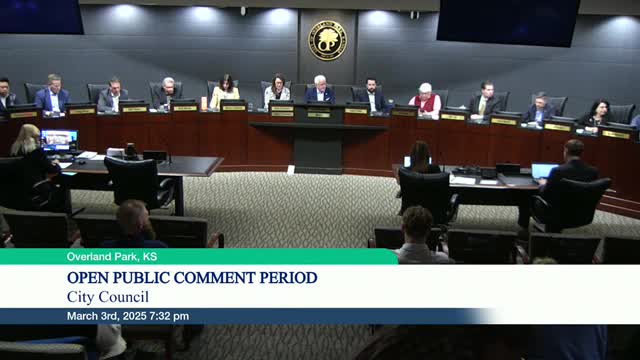
The Overland Park City Council on March 3 approved two contracts with Vance Brothers totaling $4,467,955.21 for the 2025 Street Improvement preservation program after public comment and a staff presentation on the city’s chip-seal strategy and lane-mile totals.
The Overland Park City Council on March 3 approved two bid awards to Vance Brothers LLC totaling $4,467,955.21 for the city’s 2025 street-preservation program, after a public comment urging reductions in chip seal and a staff presentation explaining the program mix and timing.
Councilmembers voted separately to approve preservation Part 1 for $1,937,044.61 and preservation Part 2 for $2,530,910.60. Councilmember John Mosher made the motions to approve both items; both passed on unanimous roll call.
The measures matter because the bids fund most of the city’s scheduled pavement-preservation work for 2025, a year when the city’s overall program is larger than in recent years. In public comment before the council voted, resident Jeff Kosen said the city’s residents had expected the extra infrastructure sales-tax revenue to hasten removal of chip seal from the maintenance program and warned that repeated chip-seal applications postpone needed rehabilitation.
City public-works staff member Lorraine (last name not specified in the transcript) told councilmembers the 2025 preservation program totals about 226 lane miles across preservation methods. The proposed program includes about 139 lane miles of chip seal (about 61.5 percent of the program), roughly 49 lane miles of overlay and 38 lane miles of UBAS (a different preservation treatment). Lorraine said those lane-mile figures are model-driven and reflect the network the city’s pavement-condition index identified as needing work this year.
Lorraine also noted the city uses chip seal to maintain unimproved thoroughfares until full improvement is feasible. “We have about plus or minus nine lane miles of unimproved thoroughfares that are included as part of our chip-seal program and about 30 lane miles in our residential and collector streets,” she said. She gave the council a typical seasonal timeframe for chip-seal work: work generally begins in May or early June and usually finishes by mid- to late September, sometimes earlier depending on weather.
Kosen, a resident who signed up for public comment, said the council’s 2024 reduction in chip-seal lane miles followed voter approval of a dedicated infrastructure sales tax but that the 2025 program appears to increase chip-seal lane miles again. “Spending tax dollars on failing chip seal is not a good investment,” Kosen said, urging the council to make 2025 the last year for chip seal in Overland Park.
Mayor Curt Skoog summarized staff remarks before the vote, saying the sales-tax revenue had allowed the city to reduce chip-seal reliance and increase mill-and-overlay and curb-and-gutter rehabilitation, but he reiterated that chip seal was never represented to voters as something that would be fully eliminated immediately.
Actions recorded in the meeting show the council approved two separate Vance Brothers bid tabulations for the 2025 Street Improvement Project preservation parts 1 and 2. Councilmember Mosher moved both contracts; a second was recorded for each motion (second unnamed in the transcript). Both motions passed unanimously on roll call.
The city’s preservation program figures cited by staff—226 lane miles total for 2025, including 139 lane miles of chip seal—are presented as program-level targets and were described by staff as model-based averages rather than exact, final contract counts. Staff said the 2024 program included about 138 lane miles of chip seal and a total preservation program of about 211 lane miles in 2024 consisting of chip seal, overlays and UBAS.
Council discussion included a request from Councilmember Matrician for the approximate seasonal timing of the chip-seal work; staff gave the May–September window. No amendments or changes to the contracts were made on the council floor.
The approved contracts will fund this year’s pavement-preservation work; staff said the city will continue to aim to reduce chip seal over multiple years as rehabilitation capacity increases.