Get Full Government Meeting Transcripts, Videos, & Alerts Forever!
Get email alerts on the Housing Development Report topic
No spam. Unsubscribe anytime.
Eau Claire planning staff: 2024 building report shows housing growth, shift toward smaller and multifamily units
Summary
City planning staff on March 3 presented the 2024 development report showing a rise in dwelling-unit permits, a shift toward smaller single-family homes and strong multifamily and two-family activity; staff said vacancies remain low and the data underscores continued demand for housing.
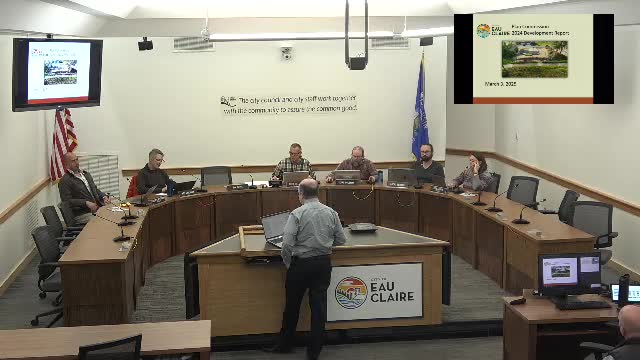
Planning staff presented the City of Eau Claire’s 2024 development report to the Plan Commission on March 3, reporting an increase in building activity and a shift in housing types toward smaller single-family homes, twin homes and multifamily units.
Staff said single-family permit counts rose to about 65 for the year and the average reported price submitted by applicants was roughly $405,000. The report showed a mix of price bands, with a notable number of smaller single-family and manufactured homes built in 2024 as well as three houses recorded above $700,000.
Planner Mr. Petrie told commissioners the 2024 data indicates a growing share of two-family (twin) and multifamily development over the past five years and a high per-unit valuation for recent multifamily permits (staff cited about $175,000 per unit in valuation in the report). The staff presentation used Department of Revenue permit and valuation data and included maps showing new construction across the West, North, Central and South areas of the city.
“We just need more housing, and this is the data just is showing it,” Mr. Petrie said, summarizing the report’s policy relevance.
Commissioners asked for clarification about how much of the 2024 activity was infill versus new development at the city edge. Mr. Petrie said infill definitions vary and that only one single-family home was recorded in the central core neighborhoods in the period presented. He also explained a year-over-year drop in dwelling-unit totals from 2023 to 2024 was largely due to exceptionally large multifamily permitting in 2023 (staff cited several very large apartment permits that inflated 2023 totals). That explains the apparent decline in permitted units even though 2024 remained active.
The report showed that roughly half of the valuation in 2024 was for public projects (city, county, CVTC, UWEC) and that the city’s taxable valuation approached the half-billion mark for large projects; staff noted that public projects register differently in valuation and tax status. Mr. Petrie said the full report and datasets are available online and that planning staff can present the findings to the City Council on request.
Commissioners encouraged staff to share the report with council members and noted the data could inform code-update discussions about housing types, core neighborhood redevelopment and incentives for smaller, more affordable units.