Get Full Government Meeting Transcripts, Videos, & Alerts Forever!
Get email alerts on the Port Overlay District topic
No spam. Unsubscribe anytime.
Fort Pierce commissioners table zoning overlay for Port of Fort Pierce after broad public comment
Summary
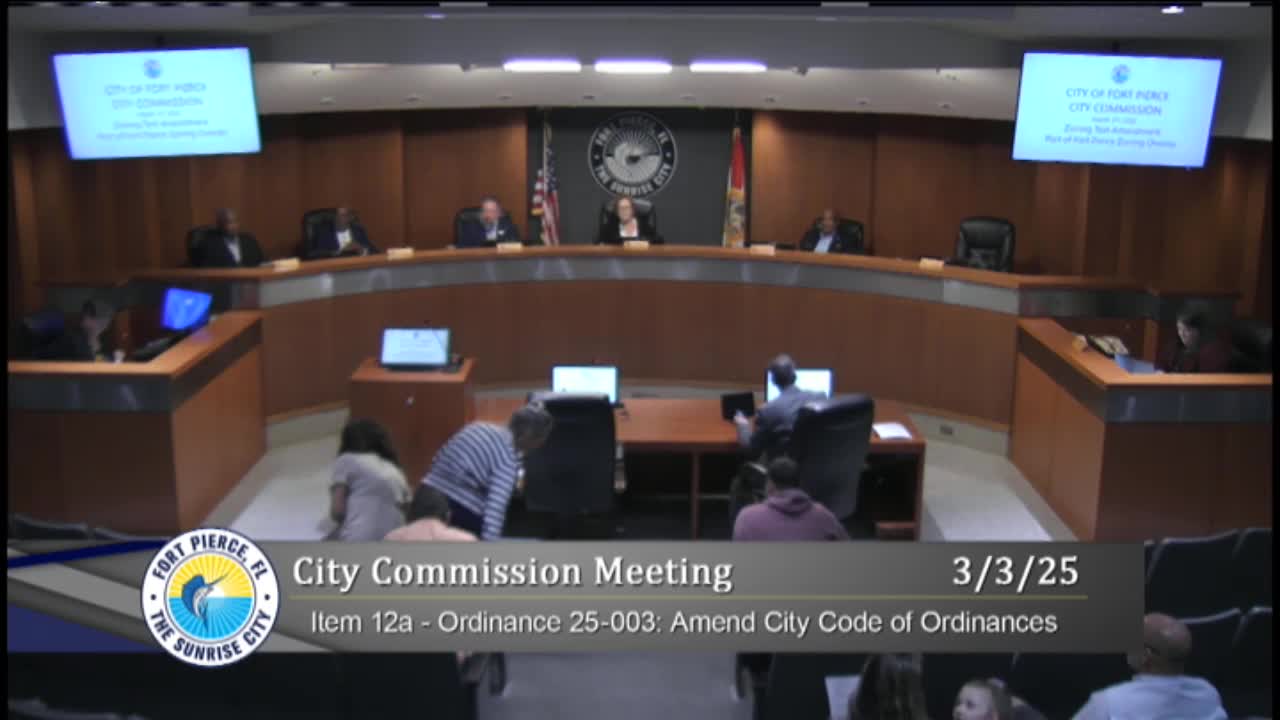
After lengthy presentations and public testimony, the Fort Pierce City Commission voted to table Ordinance 25-003, a proposed Port Overlay District for the Port of Fort Pierce, to allow staff to revise permitted/conditional use lists and to consult property owners and St. Lucie County before a new first reading.
The Fort Pierce City Commission on March 3 tabled Ordinance 25-003, a first-reading text amendment that would create a Port Overlay District (POD) intended to guide redevelopment in the Port of Fort Pierce.
Kevin Freeman, city planning director, told the commission the overlay stems from the Port of Fort Pierce Master Plan (adopted December 2020) and is intended to align zoning with the port master plan’s goals — including a megayacht facility, marine services, stormwater improvements and a working waterfront — while protecting existing property rights. Freeman said the draft overlay covers more than 40 parcels and “probably 12 or 13” distinct property owners and that staff tried to balance fast-tracking certain ‘‘permitted’’ uses through a minor site-plan path and sending other uses to the conditional-use review that comes before the commission.
The commission and members of the public pressed staff for more clarity on what would be allowed administratively versus what would require a conditional review. Freeman said the city’s ordinary minor-site-plan threshold (10,000 square feet) would not map cleanly to the port and acknowledged county processes allow larger fast-track thresholds (the county’s minor-site-plan allowance was characterized in the presentation as 100,000 square feet and a higher threshold for targeted industries). Freeman told commissioners the overlay was drafted to preserve property rights and avoid Bert Harris claims but said staff had received additional property-owner suggestions over the weekend that could change the permitted/conditional split.
Commissioners cited recurring concerns: a need to define and limit cargo-type operations and heavy industrial uses; how lodging/crew housing should be handled alongside a megayacht facility; environmental protection for the Indian River Lagoon; and coordination with St. Lucie County, which has its own port-related plans. Commissioner Taylor and others said they favored moving some broadly worded uses (for example, unspecified cargo/import/export or broad “lodging” entries) into conditional review so each application could be vetted; Freeman said more precise definitions could also allow some lodging tied to megayacht operations to be treated as part of a holistic site plan.
Public commenters were split. Christina Bell, principal of Destin Beach Inc., representing a major Southport landowner, urged approval and said the draft “strikes a balance” with the master plan and would create jobs. Joshua Reboard, identified as the county’s port director, told the commission the county supports the master plan’s priorities and asked that items that could affect federal channel and turning-basin uses be moved to conditional review so the county and other stakeholders can “flesh out” impacts. Environmental and waterfront advocates, including Dolores Hogan Johnson of the St. Lucie Waterfront Council and other speakers, urged caution and said expanded cargo operations would threaten sensitive estuarine habitat.
After extended discussion commissioners voted 4–0 to table the ordinance to allow staff to gather additional input from property owners and county officials, refine permitted-versus-conditional lists and re-advertise the amendment. City attorney staff said substantial changes would require restarting public notice and the ordinance would likely return as a first reading after a new advertisement period (staff noted re-advertising would require at least a 30-day notice window).