Get Full Government Meeting Transcripts, Videos, & Alerts Forever!
Get email alerts on the Land Use topic
No spam. Unsubscribe anytime.
Lynnwood staff outline unified development code plan, seek council direction on middle‑housing rules
Summary
City planning staff briefed the council on a months‑long effort to consolidate development rules into a single unified development code and to implement state middle‑housing and ADU requirements, setting a timetable of reviews through June to meet a July 1 state deadline.
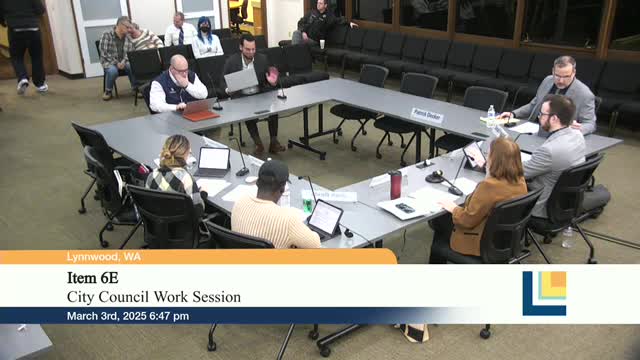
Lynnwood’s community planning manager told the City Council on March 3 that staff are assembling a unified development code (UDC) and related design‑standards updates so the city can implement new state middle‑housing and accessory‑dwelling‑unit (ADU) requirements before the state’s July 1 implementation deadline.
The update, reviewed by Community Planning Manager Carl Olmgren and planner Joe LeBlanc, described the UDC as a consolidation of regulations scattered across multiple Lynnwood Municipal Code titles into a single, clearer chapter (proposed Title 8). Olmgren said the rewrite aims to make permitting and review more predictable for applicants and to reflect recent state laws requiring cities to allow a range of “middle housing” types.
Olmgren said the outreach‑preferred middle‑housing types identified so far include duplexes, triplexes, fourplexes, townhomes, stacked flats and cottage housing, and that larger five‑ and six‑unit prototypes and courtyard apartments were less favored in public outreach. He emphasized that single‑family housing will remain an allowed use in the RN zone and that the work is intended to “add” housing types rather than eliminate single‑family options.
The UDC will also consolidate definitions and procedures (including permitting and administrative chapters), update the citywide design standards (last substantially revised in 2001) and clarify use regulations such as where mixed commercial concepts (for example, a small café with animals) fit into zoning categories. Staff warned that the state’s ADU and middle‑housing laws overlap in places and that council direction is needed on how many total units to allow per lot when both laws apply.
Olmgren described a multi‑month schedule: two weeks from the meeting staff will return with more detailed design standards and administration chapters (and the units‑per‑lot discussion), April will focus on development standards and use regulations, May will be for fine tuning, and June is targeted for public hearing and adoption. He stressed the consequence of missing the city’s adoption window: “If we do not adopt an ordinance by the June work schedule, on July 1 the Washington State Department of Commerce model ordinance becomes the regulatory framework for Lynnwood,” creating an outcome staff say the city prefers to avoid.
Council members asked about practical benefits of consolidation. Olmgren said predictability—both of process and outcome—is a primary goal, which can shorten permit timelines, reduce staff time spent resolving conflicting code language and improve institutional knowledge. Councilmembers also requested maps showing station‑area and transit proximity that will determine some middle‑housing and parking exceptions; staff said those maps are in development and will accompany the next briefing.
Staff flagged two state bills they are tracking closely: proposed parking reforms that would limit local parking mandates, and a lot‑splitting bill that has been revised and which staff currently consider “doable” in Lynnwood given recent improvements in permitting and record systems. Olmgren said Commerce will review the city’s ordinance under current state requirements.
The council set no final policy in the March 3 work session; staff will return in two weeks with the administration and design chapters and with options on how to align ADU and middle‑housing unit counts per lot for council direction.